
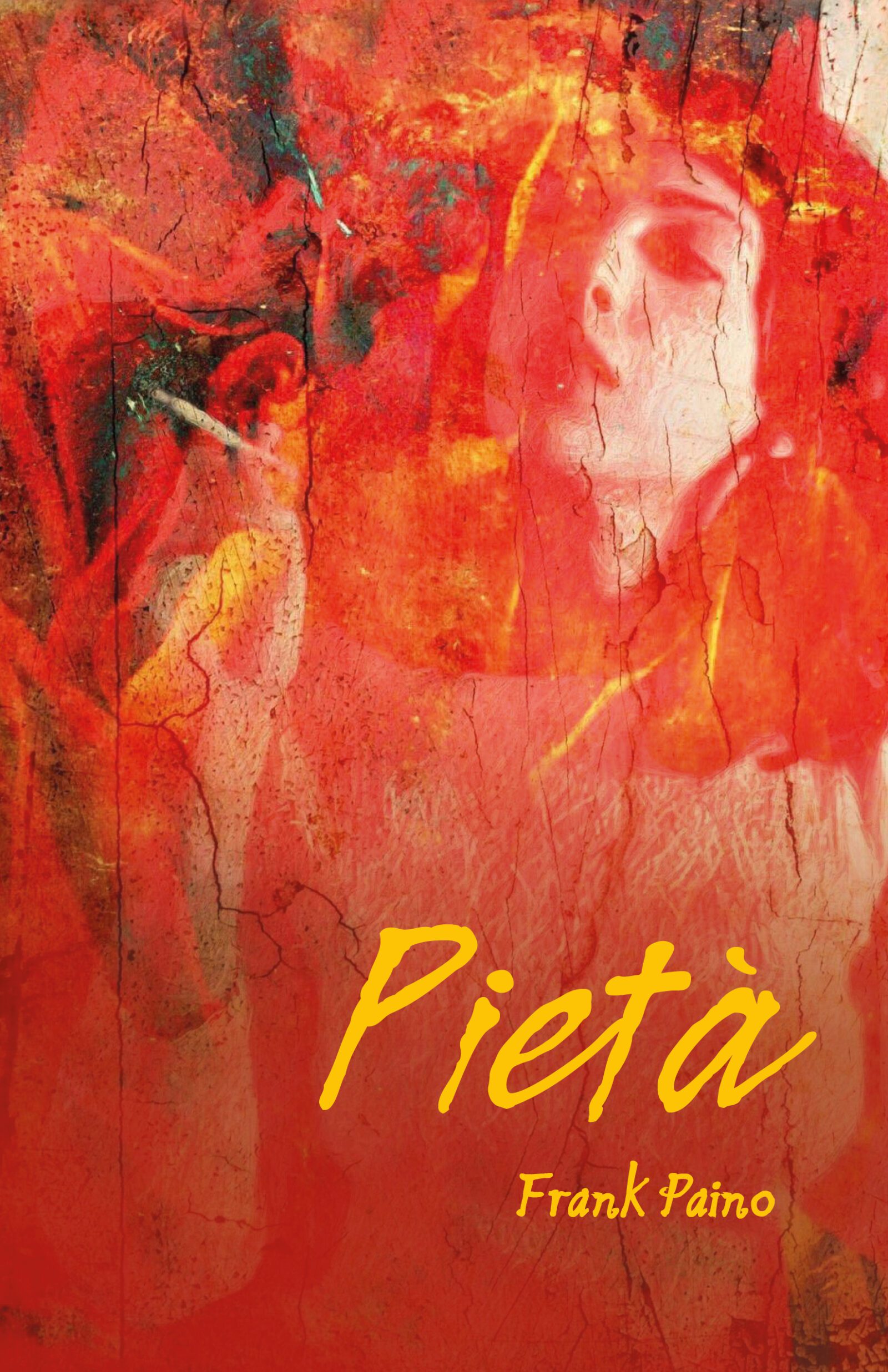
Pietà, Frank Paino, 2023 Jacar Press, Durham, North Carolina, ISBN: 978-0-936481-53-1, $14, Pietà – Jacar Press
Death, tragedy, and injustice are adept at eluding meaning, purpose, or explanations coinciding with a positive outlook on our world, and to live them yourself or helplessly watch as they unfold on a screen is a universal human experience. We all cope with tragedies and changes in our own ways, and resolution can be found with the knowledge of others who have made their journeys.
Throughout my reading of Pietà, I felt Frank Paino’s strained process of discovering meaning within what haunts him (us?). His approach to the chosen subjects—some of which are cultural artifacts seared into the American consciousness—never left me comfortable in my skin or particularly hopeful for the future, but they contributed to my understanding of the nature of suffering and its vital role in the human experience. “Thích Quàng Ðúc,” for example, confronts the act of self-immolation, one of the most taboo protests. Bringing the worst kind of death possible upon oneself is a great tragedy of suffering but also meaning:
First, a baptism
……………….of gasoline
that translated saffron
……………….to deeper gold,
then, a mirage’s
……………….shivering vapor,
the Austin Westminster’s
……………….cool blue hood
forever frozen agape
……………….as if in silent witness
to the impassive man
……………….who struck
a match as casually
……………….as an offered light,
as if to steal Death’s thunder,
……………….as if to say,
No matter how close
……………….you hold me,
I will hold you
……………….closer still.
The visual beauty of the fire contrasting the life it takes, the Austin Westminster car in the background personified as a spectator, Thích Quàng Ðúc defiantly embracing his end. An image of a burning monk many of us have had the misfortune of seeing is evoked with new depth. Pietà uses this format to build on several other tragic historical images and moments to great effect.
Other poems focus on more personal and intimate experiences. “Here in this churchyard where you’ve kept watch…,” contains the familiar sight of a statue of Christ weathered by touch, wind, and acid rain. The emotion-filled resolution reached in the poem is for the reader to discover, but I would like to note the following lines: “as with the dead who molder here beneath / wizened leaves and nodding hoods of snowdrops.” The imagery characterizes its elements with strong verbs while contributing to the solemn and enervated atmosphere (snowdrops can appear sleepy or dehydrated as their bulbs are downturned in bloom, giving them their “nodding”appearance).
Several of Pietà’s poems illustrate a cohesive view of the nature of living and the eventuality of death. “Luna Moth” and “Benediction: Whale Fall” are two works that focus on animals through a circle-of-life lens, with the latter focusing on the virtue of death within an ecosystem. Here is an excerpt:
Bless death’s incessant
………..alchemy
……………………which transmutes
………..your stillness
……………………to clamorous
………..feast for octopi,
……………………gape-jawed
………..viperfish, a shiver of
……………………bone-eating
Osedax.
“Lazarus’s Wife,” based on a biblical story, further builds Pietà’s views on the certainty of death and a distance from faith echoed throughout the collection. The poem seems to show Lazarus’s revival after four days of death as in violation of the natural order of life and certain expiration. Here we see Lazarus, through his wife’s eyes, who is no longer themselves—changed by a miracle into something almost inhuman.
Now, flies nimbus the plates
I leave for him outside
the shadowed room
in which he shelters.
Still, he quaffs the wine,
delights in how it streams
in bloodred rivulets
through the welter of his beard.
Though Pietà is daunting in its existentialism (we humans tend to avoid the subjects of suffering and death when we can), I found that the clear imagery and straightforward pacing made it consistently approachable and engaging. With careful reading, what emerged was a solid thematic cohesion across the poetry that elevates this focused work of nineteen sobering poems.
However, a few standouts challenged me. Take, for example, “Where There’s Smoke”: While vivid in imagery as the rest of the collection, its obfuscation of certain details and use of disjointed sequences yields an abstract collage that begs a deeper reading. In this poem, immolation of the body—a returning theme— serves as an atom that other elements seem to orbit and serve to define the meaning of “where there’s smoke” in the context of the poem. At risk of souring the piece’s appeal with my interpretation, I will note some connections between the idea of smoke—which seems to be linked to self-immolation, self-destruction, or disappearance—and the three animals. A rabbit setting itself in stone (preserved in that moment, but no longer living); A deer’s white tail (signaling danger, an escape in progress); A cicada’s long, dark life before their one and final song (a life marked by its end in brilliant flame).
© Frank Paino and Michael Fialkowski
Frank Paino holds a BA in English from Baldwin Wallace University and an MFA in Creative Writing from the Vermont College low-residency writing program. While studying at Vermont, he had the privilege of working with poets Richard Jackson, Mark Doty, Lynda Hull and David Wojahn. Following graduation, he eschewed a teaching career in favor of a non-academic position at a university where he continues to work to this day. Frank’s volumes of poetry are: Pietà (2024 – Jacar Press); Obscura (2020 – Orison Books); Out of Eden (1997 – Cleveland State University Press); and The Rapture of Matter (1991 – Cleveland State University Press). He has received a number of awards for his work, including a 2016 Individual Excellence Award from The Ohio Arts Council, a Pushcart Prize and The Cleveland Arts Prize in Literature.
Michael Fialkowski is the Social Media Editor of Loch Raven Review. He graduated University of Maryland, Baltimore County with a communications degree and a creative writing minor. He lives in Washington, DC, and is a content editor and certification associate at the National Association of Housing and Redevelopment Officials.
 The Loch Raven Review