
Gordon Introduction
This is a poem story about Gordon.
We can’t be sure his name was Gordon.
Some people think his name was Peter.
I’ll call him Gordon.
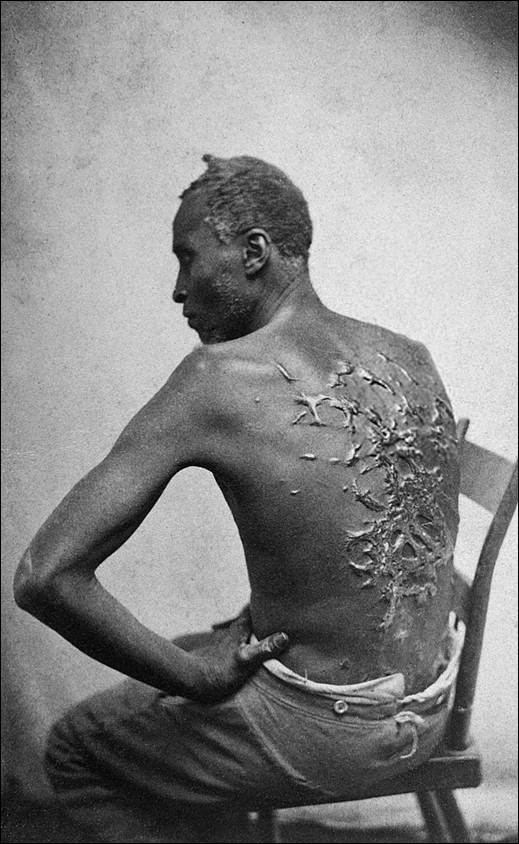
You know this picture.
Some people say this is one of the most
famous pictures in Americana.
Some people say it is the second most famous
picture of the Civil War, behind Abraham Lincoln.
The reason they say this is found in his story.
You see, those scars, so ugly and prominent,
were from a beating he received in 1862.
The beating was so severe, he lost his memory of why he was beaten,
and many other things as well.
He was beaten nearly to death.
His own words were that he lay on the dirt floor of his cabin, for months,
unable to move.
But, when he did recover, he made up his mind to run away and join the Union Army.
And with much cleverness, that is exactly what he did in 1863.
But, in those days, just like now, you had to take a physical before you could be inducted.
When he removed his shirt, and the officer in charge saw his back, he said,
“Oh, no, we have to have a picture of this.”
So, they marched him off to the local photographer, and this picture was made.
Actually, several were made.
When someone else saw this picture, they showed it to someone else.
That person then showed it to someone else.
You see where I’m going with this.
Finally, within a short period of time, this photograph ended up in Harper’s Weekly,
a major publication of the day, in the North.
As we think of such things today, photography was a brand-new technology.
In today’s language, this photograph went “viral.”
Maybe it was the first photograph to go viral.
The reaction was amazement.
You see, at that time most people in the North were, at best, ambivalent about this slavery thing.
In official language, slavery was called “the peculiar institution.”
Most people in the North really didn’t know much about “America’s peculiar institution”
other than what they read in Harriett Beecher Stowe’s novel Uncle Tom’s Cabin.
But that was dismissed as only a work of fiction,
which it was (although it was based on stories told to her).
But this was a photograph.
This was long before the days of Photoshop.
In other words, this was “real.”
And people in the North were horrified.
At last, the institution of Slavery had a real face,
and real pain.
And real suffering.
This photograph became the Face of Slavery.
It was reproduced in multiple ways throughout the North.
Little cards, much like post cards, were made by the tens of thousands.
Some say the hundreds of thousands.
It was reproduced in other publications.
It was displayed in store front windows and used in recruitment centers, to join the Union Army.
It is credited as a prime reason the hearts and minds of the people in the North began to shift and
they began to think it was the right thing to do to end “America’s peculiar institution.”
This one photograph.
It is a big deal in history.
When I found out the back-story of this photograph,
I said I want to do a poem about Gordon.
So much is owed to him and it is the least I can do.
So, here is the poem.
Its title is:
.
For the Desires of Gordon, with Respect (the time is 1863)
Perhaps my punishment was because I knew
“a” from “b” or because I desired to know
“x” from “z.”
Perhaps it was because I desired to know
anything about numbers when placed before me.
And then cipher them.
Multiplication?
Division?
Never heard of them.
Where do they live?
What is the meaning of three-fifths of a man?
But, perhaps my punishment was because
I desired to be able to read the Bible.
For my own self.
And then lead a prayer for deliverance
with stories of glories
not of this earth,
but beyond.
Whatever the message chiseled into your heart,
it was done with the same bluntness as
the dull caring you provided
for me and my kind.
Your hatred of us was writ small in your heart
and large in our minds.
And it was all made up by you
to ensure all our dignity in this life
was washed away before it ever had chance
to take solid root,
by using both lash and boot.
Thinking this through, perhaps my punishment
was because I desired to have shelter
fit to protect against the chill of cold and damp
which comes to invade my bones.
Or to have water, while it was cool.
Then again, perhaps my punishment was because
I desired to have refuge against winds
as unkindly as the ones that brought
my father’s fathers
to this land as they sprang forth
from the bowels of unthinkable ships.
But perhaps it was because I failed to disguise
my sadness
each time I realized my hands could not
sense my child through
the casing of my callused skin.
At best, I could hope my child
would remember my smile
and pass it down,
regardless of cattle-like chattel last name.
Just maybe it was because I desired
to look a man in the eye.
A white man.
Any man.
Of any height.
After all, swells of indignation would come
to drown me should I dare
to lift my head
and see more than just
the ground around me.
But perhaps it was for no good reason at all,
and you just wanted to kill on me
the night you came to steal all manner
of humanity from my eyes
with a great war to be etched across my back.
Whipped until my senses leaked out.
Whipped beyond all believing.
Whipped beyond even being able
to have a remembrance of my presence
in this world.
But a body did remain.
And, in time,
I came to recognize that it was mine.
As the lash rolled up and down my skin
in attempts to find new communion
with my flesh in fresh
spaces, I understood that my mind
had been bent and shaped and banged
to accept what you gave me.
In the proportions you desired.
You gave credit for the sinew in my body
while denying the possibility
of any reasoning in my mind.
I was forever to never be too tired or too slow.
Yet, still to dance the quadrille
with only airy,
bouncy steps after having hoed my clean row
for the day.
Until that night, my hopes did reside
in embers and soot deep within me
and on moral timbers
that were rotten to the core
and teetered upon themselves.
That night, I looked into the face of death
and found it ugly,
scarred
and pock marked.
You see, I had lost all feeling for the appropriate
distance between my desires and my well-being.
At last, the burning of the fuel
in your engine of hatred,
brought heat to my purpose.
I came to understand that these bindings were so tight,
they could not be slipped,
once loosed.
So, I did run and forage once the hell
inside my head flowed out,
with determination in each step knowing not
what would lie before me
for either my legs or my providence.
Running with uncertain steps,
in ill-fitting shoes,
on uneven land,
I did duck and dive from the sun by day
and the patrollers by night.
Made them think I was but a worthless tree stump.
I did find my way and crisscross the roads
more deftly than your fingers can
now navigate the scars on my back.
Running from dark place
to dark place knowing there will be light.
My only questions were,
whether it shines as friend or foe
and will it last long enough for me to get to it.
I know that blue is better than grey.
That is what they say.
And I believe them.
I just needed to find the way.
And I did.
I raised myself up through
my once open wounds to freedom.
I now know our country was born
with a great big racial stripe
down the middle of its back.
Great big.
Right down the middle.
It is difficult to imagine what level of erasure
or caustic compound will remove it.
No.
It is more like a smooth scar
on the back of the head
where the hair will never again grow.
I will pray that there can be a day
of salvation from this destiny.
I don’t know what the future will hold.
But it contains hope.
And though I cannot hold that in my hand,
it is more than I have ever possessed
and I now know it is only drops of blood
that will cause you to live out your creed
and place more than just a stitch
over a sin that is bursting at its seams.
I cannot write my name more than the content
of my distinctive “x”,
but I can mark with confidence
and equal the force applied to
elevate the largest “x” on my back.
Each ruche and rent in my skin was worth the tear.
I might relinquish my life,
but I will die a man’s death;
not that of a beast.
I will reach into the very jaws of hell
and pull its jagged teeth out.
With no slack in my jaw,
I reclaim my humanity because
even on the very floors of hell,
love and honor come first.
For while I and those around me suffered,
it was life.
And there was love.
And, as long as there was love,
it was worth the pain.
You see, the sound of a mind breaking
is much worse than the sound of a bone snapping.
————
And now I am ready, and I pose for this photograph.
It is what is asked of me.
There is something about me that is special.
Unique.
Something to be remembered through time.
Could it just be that I am a whole man?
I have healed from the inside out
but believe the country must heal from the outside in.
One precious mind at a time.
The thinness found in my frame
is a revealer of all my hungered desires.
Placed on a public display.
Well, la-dee-dah!
© Otis Sprow
Otis Sprow is from Baltimore and his work has been published in The Ekphrastic Review, Poets of Manor Mill, Artists from Maryland and his own self-published book through Amazon (600+ pages; https://www.otisbook.com). His Meta/Facebook page (Otis Sprow – Contemporary Poet) has nearly 15,000 followers and presents over 30 videos of him reciting his work at live Open Mic venues.
He has been a featured poet on several occasions for the Short Story Book Fest and various unique events in the Baltimore area. Additionally, he served as the featured poet for the U.S. Department of Housing and Urban Development’s Secretary’s Award program in 2022 and the Washington National Cathedral (February 2025).
Educated in the Baltimore City public school system, he attended Cornell University receiving BS and MS degrees in Mechanical Engineering. Subsequently, he received an MBA (Finance) from George Washington University.
Residing in Pikesville, he writes his free verse poems with the intent that the reader/listener “get to know me a little better and have the space between us melt.”
 The Loch Raven Review