
Nine Persian-Language Poets: Mehdi Akhavan-Sales, Mahsati Ganjavi, Siavash Kasrāi, Esmail Khoi, Sheida Mohamadi, Fereydun Moshiri, Rumi, Sa’adi (Mushrifuddin Muslih ibn Abdullah Shirazi), and Ahmad Shamlou
Translated by: Mahnaz Badihian, Mojdeh Bahar, Farideh Hassanzadeh, Hassan Javadi, Sheema Kalbasi, Richard Newman, and Sholeh Wolpé
.
INTRODUCTION
This issue of Poetry Translations features nine Persian poets and seven translators.
The first Persian poet, Rudaki, lived in the tenth century. Since then, there have been 8000 men and 400 women poets. For Persians, poetry is at once an exalted art form and a part of their everyday life. Routine conversations are peppered with a line or two of poetry. Textbooks used in schools contain many poems and the students are asked to commit the verses to memory and recite them at exam time. Family and friends engage in poetry games such as Moshaereh, where players test their recall of verses starting with a particular letter of the alphabet.
Persian poetry can be divided into classical and modern poetry. The classical forms such as ghazal (a poem of between five and twelve couplets where the first hemistich of the first verse rhymes with the second hemistich of all verses), qasideh (ode), robaee (quatrain) are highly structured. The meters are prescribed. This encompasses much of Persian poetry, from tenth century to the early part of the twentieth century. In 1920’s She’r- e- Now (New, Modern, or Nimaic Poetry) challenged the classical forms and created space for free verse poetry.
Three of the nine poets in this issue are classical poets, namely Mahsati Ganjavi, Sa’adi and Rumi. Mahsati Ganjavi, one of the earlier women poets who lived in 11th-12th century, composed mostly quatrains, three of which are included in this issue. Sa’adi, nicknamed “the master wordsmith” is a 13th century poet who wrote both poetry and lyrical/musical prose. Sa’adi is a celebrated poet whose poetry in inscribed at the entrance of the United Nations, as translated by M. Aryanpoor:
Human beings are members of a whole,
In creation of one essence and soul
If one member is afflicted with pain,
Other members uneasy will remain.
If you’ve no sympathy for human pain.
The name of human you cannot retain!
Three of his poems are included: two ghazals, O Caravan Leader and The Tree Blossomed and a masnavi, Tale 3—poems where each line has its own rhyme and is used in storytelling. Lastly, one ghazal of Rumi, the 13th century poet, scholar, and Sufi, who is well known by western audiences is also included.
The rest of the poets, namely Mehdi Akhavan-Sales, Siavash Kasrai, Esmail Khoi, Sheida Mohamadi, Fereydun Moshiri, and Ahmad Shamlou are considered modern poets. This compilation offers one poem by each of the poets, except Shamlou and Mohamadi who have two and three poems respectively. Nima Yushij, a prominent poet, introduced what came to be known She’r e-Now, New Poetry or free verse, later also known as She’r-e Nimaii or Nimaic poetry in honor of its founder.
Akhavan-Sales was one of the pioneers of Free Verse. Ahmad Shamlou, poet, translator, playwright and journalist, like Akhavan-Sales, initially adopted Nimaic poetry, but later started a new movement called She’r-e Sepid (literally translated to White Poetry). Shamlou’s poetry embraced political themes. Siavash Kasrai’s poetry was also classified as New Poetry and included political undertones. Kasrai drew upon Persian mythology and more specifically Shahnameh (The Book of Kings), in his work. He was also a literary critic and novelist and one of the founders of Iranian Writers’ Association. Kasrai left Iran for Moscow and then moved to Vienna.
Esmail Khoi, poet and writer, was also a member of the Iranian Writers’ Association. His educational background in philosophy is present in his poetry. He lived in the UK after the Islamic Revolution of 1979 in Iran. Fereydoun Moshiri, also of this same generation of poets, is known for the simplicity and accessibility of his poems. His poems are popular and often recited in Persian gatherings of all kinds. One of his poems was a part of President Obama’s Nowruz (Persian New Year) messages. Sheida Mohamadi is a poet, novelist and journalist who lives in California and also writes modern poetry. Thematically, some of her poems focus on various aspects of womanhood while others have additional socio-political tropes.
The seven translators represented in this issue, Mahnaz Badihian, Farideh Hassanzadeh, Hassan Javadi, Sheema Kalbasi, Richard Newman, Sholeh Wolpé and myself, have collectively translated/co-translated both classical and modern Persian poetry. In addition to their literary translation endeavors, they are artists, filmmakers, writers, librettists, journalists, teachers, researchers and attorneys.
I hope that this sampling of Persian poetry will entice you to read more poems by Persian poets, both classical and modern.
Happy Reading!
Mojdeh Bahar, Guest Co-Editor
.
Mehdi Akhavan-Sales
Translated by Farideh Hassanzadeh
A Love Poem
O sole confidant, sole companion
for the most beautiful moments of
my so glorious, so virtuous
solitude and loneliness!
O my satisfying sweet river!
O how many times I have walked with you
in the noble alleys of integrity
in the dead-end alleys of unity
in the alleys of our pure joy and sorrow
in the tree-lined alley of the silent flower of your
coquetteries
in the rose garden path of my shyness
in the alleys of caresses
in the alleys of so many nights
walking with you until the silver seashore of sunrise
in the foggy alleys of so many whispers
with no hint of the pleasure of falling asleep
in the angelic alleys of sonnets
where your eyes were singing
and whenever they fell silent
my pure spell kept them murmuring
O splendid river of all pure beauties
O my satisfying, my beautiful river
gone far away
tell me over there, which star
is the brightest companion of your lonely nights?
O sole companion of my lonely nights!
O sole cheerleader, sole supporter
for my saddest moments
now without your luminous look
deprived of light
in the garden alley of deadly dark flower of sorrow
in the alleys of so many nights
now forever deeply dark as graves
tell me there
which star is a broken sun, in your endless nights?
.
ای تکیهگاه و پناهِ
زیباترین لحظههایِ
پُر عصمت و پُر شکوهِ
تنهایی و خلوت من
ای شطِ شیرین پُر شوکتِ من
ای با تو من گشته بسیار
در کوچههای بزرگِ نجابت
در کوچههای فرو بستهی استجابت
در کوچههای سرور و غمِ راستینی که مان بود
در کوچه باغ گلِ ساکت نازهایت
در کوچه باغِ گُل سرخِ شرمم
در کوچههای نوازش
در کوچههای چه شبهای بسیار
تا ساحلِ سیمگونِ سحرگاه رفتن
در کوچههای مهآلود بس گفت و گوها
بیهیچ از لذتِ خواب گفتن
در کوچههای نجیبِ غزلها که چشمِ تو میخواند
گهگاه اگر از سخن بازمیماند
افسونِ پاکِ منش پیش میراند
ای شطِ پُر شوکتِ هرچه زیباییِ پاک
ای شطِ زیبای پُر شوکتِ من
ای رفته تا دوردستان
آنجا بگو تا کدامین ستاره ست
روشنترین همنشین شبِ غربت تو؟
ای همنشینِ قدیم شب غربت من
ای تکیهگاه و پناهِ
غمگینترین لحظههای کنون بینگاهت تُهی مانده از نور
در کوچه باغِ گُل تیره و تلخِ اندوه
در کوچههای چه شبها که اکنون همه کور
آنجا بگو تا کدامین ستاره ست
که شب فروز تو خورشید پاره ست؟
.
Mahasti Ganjavi
Translated by Sheema Kalbasi
What tale shall I tell of what your longing
did?
With me, what did your heart, filled with
pretense and deceit, do?
With your long, dark locks, a night is
required,
So I may tell you what your absence has done.
قصه چکنم که اشتیاق تو چه کرد
با من دل پر زرق و نفاق تو چه کرد
چون زلف دراز تو شبی می باید
تا با تو بگویم که فراق تو چه کرد
The repository of joy dwells solely in your
radiant face,
Serenity graces the streets only where you
grace with your pace.
Your stature and shadow weave a majestic
silhouette,
Wherein lies nothing but your arched brow,
yet.
سرمایهٔ خرمی به جز روی تو نیست
و آرامگه خلق به جز کوی تو نیست
آن جفت که طاق است قد و سایهٔ توست
وان طاق که جفت است جز ابروی تو نیست
As flames surged, the dreadful robe was
consumed,
From that dread, half of Rome’s realm was
engulfed.
On my feet, I stood to lift the candle high,
Yet the fire from its crown devoured all the
wax nigh.
آتش بوزید و جامهٔ شوم بسوخت
وز شومی شوم نیمهٔ روم بسوخت
بر پای بُدم که شمع را بنشانم
آتش ز سر شمع همه موم بسوخت
.
Siavash Kasrai
Translated by Mojdeh Bahar
Belief
My heart does not believe in its own demise
No! No! I will not believe this certainty!
As long as life’s breaths are my companions
I won’t waste a moment with thoughts of death.
How in the world will a flower turn into debris?
How in the world will these budding dreams
Not yet bloomed
Not yet grounded in Spring
Wilt on my soul and turn into dust?
Within me so many promises
Within me so much longing
Within me, day and night, hands remain together
in prayer
What will happen to them?
How in the world will countless lovers
Displaced from their homeland
One day,
Without a sound,
Perish on the road?
Shall I believe that lucky young girls
Unattached, unfulfilled
On rooftops, by the lakes
Awaiting their lovers
Will have to dress in mourning clothes?
I don’t believe that love could be buried
without its rebellious flower sprouting from the grave.
I shall believe that one day
the heart will stop beating
Damn this lie, this terrifying lie!
My poem serves as a bridge to future coasts
May the travelers of joy walk over it!
My message flutters to kisses on lips, on hands
May the lovers take note of the heralds of peace!
It’s in the endless quest of lips and hands
That man’s imprint
Is set in stone
On the tablet of time
Surely, one day
Our flickering warmth
Will rise and become the sun
As long as you love me
As long as I love you
As long as we lovingly shed tears on each other’s cheeks
As long as there is a loving soul
How can death
Sweep away my memory?
Though wind has snatched many a flower from the palm of my hand
I, filled with sorrow,
Will not pluck the petals of anyone’s memory.
I will not believe the death
of a loved one
Finally, one day
My leaves will fall
One day, my eyes will be asleep shut
No eye can escape this sleep
But in the garden
The scent of my belief continues to fill the air.
.
باور
باور نمی کند دل من مرگ خویش را
نه،نه من اين يقين را باور نمى كنم
تا همدم من است نفس هاى زندگى
من با خيال مرگ دمى سر نمى كنم
آخر چگونه گل خس وخاشاك مى شود؟
آخر چگونه اين همه روياى نونهال
نگشوده گل هنوز
ننشسته در بهار
مى پژمرد به جان من وخاك ميشود
در من چه وعده هاست
در من چه هجرهاست
در من چه دست ها به دعا مانده روز وشب
اينها چه ميشود؟
آخر چگونه اينهمه عشاق بى شمار
آواره از ديار
يكروز بيصدا
در كوره راه ها همه خاموش ميشوند
باور كنم كه دختركان سفيد بخت
بى وصل ونامراد
بالاى بام ها و كنار دريچه ها
چشم انظار يار،سيه پوش مى شوند
باور كنم كه عشق نهان ميشود به گور
بى آنكه سركشد گل عصيانيش زخاك
باور كنم كه دل
روزى نمى تپد
نفرين برين دروغ، دروغ هراسناك
پل مى كشد به ساحل آينده شعر من
تا رهروان سرخوشى از آن گذرند
پيغام من به بوسه لب ها ودست ها
پرواز مى كند
باشد كه عاشقان به چنين پيك آشتى
يك ره نظر كنند
در كاوش پياپى لب ها و دست هاست
كاين نقش آدمى
بر لوحه زمان
جاويد ميشود
اين ذره ذره گرمى خاموش وار ما
يك روز بى گمان
سر مى زند زجايى وخورشيد مى شود
تا دوست داريم
تا دوست دارمت
تا اشك ما به گونه هم مى چكد زمهر
تا هست در زمانه يكى جان دوستدار
كى مرگ مى تواند
نام مرا بروبد از ياد روزگار؟
بسيار گل كه از كف من برده است ياد
اما من غمين
گل هاى ياد كس را پرپرنمى كنم
من مرگ هيچ عزيزى را
باور نمى كنم
مي ريزد عاقبت
يك روز برگ من
يك روز چشم من هم در خواب ميشود
زين خواب چشم هيچكس را گريزى نيست
اما درون باغ
همواره عطر باور من در هوا پر است
.
Esmail Khoi
Translated by Hassan Javadi
Tonight in Me, a Ghazal is Tuning
Tonight, within me, a ghazal is tuning,
Tonight, upon my heart, stars are falling.
Call the words to hurry to me with empty pitchers,
For tonight, I feel what is in the drums of the rain,
And what echoes in the flutes of the stream.
Love has been found,
Its silken breeze kissed my cheek,
Its fragrance filled the freshness of the morning.
Love has been found,
Do you see?
Love has been found once again.
Oh, heart!
Oh, lonely ash!
Drink the gust of the flame,
Drink deeply.
Rejoice, my autumn!
For that departed swallow has returned,
In the fields of ash,
The cup of tulips has ignited once more.
Rejoice, my night of life!
The wings of light have spread,
“The horizons are ablaze with sparks.”
Rejoice, delicate silence!
The poetry is overflowing!
Tonight, within me, a ghazal is tuning,
My heart has become a heart once again.
This bond is eternal,
A reflection of your beauty,
A manifestation,
A ladder to joy.
It is best now that I say no more.
.
در من امشب ترنم غزلی ست
.دلم امشب ستاره باران است
واژه ها را خبر کنید
تا که با کوزه های خالی خویش
بشتابند سوی من
کامشب
،در من است آنچه در دف باران
.وآنچه در نای چشمه ساران است
.عشق پیدا شده ست
پرنیان وزیدنش
در باد
.گونه ام را نواخت
.عطر او بود در طراوت صبح
،عشق پیدا شده است
می بيني
.عشق پيدا شده ست بار دگر
!آی دل
!آی خاکستر غریب
،وزش شعله را بنوش
بنوش
!مژده، پاییز من
.کان پرستوی رفته برگشته ست
باز در دشت های خاکستر
.جام آلاله شعله ور گشته ست
! مژده، شب جان
بال بگشوده نور
.همه آفاق پر شرر» گشته ست»
!مژده، خاموشی لطیف
!شعر سرشار
در من امشب ترنم غزلی ست
.دل من دل شده ست دیگر بار
ازلی دیگر است این پیوند
پرتو حسن توست
و تجلی و
.نردبام سرور
.دیگر آن به که هیچ دم نزنم
.
Sheida Mohamadi
Translated by Mojdeh Bahar
You have dreamt of me
We are sitting in a balcony
Eating watermelon.
You turn your head
Summer’s over
And I’m left all alone.
خواب ام را ديده اى
در بالكن نشسته ايم
.هندوانه مى خوريم
سربر مى گردانى
تابستان مى گذرد
.و من چه قدر تنها مى مانم
In the crevices of memories
Thoughts of you linger
And I am resentful of
This empty space.
لا به لاى خاطره ها
خيال تو مى ماند
و من از اين جاى خالى
.دل پر دارم
I pull away
Your hand reaches my shadow
I reclaim my shadow
A hand remains between us.
تن ام را كنار مى كشم
دست ات مى رسد به سايه ام
سايه را پس مى گيرم
.دست مى ماند بين ما
.
Fereydun Moshiri
Translated by Hassan Javadi
Believe in Spring
1
Open the windows,
For the breeze is celebrating
The birth of acacias,
And Spring
Has lit candles
On every branch,
On every leaf.
2
All the swallows have returned,
Proclaiming the freshness of life.
The street is filled with song,
And the cherry tree
Drapes itself in blossoms,
A gift for the acacias’ celebration.
3
Open the windows, my friend.
Do you remember how the earth
Was scorched by a wild thirst?
The leaves withered,
The thirst ravaged the heart of the land.
4
Do you recall
In the long, dark nights
How the cold slapped the vineyard?
What havoc the furious wind wrought
In the dead of night?
Do you remember?
5
Now, believe in the miracle of rain,
See generosity in the eyes of the meadows,
And love in the soul of the breeze,
Which, with empty hands,
Celebrates the birth
Of the acacias.
6
The earth has come to life again.
Why have you turned to stone?
Why have you become so forlorn?
Open the windows,
And believe
In Spring.
.
بهار را باور کن
باز کن پنجره ها را که نسیم
روز میلاد اقاقی ها را
جشن میگیرد
و بهار
روی هر شاخه کنار هر برگ
شمع روشن کرده است
*
همه چلچله ها برگشتند
و طراوت را فریاد زدند
کوچه یکپارچه آواز شده است
و درخت گیلاس
هدیه جشن اقاقی ها را
گل به دامن کرده ست.
*
باز کن پنجره ها را، ای دوست
هیچ یادت هست
که زمین را عطشی وحشی سوخت؟
برگ ها پژمردند
تشنگی با جگر خاک چه کرد؟
*
هیچ یادت هست
توی تاریکی شب های بلند
سیلی سرما با تاک چه کرد؟
با سرو سینه گلهای سپید
نیمه شب باد غضبناک چه کرد؟
هیچ یادت هست؟
*
حالیا معجزه باران را باور کن
و سخاوت را در چشم چمنزار ببین
و محبت را در روح نسیم
که در این کوچه تنگ
با همین دست تهی
روز میلاد اقاقی ها را
!جشن میگیرد
*
خاک جان یافته است
تو چرا سنگ شدی
تو چرا اینهمه دلتنگ شدی
باز کن پنجره ها را
و بهاران را
باور کن
.
Rumi
Translated by Sheema Kalbasi
Standing in this corner, we hide in
drunkenness
Join us and see the souls that unite in their
oneness
Like hard shelled pistachios, aloof and mouth
sealed
Breathe softly, breathe, let your secrets be
revealed
Immersed in this quiet, plunged in graceful
hold
Clap, beloved, clap, you are made out of this
mold
Enamored of paucity, lowliness, and privation
Lofty heights razed to dust, in humble
veneration
Absorbed in yourself, confused and plaited
Unwind and be selfless, and you’ll be
liberated!
Seal off the gate of house to breaches from the
strangers
Cloak that smiling face and hair weaved by
artful braiders
Don’t do to me, beloved, what you do me of
late
Leaving me in a hustle, allure me in your bait
Although you broke away, you are on my
mind, concealed
Although you left the sight, you are in my
heart,
revealed
The wits that you have seized never permeate
malaise
The deep wounds you have touched are all
vanished to a graze
Tell me of your desires, chasing that fleeting
fish
Oh fish, swim deep, escape your hostile wish
.
ماییم در این گوشه پنهان شده از مستی
ای دوست حریفان بین یک جان شده از مستی
از جان و جهان رسته چون پسته دهان بسته
دمها زده آهسته زان راز که گفتستی
ماییم در این خلوت غرقه شده در رحمت
دستی صنما دستی میزن که از این دستی
عاشق شده بر پستی بر فقر و فرودستی
ای جمله بلندیها خاک در این پستی
جز خویش نمیدیدی در خویش بپیچیدی
شیخا چه ترنجیدی بیخویش شو و رستی
بربند در خانه منمای به بیگانه
آن چهره که بگشادی و آن زلف که بربستی
امروز مکن جانا آن شیوه که دی کردی
ما را غلطی دادی از خانه برون جستی
صورت چه که بربودی در سر بر ما بودی
برخاستی از دیده در دلکده بنشستی
شد صافی بیدردی عقلی که توش بردی
شد داروی هر خسته آن را که توش خستی
ای دل بر آن ماهی زین گفت چه میخواهی
در قعر رو ای ماهی گر دشمن این شستی
.
Sa’adi
Translated by Mahnaz Badihian
The tree blossomed, and the nightingales are intoxicated;
The world became young, and friends gathered to rejoice.
The green carpet was trampled in joy,
For so many mystics and commoners leaped into dance.
Two friends appreciate the time spent together,
After parting for a while and then reuniting.
No one sober leaves the monastery
To tell the judge that the mystics are intoxicated.
A rose tree stands in the middle of our house;
The garden’s cypresses bow before its stature.
If the whole world becomes an enemy of a friend’s fortune,
I am unaware of those who exist in this world.
Like the rider of the sea, love’s martyrs
Abandoned their burdens and freed themselves.
.
درخت، غنچه برآورد و بلبلان مستند
جهان جوان شد و یاران بـه عیش بنشستند
بساط سبزه لگد کوب شد بـه پای نشاط
ز بس کـه عارف و عامی، بـه رقص بر جستند
دو دوست قدر شناسند عهد صحبت را
کـه مدّتی ببریدند و باز پیوستند
بـه در نمیرود از خانگه یکی هشیار
کـه پیش شحنه بگوید کـه صوفیان مستند
یکی درخت گل اندر میان خانه ماست
کـه سرو هاي چمن پیش قامتش پستند
اگر جهان همه ی دشمن شود بـه دولت دوست
خبرندارم از ایشان کـه درجهان هستند
مثال راکب دریاست ،کشته عشق
بـه ترک بار بگفتند و خویشتن رستند
.
O caravan leader, go slowly; my dear one is leaving,
And the heart I had with me is going with my beloved
I remain separated from her, miserable and in distress,
As if a thorn far from her is piercing my bones.
I tried with deceit and trickery to hide the wound within,
But it cannot remain hidden, for blood flows from my heart.
Hold the litter, O caravan leader, do not rush with the caravan,
For from the love of that flowing cypress, my soul seems to be departing.
She leaves gracefully, and I taste the poison of loneliness.
Do not ask me for any sign, for all signs are departing from my heart.
My rebellious beloved has returned and left my joy in ruin;
Like a brazier full of fire, smoke rises from my head.
Despite all her tyranny and that foundationless promise,
I keep her memory in my heart or on my lips.
I said I would weep forever, like a donkey stuck in the mud,
But even that I cannot do, for my heart goes with the caravan.
Come back and sit on my eyes, O dear beloved,
For my turmoil and cries rise from the earth to the heavens.
Patience for the union with my beloved, turning away from my dear one,
Though it is not my way, my deeds depart from me.
In the departure of the soul from the body, they say all kinds of things.
I myself saw with my own eyes that my soul was leaving.
Saadi, cry out from my hand, the unfaithful was not worthy;
I cannot endure this cruelty; my deeds depart from my cries.
.
ای ساربان آهسته رو کآرام جانم میرود
وآن دل که با خود داشتم با دلستانم میرود
من ماندهام مهجور از او بیچاره و رنجور از او
گویی که نیشی دور از او در استخوانم میرود
گفتم به نیرنگ و فسون پنهان کنم ریش درون
پنهان نمیماند که خون بر آستانم میرود
محمل بدار ای ساروان تندی مکن با کاروان
کز عشق آن سرو روان گویی روانم میرود
او میرود دامنکشان من زهر تنهایی چشان
دیگر مپرس از من نشان، کز دل نشانم میرود؟
برگشت یار سرکشم بگذاشت عیش ناخوشم
چون مجمری پرآتشم کز سر دخانم میرود
با آن همه بیداد او وین عهد بیبنیاد او
در سینه دارم یاد او یا بر زبانم میرود
بازآی و بر چشمم نشین ای دلستان نازنین
کآشوب و فریاد از زمین بر آسمانم میرود
شب تا سحر مینغنوم و اندرز کس مینشنوم
وین ره نه قاصد میروم کز کف عنانم میرود
گفتم بگریم تا ابل چون خر فروماند به گل
وین نیز نتوانم که دل با کاروانم میرود
صبر از وصال یار من برگشتن از دلدار من
گرچه نباشد کار من هم کار از آنم میرود
در رفتن جان از بدن گویند هر نوعی سخن
من خود به چشم خویشتن دیدم که جانم میرود
سعدی فغان از دست ما لایق نبود ای بیوفا
طاقت نمیآرم جفا کار از فغانم میرود
.
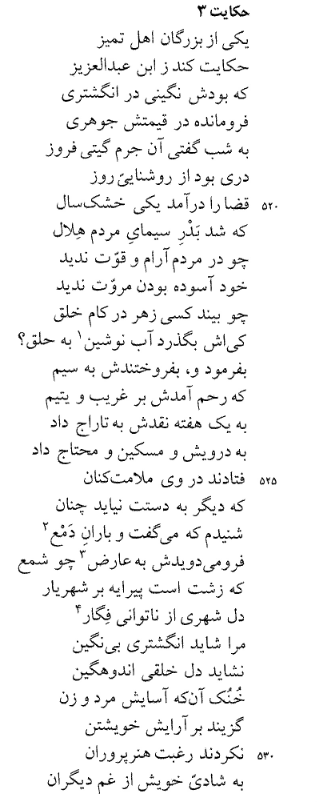
Sa’adi
Translated by Richard Newman
Tale 3: Ibn Abd al-Aziz Sacrifices A Jewel
A man other men follow on the path
tells the story of Ibn Abd al-Aziz,
who owned a ring in which was set a stone
no jeweler could properly assess.
At night, you’d swear it was the rising sun.
By day, its luster was the brightest pearl’s.
Once, when fate decreed a year of drought,
his people’s well-fed faces waned to crescents.
He knew the royal comfort he enjoyed
would unman him in his people’s eyes—
who could watch another swallow poison
then dare drink sweet-water in their sight?—
so he ordered his men to sell the stone for silver,
giving the proceeds in a single week
to anyone in whom he saw a need.
His critics pounced. “You’ll never find it’s like
again!” I’ve heard the tears ran down his cheeks
like melted wax when he replied, “A prince
should not adorn himself with any jewels
when his people lack the means to feed themselves.
This ring without a stone looks fine on me,
but a grieving people’s heart becomes no one.
The one who puts the comfort of his people
before his vanity—he will be happy!
Those who value virtue will never buy
with others’ pain and sorrow their own joy.”
*Translator’s note: This translation of Sa’adi’s poem emerged from an early-2000s commission I received from the now-defunct International Society for Iranian Culture (ISIC) to produce five book-length literary translations of selections from some of the most important works in the Persian literary canon. To read more about the project, click here.
.
.
.
.
.
.
.
.
.
.
.
.
.
.
.
.
.
Ahmad Shamlou
Translated by Hassan Javadi
Death of the Nazarene
With a monotonous,
monotonous sound
the end of the cross
drew a heavy and shaky line
on the ground
behind him.
–“Put a crown of thorns on his head!”
And the lasting sound of the burden
in the delirium of his pain
was weaving
a flaming cord.
“Hurry Nazarene, hurry!”
Within himself he found a tranquility
that made him light,
and like a proud swan
he looked into the depth of his soul.
“Lash him!”
The woven leather struck him
and the endless flaming
red cord
within its length
passed a knot of pain.
“Hurry Nazarene, hurry!”
From the tumultuous watching crowd
Lazarus
Made his way, walking away,
While
clasping his hands
behind his back
he freed himself from
the reproach of a heavy and tormenting debt:
–“ He himself did not want to, otherwise couldn’t he?”
The low sky
Descended heavily on the muting sound
and the sun and the moon
came
together.
.
مرگ ناصری
احمد شاملو
، با آوازی یکدست
، یکدست
دنبالهٔ چوبینِ بار
در قفایش
خطّی سنگین و مرتعش
. بر خاک می کشید
“تاج خاری بر سرش بگذارید”
و آوازِ درازِ دنبالهٔ بار
در هذیانِ دردش
یکدست
رشته ای آتشین
. می رشت
–“شتاب کن ناصری ، شتاب کن”
از رحمی که در جان خویش یافت
سبک شد
و چونان قویی مغرور
. در زلالیِ خویشتن نگریست
— “تازیانه اش بزنید”
. رشتهٔ چرمباف فرود آمد
و ریسمانِ بی انتهایِ سرخ
در طولِ خویش
از گرهی بزرگ
.برگذشت
— “شتاب کن ناصری ، شتاب کن”
از صف غوغای تماشاییان
، العازر
گام زنان راه خود گرفت
دستها در پسِ پشت
، به هم درافکنده
و جانش را از آزارِ گرانِ دینی گزنده
: آزاد یافت
— “مگر خود نمی خواست ، ورنه می توانست”
آسمان کوتاه
به سنگینی
. بر آوازِ روی در خاموشیِ رحم فرو افتاد
سوگواران ، به خاک پشته برشدند
و خورشید و ماه
به هم
. برآمد
.
Ahmad Shamlou
Translated by Sholeh Wolpé
All this
trembling of my heart and hands
is from
lest love becomes a shelter,
a refuge,
…………………………and not flight.
…………………………………………………..Love, O love
…………………………………………………..where is your blue face?
—
A balm’s cooling touch
on a flaring wound,
……………………….and not fire’s bounce
……………………….in this chill we enfold.
……………………….Love, O love
……………………….where is your red face?
—
Or become an appeasing dark cloud
………………………..in presence of languor,
seclusion’s isolation
………………………..in fleeing presence,
gloom
………………………..surfacing the calmness of blue
and abundant leaves
………………………..on a Judas tree.
…………………………………Love, O love
…………………………………your intimate color is lost.
*Permission has been secured from Bamdad Foundation for publication of this translation.
.
بر سرمای درون
همه
لرزش دست و دلم
از آن بود که
که عشق
،پناهی گردد
پروازی نه
گریز گاهی گردد
آی عشق آی عشق
چهره آبیت پیدا نیست
***
و خنکای
مرحمی
بر شعله زخمی
نه شور شعله
بر سرمای درون
آی عشق آی عشق
چهره سرخت پیدا نیست
***
غبار تیره تسکینی
بر حضور ِ وهن
و دنج ِ رهائی
بر گریز حضور
سیاهی
بر آرامش آبی
و سبزه برگچه
بر ارغوان
آی عشق آی عشق
رنگ آشنایت
.پیدا نیست
© Mehdi Akhavan-Sales, Mahsati Ganjavi, Siavash Kasrāi, Esmail Khoi, Sheida Mohamadi, Fereydun Moshiri, Rumi, Sa’adi (Mushrifuddin Muslih ibn Abdullah Shirazi), Ahmad Shamlou, Mahnaz Badihian, Mojdeh Bahar, Farideh Hassanzadeh, Hassan Javadi, Sheema Kalbasi, Richard Newman, and Sholeh Wolpé
POETS
Mehdi Akhavān-Sāles (1929-1990), pen name M. Omid (Hope) was born in Mashhad in Khorasan province in Northeastern Iran. He was a prominent Iranian poet and one of the pioneers of Free Verse (She’er-e Now or New Poetry) in the Persian language. His literary career spanned half a century, his first collection of poetry, Arghanoon (Organ) was published in 1951 and his last, Torā Ay Kohan Boom o Bar Doost Dāram (O You Ancient Land, I Love Thee) in 1989.
Mahsati Ganjavi lived in 11th-12th century. She was from Ganjeh in what is now independent Azarbaijan. She wrote a considerable number of short poems. The themes of her poetry are love, lovers and their absence or cruelty. She was one of the earliest poets to compose quatrains in Persian. She is said to have been a professional scribe (Dabīra). Some sources present her as musician and singer as well.
Siavash Kasrāi (1927-1996), a poet, literary critic, novelist, and political activist. During his life, he published sixteen poetry books. His complete poetry collection (over 700 pages) was published in 2005. Kasrāi was one of the founding members of the Writers’ Association of Iran (Kānun-e nevisandegān-e Irān). His most famous poem is the retelling of a Persian myth Arash-e Kamāngir (Arash the Archer) written in 1959.
Esmail Khoi (1938-2021), a poet and writer, lived in England in exile since 1980s. Khoi combines his social commitment, at times expressed through the angry voice of a frustrated revolutionary, with philosophical reflections or lyrical expression. He uses a delicate, precise imagery, ranging from daily life to unexpected metaphors.
Sheida Mohamadi, a poet, writer, scholar, and journalist, she lives in Los Angeles, CA. She was a Poet in Residence at the University of California from 2015 to 2017. She has authored six books, including “Hug Me Against the Haze,” “Crimson Whisper,” and “I Blink and You Are a Peacock.” Sheida also held the position of Poet in Residence at the University of Maryland in 2010.
Fereydun Moshiri (1926 – 2000), a prominent 20th-century poet known for his simplicity and humanistic vision. His work often celebrated nature, love, and optimism. Moshiri’s poetry blended classical and modern forms, creating accessible, heartfelt verses that resonated deeply with the Iranian public. His emphasis on kindness and belief in better days ahead, like the coming spring, defines his poetic legacy.
Jalāl al-Dīn Muḥammad Rūmī (1207-1273) was a 13th-century Persian poet, scholar, and Sufi mystic from Balkh, which was then part of Persia. His Masnavi is celebrated as one of the greatest works of Persian literature.
Sa’adi or Mushrifuddin Muslih ibn Abdullah Shirazi, one of the most renowned poets and writers of the 13th century. His poetry, while simple, contains beautiful moral lessons. In 1257, Sa’adi composed the Bustan of Sa’adi Nama in verse, and the following year he wrote the Gulistan in prose. In addition to these works, Sa’adi also composed and wrote odes, ghazals, quatrains, essays, and Arabic odes, all compiled in his Collected Works. The exact date of his death is not known, but reliable sources estimate it between 690 and 694 Hijri. Sa’adi’s eternal resting place is in the city of Shiraz.
Ahmad Shamlou (1925-2000) was born in Tehran. He wrote under his pen name of A. Bamdad (Morning), and was a follower of Nima Yushij, Iran’s first modernist poet. A gifted poet, Shamlou went on to develop his own distinct style. He published over twenty volumes of poetry. Today, he is one of the most revered literary figures in modern Iranian history.
TRANSLATORS
Mahnaz Badihian is a poet, translator and artist. Though life took her through Nursing school, Dental school, art school, revolution, immigration, and motherhood, she has always remained a poet and artist. Her poems have appeared in numerous anthologies; her art has been exhibited internationally. Her poetry book, Raven of Isfahan, was published in 2019 to critical acclaim. In 2020 she edited 300 pages of COVID poetry and art from around the world for a collection entitled Plague 2020. In 2022, Vagabond published her collection of poems Ask the Wind. Mahnaz is nominated for San Francisco poet laureate 2024.
Mojdeh Bahar is an attorney, mediator and translator. She has a deep interest in world literature, including Persian Poetry. Mojdeh has translated a selection of Shafi’i Kadkani’s nature poetry entitled Milkvetch and Violets, (Mage, 2021); selected and translated poems by 52 Iranian women poets entitled Song of the Ground Jay: Poems by Iranian Women, 1960-2022, (Mage, 2023) and poems of Taraneh Habib, In the Mirror: Poems and Collages; and selected and translated the poetry of 104 contemporary Iranian women poets entitled, Song of the Ground Jay, Expanded Edition (Gordyeh Publishers, 2023). Her translations have appeared in Lyrikline and Stepaway.
Farideh Hassanzadeh is a poet, translator and freelance journalist. Her poems appear in the anthologies: Letters to the World, Contemporary Women Poets of Iran, Anthology of Best Women Poets, After Shocks, The World’s Best Love Poems, Choice Words: Writers on Abortion, and Heartbeat: Poems of Family and Hometown. She is the author of Eternal Voices: Interviews with Poets East and West and The Last Night with Sylvia Plath: Essays on Poetry. Her translations of international poets’ works were published in 17 anthologies.
Hassan Javadi, born in Tabriz, has taught English and Persian literature at the University of Cambridge, Tehran University, and the University of California at Berkeley. Author and translator of books: Satire in Persian Literature; Persian Literary Influence on English Literature; Obeyd-E Zakani: Ethics of the Aristocrats and Other Satirical Works; and with Willem Floor, Abbas Qoli Aqa Bakikhanov’s The Heavenly Rose-Garden: A History of Shirvan & Daghestan; Evliya Chelebi’s Travels in Iran and the Caucasus, 1647 and 1654; Wake Up Call: Memoirs of a Moslem Woman’s Struggle to Educate Her People, 1907-1931. Edited Letters From Tabriz: The Russian Suppression of the Iranian Constitutional Movement.
Sheema Kalbasi is an Iranian-American poet, writer, filmmaker, and literary translator. Her work has garnered recognition, including a humanitarian award from the United Nations in Pakistan and grants from the Ministry of Foreign Affairs in the Netherlands and Hivos. Her poetry has been anthologized and translated into over 20 languages. In 2012, Senator LGen the Hon. Roméo Dallaire from Quebec, Canada, concluded his speech on Iran by reciting excerpts from her poem titled “Hezbollah.” Additionally, her poem “THE PASSENGER” was selected and performed at the Tribute World Trade Center in New York in 2008.
Richard Jeffrey Newman is a poet, literary co-translator, essayist and Professor of English and Creative Writing at Nassau Community College. He has published three books of poetry, T’shuvah (Fernwood Press 2023), Words for What Those Men Have Done (Guernica Editions 2017), and The Silence of Men (CavanKerry Press 2006), as well as three books of translation from classical Persian poetry, Selections from Sa’adi’s Gulistan, Selections from Sa’adi’s Bustan (Global Scholarly Publications 2004 & 2006) and The Teller of Tales: Stories from Ferdowsi’s Shahnameh (Junction Press 2011). His website: www.richardjnewman.com.
Sholeh Wolpé is an Iranian-American poet, librettist and playwright. Her literary work includes six collections of poetry, several plays, three books of translations, and three anthologies. Her most recent book is Abacus of Loss: A Memoir in Verse. Her forthcoming books are from Visor Libros in Spain (Feb 2025) and Harper Collins in (Sept 2025).
 The Loch Raven Review