
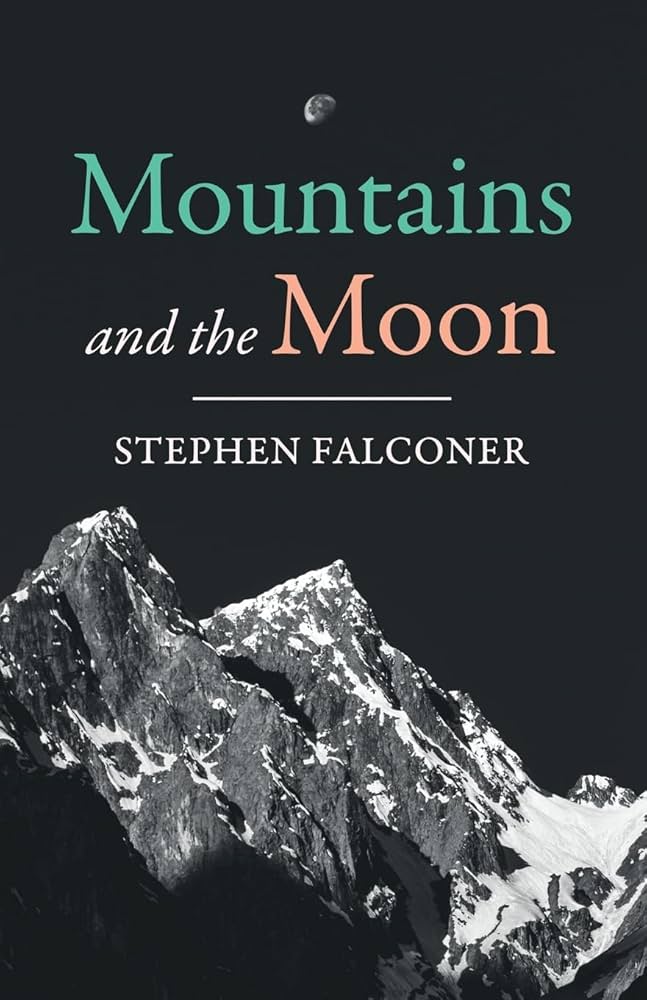
Mountains and the Moon, Stephen Falconer, Resource Publications, and imprint of Wipf and Stock Publishers| Eugene, Oregon, 07/15/2024, ISBN: 979-8-3852-2666-5, 150 pages, Paperback: $15, eBook: $15, HardCover: $30, https://wipfandstock.com/9798385226665/mountains-and-the-moon/
Falconer’s latest work seems to be covered in an obscuring film. The makeup of this recondite film includes responses to other works I have no knowledge of, mythological references, and a diction that humbled me.
For those willing to engage—and that means everyone, not just the well-read—that film of inaccessibility can, with some deliberate swipes, be brushed away like cobwebs to reveal a work that rewards surface-level and deep reads alike.
yet, if only divulging the ectasis resounding in light,
the propinquity
of eyes that shone inwards outward,
can I say that uselessness doesn’t saturate every clause
and the reader will chance upon their vacuity
—from “Irresponsibility,” p. 85.
As an exploration of mystical traditions, the works draw from a wide range of ancient creative work, like Greek mythology and the ancient Chinese classic I Ching. Many of the eighty-nine poems also explore subjects of the body and its congruences with natural and supranatural phenomenon, both biological and non-biological, to build a mythology of their own.
Much of the most striking, sometimes perturbing imagery can be categorized under bodily functions; sweat, blood, pus, flesh, all are invoked. I sometimes feel that contemporary explorations of the physical body are restricted to what might be called body horror (think David Cronenberg). It is therefore refreshing to see a more varied approach to the confrontation of our sometimes gross, yet simultaneously aesthetical bodies. Take, for instance, some choice lines from “The Distant Joy of Light” (p. 93–5):
orifices clam shut
sputum curdles every healthy node,
rose welters
like plague on the skin
umbilical dreg
red,
ripe, and juicy bruise little bones
subzero baby’s eyes see the spear sticking her womb.
Also notable are the intersections between nature and elements of the human body. A bleeding eye looking upon a morning star, moss soaked with moss and fetal plasma, the edibility of one’s calf muscle and a layer of the earth; the many choice combinations of this sort throughout the work spurs imagery that, while sometimes unpleasant or confounding, is unique and reminiscent of seeing something in your youth for the first time, like a strange creature at the zoo. This should not detract from the captures of relatable experience that crop up in the work; I found that the more digestible lines worked to ground the reader and provide reference points for the more abstract concepts and descriptions:
Refreshed by the downpour,
I’ll sink into the grass
and allow it to drench my backbone
—from “Indebtedness,” p. 13.
Sticking to imagery, the wide range of this work is apparent when contrasting the more grounded imagery that calls on the comforting and familiar with psychedelic, otherworldly visuals that push back on the comfort of the reader. I’ll use sections that are heavy on colorful imagery to illustrate this. Several seasons are covered in a series of poems, toward the end of the work, titled “A Year Slowly Turing,” which is a response to “The Twelve Virtues,” from Rudolf Steiner, who was the founder of the spiritual movement anthroposophy. “Twilight” (p. 125), which represents the Mid Autumn time of year, contains a batch of more neutral colors that strike at the placid associations I have with the time of year:
I’ll dress in shades of brown, tan,
and ocher
with a snow white shirt and black tie,
visit the chapel sited under yellow leaves
and grey branches
For reference, ocher is a natural color alike to clay. I’ll note that the comforting use of color is contrasted by the disclosure that the narrator has their imminent mortality on their mind. From this, the association of autumn with death or an upcoming deep sleep comes to mind:
It is only a matter of months now,
so they said in the infirmary.
In contrast, “Royal Blue” has that aforementioned psychedelic tinge—using brilliant hues of blue, a face is constructed, then a body. You may note that this poem is also concerned with the nature of mortality. Here is an excerpt:
Turquoise lids, azure cheekbones,
blue black pupil centered in dark blue iris,
cobalt words splayed in light blue haze
“The instant you know you have longer to live,
suffering will dissipate.”
Indigo heart beating in the wind,
cerulean expanse breathing without respite,
sapphire raindrops millimeters apart,
sky blue ankles
caught
in hands reaching to touch your crown.
I don’t know much about the mythology created by past civilizations, classic texts in general, and mystical traditions. I would therefore be interested to see what a more knowledgeable reader might dig up from Falconer’s latest work. Even works that are steeped in esotericism can offer all readers something valuable. Reaping understanding from The Mountains and the Moon may feel laborious, as clear meaning or intent are never handed to you on an open palm. Yet, my experience attempting to pry away something profound from a challenging text with my limited knowledge base was a rewarding experience that I recommend to any reader who is ready for a close read.
© Stephen Falconer and Michael Fialkowski
Stephen Falconer is an Australian poet who lives with his wife, Helen, in Latrobe, Tasmania. Apart from two collections published by Wipfandstock, Oregon- “‘Indebted to Change’ and ‘Arcadian Grace’, his previous book was titled “A Place to Breathe” and was reviewed in LRR Vol. 19 No.2
Michael Fialkowski is the Social Media Editor of Loch Raven Review. He graduated University of Maryland, Baltimore County with a communications degree and a creative writing minor. He lives in Washington, DC, and is a content editor and certification associate at the National Association of Housing and Redevelopment Officials.
 The Loch Raven Review