
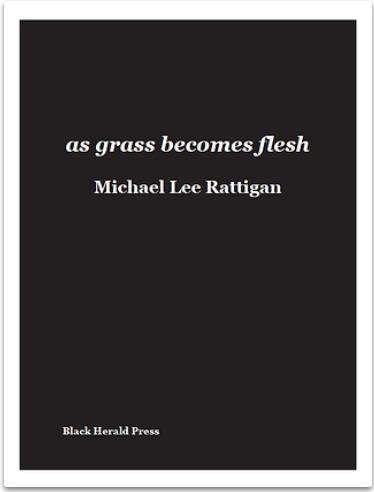
as grass becomes flesh, Michael Lee Rattigan, Black Herald Press, 2023: Chartres-London. ISBN: 978-2-919582-35-8, 59 pages.
Gratitude must be extended to editor-poets Paul Stubbs and Blandine Longre for publishing as grass becomes flesh (2023) by Michael Lee Rattigan. Their Black Herald Press has been publishing some of the most riveting poetry collections for well over a decade. (As well as republishing work by Gregory Corso, W.S. Graham, and David Gascoyne, among others.) Michael Lee Rattigan is no stranger to their catalogue, having appeared in their journal and having published the collection Hiraeth (2016). Now their impeccable editing has gathered a collection of Rattigan’s latest work. Words like “stunning, beautiful, and brilliant” are thrown around as blurbs; however, many of the poems in this book prove to be supremely powerful. This is a collection anyone interested in unique developments of English poetry must read and have on their bookshelf, to be shared with others, and preferably aloud.
There is a simple answer when asking: Why is his voice is so singular? Rattigan encapsulates Clayton Eshleman’s ideal of the poet: I see the poet as a figure who, while based in his own poetry, extends his vision into translation, prose commentary, and into long research projects. Rattigan has done his own “saturation-jobs” by translating César Vallejo—that most difficult open sequence, Trilce—as well as Fernando Pessoa (the complete poems of Alberto Caeiro.) Not building his poetry on a purely anglophonic and Anglo-centric foundation—and bypassing the Larkin/Armitage turnpike road—Rattigan aligns his voice with the deeper traditions (more on that later) that weave their trajectory through epochs and languages.
The poems in as grass becomes flesh possess that touch of the marvelous, as Lamantia would suggest. Rattigan’s work is clearly grounded in Surrealism, Deep Imagism, yet also more current developments in poetry, such as Ecopoetry; other poems, like work by Miroslav Holub, Will Alexander, or Alberto Blanco, fuse the lexicons of science with nature writing. The collection opens with “Omnidirectional”, a tour-de-force. The ladder-like lines—which can be read top-bottom/bottom-top, and even from left-to-right, right-to-left—addresses the “perpetual present”, in which true poetry resides, as a cinematic and universal eye/I provides a flickering of “a spider” that “stares back”, “the footfalls of an ant”, “a falcon’s descending spiral”, among other natural images “across 700 million years” all pulsing with a “magnetic course” through the “needle’s eye”. Of course, this compression of eternity, with all the moments happening simultaneously and yet independently remind the reader of Borges and his Aleph. A close reading also evokes the catalogues in Whitman and that sense of vast spaces—seascapes, city sidewalks, forests, factories, and cabins—fused in successions of long, end-stopped lines.
Like others working with Ecopoetry, Rattigan imagines himself into the alternate natures of the beings that breathe among us. The poem “Anew” reaches into the “molecular language / between the leaves” so that the reader participates in the “vascular forms extending” though nature’s “green monarchies”. The line-breaks in “Anew” resemble the late poems by W.C. Williams, as well as those in Contra Natura by Rodolfo Hinostroza, a poet simpatico to Rattigan’s voice and weltanschauung. The lines step down and across the pages, leaving swaths of white-space and respiration, or “staccato lines”, as the poet himself suggest, perfectly assembled to create the confluence that congeals in each poem.
The poem “Multitudes” may be the collection’s strongest. Its topography on the page—even more complex than “Omnidirectional”—arises from Rattigan’s reading of Latin American poetry. The poem’s structure suggests those forays into post-Mallarmé works like “Blanco” by Octavio Paz or “Antes de Nacer” by Alberto Blanco. The poem moves from the micro to the macro, from a “mother’s milk” or “drop of seawater” to “a worm’s trophosome” to “herbivorous and carnivorous mammals” all in perpetual changes, in the interval between life and death. Clearly, Rattigan as poet is assuring us of the marvel to be alive, to observe and to accept one’s transience and fusion with the cosmos. We return to that great tradition summed up in Shelley’s assertion: The mist of familiarity obscures from us the wonder of our being. We are struck with admiration at some of its transient modifications, but it is itself the great miracle.
“Metanoia” opens with “the size of time / a pause / a movement / a cage” and then closes with a conduit into change of perception by “compassion / rewoven / a life purpose / belonging”. Rattigan’s poetry serves as a voice of solace, eschewing the trend in hyphenated-poets gazing on their navels as they limit their poems to identity politics, narrative games, or slapdash lines meant to assure the reader that the poet remains a sensitive, if not sensible fellow, who loves nature, and aches for the poor and broken. Here, in as grass becomes flesh, a more tellurian compassion is revealed, and a mind absorbing insights from diverse fields of inquiry, spirituality, and traditions. One thinks of Ginsberg’s suggestion: “What’s the Work? (of poetry). To ease the pain of living. / Everything else, drunken / dumbshow.” Succor, indeed. One of the closing poems, “Clarity”, functions as a directive for the reader “no longer fearing he future’s / present tense / and welcome the simple / most difficult task / of failure to know”. This no-knowledge, which is a type of knowledge too, swells “with only a few tomorrows / common to all / the flame above our head”.
The Whitmanesque title of Rattigan’s book alludes to the passage in “Song of Myself” from Leaves of Grass where the protagonist responds to a child’s query: What is the grass? fetching it to me with full hands; How could I answer the child? […] Or I guess the grass is itself a child, the produced babe of the vegetation. These lines appear shortly after the revelatory passage in the 4th section: I mind how once we lay on such a transparent summer morning. […] How you settled your head athwart my hips and gently turn’d over upon me, And parted the shirt from my bosom-bone, and plunged your tongue to my bare-stript heart, And reach’d till you felt my beard, and reach’d till you held my feet. After citing that passage, Malcolm Cowley wrote of Whitman’s tie to the Perennial phenomenology—the epiphany, the awakening, the Satori, or Kerouac’s “kick in the eye”, call it what you will—and a tradition deeper than the beliefs and laws of individual religions. Yes, I am asserting that Rattigan is tapping into that wire.
Leaves of Grass (1855) will shortly reach 200 years of comforting and electrifying readers. Clearly that tome confirms the statement by Octavio Paz that poetry is “the secret religion” of our times. And it remains so today as we face our troubling landscape of Artificial Intelligence, climate change, shrapnel, and mass migration. It would be presumptuous to claim that Michael Lee Rattigan will contribute to English poetry a body of work that will be read two centuries from now (will there even be books or readers a hundred years from today?). However, many of the poems in as grass becomes flesh cause the reader to shudder from the recognition of the perennial voice, of the verb and the revelation.
© Michael Lee Rattigan and Anthony Seidman
Michael Lee Rattigan has lived and taught in Mexico and Spain, and translated the complete collection of Fernando Pessoa’s Alberto Caeiro Poems (Rufus Books, 2007). Other translations have appeared in The Los Angeles Review, Asymptote Magazine, The Black Herald, The Fiend Journal, and in Selected Writings of César Vallejo (ed. Joseph Mulligan, Wesleyan University Press, 2015). He has since been working on César Vallejo’s Trilce and has completed a fresh translation with the poet and translator Mario Domínguez Parra. His poetry collection Liminal was published in 2012 (Rufus Books), and Hiraeth in 2016 (Black Herald Press).
Anthony Seidman is a poet-translator. His most recent full-length translations include Confetti-Ash: Selected Poems by Salvador Novo (Bitter Oleander), The End of the World Came to My Neighborhood (Spuyten Duyvil) by Frank Báez, and Contra Natura (Cardboard House Press) by Rodolfo Hinostroza. Seidman’s poetry, reviews, translations, and articles can be found in publications like World Literature Today, Los Angeles Review of Books, New American Writing, Poetry International, Rattle, and such anthologies as The Ecopoetry Anthology and The Serpent and the Fire: Poetry of the Americas. His latest collection is Black Balloons (Spuyten Duyvil), an open sequence of prose poems.
 The Loch Raven Review