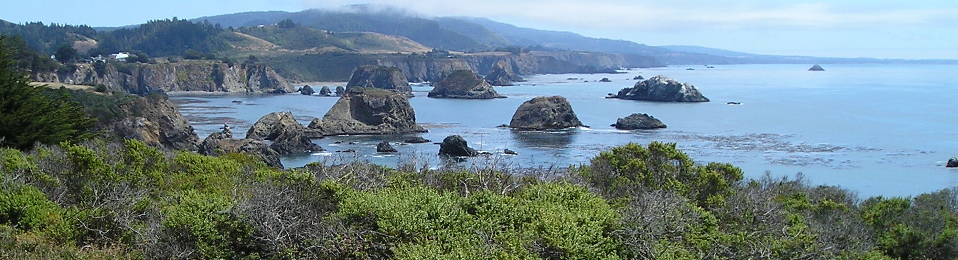
Fourteen Irish-Language Poets: Colm Breathnach, Eibhlis Carcione, Máirtín Coilféir, Philip Cummings, Celia de Fréine, Áine Durkin, Caitríona Lane, Proinsias Mac a’Bhaird, DS Maolalaí, Caitríona Ní Chléirchín, Aibhe Ní Ghearbhuigh, Simon Ó Faoláin, Cathal Ó Searcaigh, and Gabriel Rosenstock
Translated by: Colm Breathnach, Paddy Bushe, Máirtín Coilféir, Philip Cummings, Celia de Fréine, Áine Durkin, Caitríona Lane, Sean Lysaght, Proinsias Mac a’Bhaird, Thomas McCarthy, Caitríona Ní Chléirchín, Seosamh Ó Maolalaí, Billy Ramsell
.
INTRODUCTION
This substantial section of Irish language poetry in translation is published in a spirit of celebration and humility. The aim is to showcase a selection of fine poetry by a wide array of established and emerging poets powerfully advancing the extraordinarily rich tradition of poetry in Irish that goes back many centuries. All these featured poets and translators are from the geographic space that is Ireland—an island on the northwestern edge of Europe, bathed in the temperate flow of the Gulf Stream, whose layers of culture and history reach back at least ten millennia. Of course, this island contains the modern political entities of the Irish Republic, consisting of twenty-six counties to the south, and the six counties in the north composing Northern Ireland, one of four constituent governing bodies of the United Kingdom. Though the language is more traditionally known as Gaelic, today Irish is commonly used to describe the various Gaelic language dialects indigenous to the island. Boasting 1500 years of textual history, Irish as a national language and a repository of cultural knowledge, lies at the center of the last 850 years of often brutal relations with England and its language. Beginning in 1169 with the Anglo-Norman invasions, this history of trauma and survival, of oppression, colonization, resistance, and recovery is enormously complex. Hopefully the work of the poets represented here will encourage readers to explore further not only the early and modern history of the place, but its deep well of poetry whose origins are rooted in Irish. The great (Anglo) Irish poet, W. B. Yeats famously (if obliquely) acknowledged this fact when declaring, “Gaelic is my national language, but it is not my mother tongue.”
Today, while Irish remains the national and first official language of the Republic of Ireland and is a required course in Irish schools, English, also constitutionally recognized as an official language, is the predominant language, having displaced Irish over the course of the 19th century. Most people growing up in Ireland over the last several decades still have significant exposure to the language, with a large minority of the population possessing varying degrees of linguistic competence. Nonetheless, census data in the Republic indicates that for less than 5% of the population Irish is the principal language spoken in the household or community. Some of the writers represented here come from and still live in such Irish-speaking spaces. Yet the decline in the general use of Irish over centuries and up to the present persists as a distinct burden that contemporary writers in Irish consistently face in terms of readership, publishing, book distribution, and promotion—as well as in a pervading sense of responsibility for not just the preservation of Irish as a living and literary language but its furthering in Ireland and even abroad.
Akin to the critical decline in biodiversity, today we are bearing witness to a linguistic mass extinction event with the catastrophic loss of indigenous languages around the world. Everywhere, the plight of minority languages is only worsening. Over 7000 languages are spoken today, but UNESCO estimates that 3000 are endangered with extinction, though at current extinction rates far more than that may disappear this century. Since developing the Poetry in Translation section under the leadership of Danuta E. Kosk-Kosicka, the Loch Raven Review has now featured 29 languages including minority, disappearing, or seldom published languages such as Mayan, Catalan, Kashubian, Occitan, Breton, Faroese, Amharic, and various Philippine languages. Given the dominance of English in Ireland where it is far more than a lingua franca—all the writers represented in this issue live fully immersed in Ireland’s English language world—it may seem extraordinary that Irish is not officially considered at-risk of disappearing. And yet, the loss of Irish as the principal language of Ireland has persistently haunted many writers working in both Irish and English.
Brian Friel’s play Translations (1980) famously stages the general grief associated with this haunting loss. Set in county Donegal in 1833, it is written almost entirely in English (save for some lines in Greek and Latin) and seeks to capture in its dominant conceit—that all characters including the native Irish speakers speak English on stage—the process of the native language of the place transforming into a minority language. At once a beautiful and harrowing admonition, Friel’s play stages Irish as the presence of a tragic ghost-language, something the writers in this issue definitively rebut as they engage extremely heterogeneous themes extending from Ireland to the world. The vocational dedication of today’s Irish language poets continues an impressive tradition of work that asserts and sustains the vibrancy of Irish as a highly literary language.
A remarkable feature of this gathering of poets is the fact that nine of the fourteen have written their own translations. This is a much higher percentage of self-translation than any previous issue of the Loch Raven Review’s translation section. Whether this speaks to the intensely intimate relationship between Irish and English in Ireland as in the minds of these poets, the immersion of Irish in a deep overlay of English, or the complicated responsibilities of the translator facilitating the welling up of the original language through its translation, it is a reminder of the variety of ways that Irish pushes back against English in this place.
In 1990, the Irish language poet Nuala Ní Dhomhnaill published her watershed poem “The Language Question,” translated by Paul Muldoon. Beginning, “I place my hope in the water/in this little boat/of the language,” she describes the poem, her “hope,” as laid like the baby Moses in the curragh of the Irish language and then set adrift into the world where it will journey “hither and thither/not knowing where it may end up;/in the lap, perhaps,/of some Pharaoh’s daughter.” The challenges of maintaining and more broadly reviving the Irish language are daunting, but all the writers represented here, poets and translators alike—the distinction being moot—espouse the hope Ní Dhomhnaill captures as they embrace that work with care, love, and with a verve that bespeaks knowledge in the staying power of Irish as a vital language for poetry in Ireland. I would like to sincerely thank these poets for sharing their art and with it their visions of the roles, responsibilities, and possibilities of Irish poetry in the world today.
Brendan Corcoran, Guest Co-Editor
.
Colm Breathnach
Translated by Colm Breathnach
Besides Water
Besides water what else
is there in the open sea,
besides water and fish and seaweed and reefs
what else is there in the open sea,
besides water and fish and seaweed and reefs
and crabs and lobsters what else
is there in the open sea,
besides water and fish and seaweed and reefs
and crabs and lobsters and brine
and seals and whales and waves
with the sun glistening on them
and jellyfish and plankton
and dark unknown depths
what else is there in the open sea,
besides water and dark unknown depths
and brine and drowning and terror
and roller upon roller upon roller
what else is there in the open sea?
Plastic.
There is plastic in the open sea.
There are plastic bags in the open sea.
There are plastic chords and wire,
plastic bottles and plastic crates
in the open sea.
And there are plastic microbeads
and thousands and thousands of millions
of other bits of plastic in the open sea.
Besides water and plastic, what else is in the open sea?
.
Seachas Uisce
Seachas uisce, cad eile
atá sa bhfarraige mhór,
seachas uisce agus éisc agus feamainn agus fochaisí,
cad eile atá sa bhfarraige mhór,
seachas uisce agus éisc agus feamainn agus fochaisí
agus portáin agus gleamaigh, cad eile atá
sa bhfarraige mhór,
seachas uisce agus éisc agus feamainn agus fochaisí
agus portáin agus gleamaigh agus sáile
agus rónta agus míolta móra agus tonnta
go bhfuil glinniúint na gréine orthu
agus smugairlí róin agus planctón
agus doimhneacha dorcha do-eoil,
cad eile atá sa bhfarraige mhór,
seachas uisce agus doimhneacha dorcha do-eoil
agus sáile agus báthadh agus sceoin
agus ólaí ar ólaí ar ólaí,
cad eile atá sa bhfarraige mhór?
Plaisteach.
Tá plaisteach sa bhfarraige mhór.
Tá málaí plaisteacha sa bhfarraige mhór.
Tá téada agus sreanga plaisteacha,
buidéil phlaisteacha agus crátaí plaisteacha
sa bhfarraige mhór.
Agus tá micreachoirníní plaisteacha
agus na mílte mílte milliún míreanna plaisteacha eile
sa bhfarraige mhór.
Seachas uisce agus plaisteach, cad tá sa bhfarraige mhór?
Original first published in Aneas 1
.
A Bag of Potatoes*
A bag of potatoes on the footpath by the street
with some of them having spilled out.
One, two, three,
four, five, six, seven…
I cease counting
but still they distract me
from the man lying beside them
dead on the street.
…eight, nine, ten,
eleven.
Twelve potatoes spilled from their plastic bag.
A friend of mine used to maintain
‘potato sack’ was the proper thing to say,
that that usage was still the more correct,
even if the material was now plastic
the traditional term should be preserved.
I let those thoughts distract me,
I am concentrating on that plastic bag
of the type you’d get in a supermarket,
that bag full of potatoes,
rather than the dead man beside them in the street.
Where did he get them?
Is it too early yet for digging potatoes?
Is there a shop still open or a vegetable stall?
Did a grocer or a shopkeeper put loose potatoes into a bag for him—
for the man who is dead on the street?
Where was he going?
Who were the potatoes for?
For his wife?
For his wife and their children?
For his parents, the old couple at home?
Or was his wife with him, perhaps?
Was he trying to protect her when he was shot?
What did they do with her?
What did they do to her?
Were his parents in some basement?
Did they manage to get away?
Who were those potatoes for,
that spilled from a bag
on the side of the street in Bucha,
Ukraine?
*This poem is a response to a photograph published in El Pais, 4 April 2022, viewed online.
First published in Poetry Ireland Review.
.
Mála Prátaí*
(05-04-2022)
Mála prátaí ar an gcosán ar thaobh na sráide
agus roinnt prátaí tar éis scéitheadh as.
A haon, a dó, a trí,
a ceathair, a cúig, a sé, a seacht…
Éirím as an gcomhaireamh
ach fós baineann siad m’aird
den bhfear atá ina luí in aice leo
marbh ar an tsráid.
…a hocht, a naoi, a deich,
a haon déag…
Dhá phráta dhéag scéite as a mála plaisteach.
Deireadh cara liom
gur chirte mála plaistigh a rá,
faoi mar a deirtear bosca adhmaid, abair.
Gur ainm ar ábhar ruda seachas aidiacht
ba cheart a úsáid sa chás seo.
Ag ligean do m’aird luí ar na smaointe sin atáim,
is ar an mála plaisteach sin den saghas a gheofá san ollmhargadh
agus é lán de phrátaí
seachas ar an bhfear marbh in aice leo ar an tsráid.
Cá bhfuair sé iad?
An bhfuil sé ró-luath go fóill dul ag baint prátaí?
An bhfuil siopa fós ar oscailt nó stalla glasraí?
Ar dhein grósaeir nó siopadóir prátaí scaoilte a chur isteach i mála dó—
don bhfear atá marbh ar an tsráid?
Cá raibh sé ag dul?
Cér dóibh na prátaí?
Dá bhean?
Dá bhean agus a gclann?
Dá mhuintir, an tseana-lánúin age baile?
Nó ab ann go raibh a bhean ina theannta?
Arbh ag iarraidh í a chosaint a bhí sé nuair a lámhachadh é?
Cad a dheineadar léi sin?
Cad a dheineadar uirthi?
An raibh a thuismitheoirí in íoslach éigin?
Ar thugadar siúd na cosa leo?
Cér dóibh na prátaí
atá scaoilte as a mála
ar thaobh na sráide in Bucha
na hÚcráine?
*Grianghraf a foilsíodh in El Pais an 4 Aibreán, 2022 agus a chonac ar líne a spreag an dán seo.
First published in Poetry Ireland Review.
Eibhlís Carcione
Translated by Thomas McCarthy
The Monster My Aunt Saw
A monster my aunt saw
In the Field of Kindling
One day at summer’s end.
A monster, so she claimed,
As fierce and huge as a tiger
With horns of a snail.
I saw nothing but rabbits and hares
Bounding through rushes
In the Field of Kindling,
But I felt the terror of my aunt
Every time I went there,
And it played on my mind
Each day I left home.
The years went by,
My aunt’s son died in his sleep,
A newly married man with a boy,
Everyone ravaged by the death.
When I went for a walk
In the Field of Kindling
I found my aunt,
A dead fox
In her arms.
A fox that was as bright
As the orange cushions at Lochabhán
Where I ate apple tart with my aunt
On a day at summer’s end,
The drowned soul of her grief
In the pools of her eyes,
My own life still ahead.
.
Arracht a Chonaic M’Aintín
Arracht a chonaic m’aintín
i bPáirc an Chipín,
lá deireadh samhraidh,
í ina máthair óg.
Arracht dar léi
a bhí chomh mór millteach le tíogar
le hadharcáin sheilide.
Ní fhaca riamh ach coiníní is giorraithe
ag rith sa luachair
i bPáirc an Chipín,
ach bhraitheas sceimhle m’aintín
gach uair a chuas ann,
is smaoiníos go minic uirthi
nuair a d’imíos ón cheantar.
D’imigh na blianta thart.
Cailleadh mac m’aintín ina chodladh,
é ina ógfhear nuaphósta, mac aige féin,
gach duine céasta faoina bhás.
Geábh a thugas go dtí Páirc an Chipín,
cé a bhí romham ach m’aintín bhocht
agus sionnach marbh ina baclainn.
Sionnach a bhí chomh geal
leis an dtolg oráiste i Lochabhán,
ar a d’itheas pióg úill le m’aintín,
lá deireadh samhraidh,
greim an duine bháite aici orm,
linnte móra in a súile,
mo shaol romham.
.
Night Swan
There was a time you were a sister to me.
We slept in harmony and love
In a room nearest the river;
The lively song of the dipper
At the heart of our ease,
Birds skipping from stone to stone
In the depths of our sleep.
Our mother’s thin arms
Threw back the curtains in alarm.
Suddenly, too much light.
What happened to you since, dear pet,
You so far from me?
A night swan you’ve become,
Perched on a wild rock in the harbour,
Patches of oil blotch your lovely wings,
Your reflection glistening in the sea,
Like the white jumper you once wore,
Full of perforations, full of ghosts,
That shipwrecked my every dream.
.
Eala Oíche
Seal dá raibh bhí tusa i do dheirfiúr agam.
Chodlaíomar go sítheach sóch
sa seomra ba ghaire don abhainn;
cantaireacht na ngabha dubh le clos
in inbhear ár suain,
iad ag scinneadh ó chloch go cloch
sa duibheagán,
lámh seang ár máthar
ag oscailt na gcuirtíní de sceit,
an ghrian ag sileadh isteach ró-obann.
Cad a tharla duit ó shin, a chroí?
Tú i bhfad uaim.
Eala oíche tú,
id’ aonar ar charraig mhillteach sa chuan,
stríoca ola ar do chleití maorga,
do scáil ag drithliú sa mhuir:
an geansaí olann bán,
a chaiteá tráth,
pollta, taibhsiúil,
ina long bháite i mo thaibhreamh laethúil.
Máirtín Coilféir
Translated by Máirtín Coilféir
Visit to a Nursing Home
Sarajevo, May 2022
Just in case we’d start the massacre –
pass some cruel dose to deda and baba,
lay nurses low with volleys of germs
and wreak red slaughter on the rest of the elders
that bounce around here on foot and walker
they pulled us all up, put our backs to the wall,
one person, another, and next,
ordered each in their time to shut tight their eyes
and when they levelled at me the snout of the gun
inside in my mind, low, in a whisper,
for spray I cooed the word ablute:
from toe to top, head to heel,
from tóin to ceann, from bearradh to diúra,
and on my fresh and gleaming forehead
I’d cut the ooze with the sign of the cross
but summer clouds fattened – the gates
of the deluge creaked and burst open
and again we were drowned, all in a sudden.
‘You’ve visitors in today, my pet,’
the manager smiled at my other half’s gran
and as I stood there waiting on who’s-this-now
and three slobbery kisses – left, right, left –
I readied my own introduction:
I am swan on lake, I am fish under wave,
I am green stalk of spud, dancing after rain.
.
Cuairt ar Theach Altranais
Sarajevo, Bealtaine 2022
Ar fhaitíos an tsléachta –
ulpóg a scaipeadh ar deda is baba,
altraí a leagan le teann frídíní,
dearg-ár a imirt ar gach seanóir eile
a rinceann anseo ar leathchois is cána –
cuireadh in aghaidh balla muid
inár nduine is inár nduine,
tháinig an t-ordú ár súile a dhúnadh,
díríodh orainn béal caol gunna
is istigh i m’aigne féin go ciúin
ar spréáil is ea a thugas-sa ionladh:
ó mhullach go lár, rinn go sáil,
tóin go ceann agus bearradh go diúra
go ngearrfainn ansin ar m’éadan sciomartha
fíor na croise le fuílleach an ungtha
ach ramhraigh spéartha lár an tsamhraidh,
osclaíodh romhainn geataí díleann
is bádh arís muid faoi bháisteach thobann.
‘Tá cuairteoirí chugat inniu, a chroí,’
arsa bean an tí le mamó mo chéile
is fhad is a d’fhanas ar an cé thú fhéin,
ar na trí phóg fhliuch ar gach aon leiceann
réitigh mé mo chur in aithne:
mé eala ar linn, mé iasc ar muir,
mé gas glas fataí ag damhsa théis ceatha.
.
Swordplay
Cnoc an Chapaill, Co. Leitrim
Two rushes we’d pick
as we headed up the slope,
two that wouldn’t bend
against hand or belly
but would set the air
all whistling
with the slashes of foils.
That was it then, all thrust
and parry, the whole way up
to the old bed frame
the neighbour had set
as boundary marker
and ram blocker
until dad would die
a gurgling death
amid the wrought-iron posts.
I’d be the next one to fall
in battle’s heat:
a pair expiring at the top of their lungs
on their way to inspect
the roof of the old house,
the annual duty
of the in-law.
Yesterday, he had a lift in his step,
my father, buzzing from flower
to bush in the garden,
studiously bending forward,
stretching, sniffing,
but still came a snigger
when he heard
the whack
that I sounded
off his arse
with a rush.
When I asked him
if he remembered,
he didn’t turn his head,
just straightened up a pansy
fallen down by his ankle
and said over shoulder,
‘Na claimhte, ab ea?’
.
Claimhteoireacht
Cnoc an Chapaill, Co. Liatroma
Phiocadh muid dhá ghiolcach
is muid in aghaidh na fána,
cinn nach lúbfadh
in éadan lámh ná bolg
ach a chuireadh an t-aer
ag feadaíl
le scoradh na bpionsaí.
B’sheo muid ansin ag sá
is ag cosc chomh fada
leis an seanstoc leapa
a leag comharsa
ar theorainn garraí
mar bhac ar reithe,
go bhfaigheadh deaid
bás glotharach
i measc na bpostaí iarrainn.
Thitinn féin le scread sa ngleo ansin,
beirt ag saothrú an bháis in ard a gcinn
is iad ar a mbealach le breathnú
ar dhíon an tseantí,
cúram bliana
an chliamhain isteach.
Inné, bhí preab ina chéim aige,
m’athair ag imeacht ó bhláth
go tom sa ngairdín,
ag cromadh go dícheallach
le dul ag smúrthacht,
ach bhris air a scige
nuair a chuala sé
an plab
a bhaineas
as a thóin
le giolcach.
Nuair a d’fhiafraigh mé de
ar chuimhneach leis é
níor chas sé dá threoir
ach shocraigh sé goirmín
in aice a rúitín
is dúirt thar a dhroim,
‘What, swords?’
Philip Cummings
Translated by Philip Cummings
Passer-by
petal by petal
I picked up the yellow rose
you left behind you
in the hotel room
drop by drop
you wept the memory of him
you forced the blood of your heart
out through the fortress of your eyes
we both know
that you are
in the wrong hotel
with the wrong man
.
Seallach
peiteal ar pheiteal
tógaim an rós buí
a d’fhág tú i do dhiaidh
sa tseomra óstáin
deoir ar dheoir
chaoin tú a chuimhne
d’fháisc tú fuil do chroí
trí dhaingean do shúl
tá a fhios againn beirt
go bhfuil tú
san óstán mhícheart
leis an fhear mhíchuí
.
Newspeak
Lockdown, social distancing, cocooning –
I concede they were necessary, as terms,
but they left a bad taste in the mouth.
I find an old word more fulsome
for forgiving the mess we are in:
a break, sometimes as good as arrest.
When I was young – yonks and yonks ago;
the World itself was young at the time,
or, at least, not so worn out –
from that era I share with you great graffiti:
Stop the World I wanna get off
‘If you were of the World …’
It was a break, but, alas, not an end.
From the vision forced on me I now prophesise:
the new normal will be exaclty like the old one;
suffering, for the most part,
the foot soldiers most often
under the boot of the big bucks,
as it was in the beginning, is now …
The pubs shut; life did not stop.
Pupils got their O and their A Levels; life did not stop.
We herded parents out of hospitals and
into coffin homes to kill them – even then, life did not stop.
At this Bridge of Tears, as the dead we did not keen properly
fall into forgetfulness,
let the graves be opened,
let them be granted a soulbreak before the new old normal starts.
.
Nuafhoclú
Dianghlasáil, scaradh sóisialta, cocúnú –
géillim go raibh gá leo, mar fhocail,
ach ní mórán feola a bhainim astu.
B’ansa liom seanfhocal leis an phrácás
ina bhfuil muid a mhaitheamh dom féin:
sos; agus ná tuigtear S-O-S as.
Agus mé óg – na cianta, cianta ó shin;
bhí an domhan féin óg ag an am,
nó, ar a laghad, cha raibh sé chomh caite –
as an ré sin, graifítí gliondrach a roinnim libh:
Stop the World I wanna get off
‘Dá mba den tsaol sibh …’
Sos a bhí ann, ach, monuar, chan deireadh.
Tairngrím anois as an fhios a brúdh orm:
beidh an gnáth úr go díreach mar a bhí an seancheann;
fulaingt is minice a bheidh ann,
faoi chois na mboc mór go hiondúil
a bheidh an chosmhuintir,
mar a bhí ar dtús, mar atá anois …
Druideadh na tábhairní; níor stad an saol.
Fuair daltaí a nO is a not hArd-Leibhéil; níor stad an saol.
Dhíbir muid tuismitheoirí amach as ospidéil agus
isteach i dtithe bána lena marú – fiú ansin, níor stad an saol.
Ag Droichead seo na nDeor, is muid ag ligint i ndíchuimhne
na marbh nár chaoineamar i gceart,
go n-osclaítear na huaigheanna,
go dtugtar sos anama dóibh sula dtosóidh an seanghnáth úr.
Celia de Fréine
Translated by Celia de Fréine
In Absentia
The tulips, roses and carnations are arranged
in beds. Colour-coordinated rectangles
dotted across the lawn. Along with
white structures. Tiny chevaux-de-frise,
warning you to keep off the grass, a girl says.
Her mother must have told her. Yours may not
have known. She never comes to the park.
She isn’t by your side when you watch those
colours from a distance. Knowing you can’t
touch the flowers, smell their scent. That the place
in the park reserved for you is the playground.
There are no white obstacles to warn
that a man will follow you there, offer
you sweets, make suggestions in words
you don’t understand but later learn spell danger.
Nor will you have the words to share what happened
when you return home. First you will have to walk
up the path to the front door. Past the lawn
where the landlord has cut the daisies. Their
tiny yellow and white heads lying massacred
before you can pick them. Before you can
make a chain. A crown to put on your head –
to declare: you are a child. You are special.
In time you will learn that the aster
is the flower of your birth month.
A daisy with purple-tinted petals
that fold inwards at twilight. As though
wanting to swallow all trace of that day.
.
In Absentia
I gceapacha atá na tiúilipí, rósanna is coróineacha
leagtha amach. Dronuilleoga ar dhathanna comhordaithe
breactha fud fad an léana. Maraon le struchtúir bhána.
Chevaux-de-frise bídeacha a thugann foláireamh
coinneáil amach ón bhféar, dar le cailín amháin.
Caithfidh sé gurb í a máthair a d’inis di. Seans nach
bhfuil do mháthair ar an eolas fúthu. Ní thagann sí chuig
an bpáirc ariamh. Níl sí id’ aice is tú ag breathnú
na ndathanna úd de chéin. Ag glacadh leis nach bhfuil tú
in ann na bláthanna a bhrath. A gcumhracht a bholú. Gurb é
an clós súgartha an chuid den pháirc curtha i leataobh duit.
Níl aon bhaic bhána le foláireamh a thabhairt
go leanfaidh fear isteach inti thú, milseáin
á dtairiscint aige, moltaí á ndéanamh i bhfocail nach
dtuigeann tú ach a dtuigfear duit ar ball go bhfuil baol ag baint leo.
Ná ní bheidh na focail chuí faoinar thit amach
le roinnt agat ar shroicheadh an bhaile duit. Ar dtús
beidh ort siúl suas an cosán chuig an doras tosaigh.
Thar an léana inar bhain an tiarna talún na nóiníní.
A gcloigne beaga bána is buí ina luí scriosta sula
bhfuil tú in ann iad a phiocadh. Sula bhfuil tú in ann
slabhra a chruthú. Coróin le cur ar do chloigeann –
le fógairt: is leanbh thú. Duine speisialta.
In am trátha gheobhaidh tú amach
gurb é an t-astar bláth do bhreithmhíosa.
Nóinín a bhfuil imir chorcra ar a pheitil
a fhilleann isteach faoin gclapsholas.
Mar a bheidís ag iarraidh lorg an lae úd a alpadh.
.
What becomes of desire?
When young you often wondered what
would become of desire as you grew older –
would it still grasp you by the throat
make you yearn for that which you could not have –
be it a teapot in a china shop or a piece
of onyx bearing a Celtic motif?
Would you still covet the tall guy
who came late to class and stood by the door
where all could feast their eyes on him?
Or the other who paid for your meals
in pound coins, when such were rare,
before retreating to his darkroom?
You were not to know that with age comes
wisdom and the realisation that desire
is best compared to a bar of soap –
one that will slip from your grasp
once taken from its wrapper,
held under a tap and lathered up
or that its wrapper can then be placed in
a drawer – where it can nestle between
folds of silk, giving off its scent. Its longing.
.
Céard a bhaineann don mheanmarc?
Le linn d’óige ba mhinic leat machnamh faoi céard
a bhainfeadh don mheanmarc agus tú ag dul in aois –
an mbéarfadh sé greim scornaí fós ort
cluain á cur ort faoi nach bhféadfá seilbh a fháil air
ba chuma dá mba thaephota i siopa deilfe é
nó píosa oinisce le móitíf Cheilteach breactha air?
An santófá fós an fear ard a thagadh go mall
chuig an rang is a sheasadh taobh leis an doras
áit a bhféadfadh cách lán a súl a bhaint as?
Nó an duine a d’íocadh as bhur mbéilí
le boinn phuint, am a raibh a leithéid gann,
sula dteitheadh sé chuig a sheomra dorcha?
Ba bheag a bhí a fhios agat go dtagann ciall
le haois mar aon leis an tuiscint gur fearr
meanmarc a chur i gcomparáid le barra sópa –
ceann a sciorrfaidh as do lámh a luaithe
a bhaintear a chumhdach de, a chuirtear
faoin sconna é, sobal á chruthú aige,
nó gur féidir a chumhdach a leagan i dtarraiceán
ansin – le neadú idir fillteacha síoda, a chumhracht
á scaipeadh aige. Maraon lena mhian.
Aine Durkin
Translated by Aine Durkin
Going Home
I came across a picture that was taken long ago,
My mother on her mother’s lap, when she was five years old,
It reminded me of family, of homestead, of respect,
Ancestry’s that part of me a lifetime can’t forget.
I will be returning to the ones who know me best,
Back to the place where I was born, they’ll lay my bones to rest,
And, on a stone above the grave, my name for all to see,
At home, beneath my native soil, my soul will be at peace.
I recall that traditions made a living for each home,
Now, sea and land don’t yield as much as they had done before,
Livelihoods can come and go, but cornerstones remain,
Those helping hands that understand are never far away.
I will be returning to the ones who know me best,
Back to the place where I was born, they’ll lay my bones to rest,
And, on a stone above the grave, my name for all to see,
At home, beneath my native soil, my soul will be at peace.
I have been reflecting on our customs, old and new,
The ‘long ago,’ the ‘here and now’ that passing time accrues,
But, certain things are constant, whether times are good or bad,
Community’s the unity that draws my heartstrings back.
I will be returning to the ones who know me best,
Back to the place where I was born, they’ll lay my bones to rest,
And, on a stone above the grave, my name for all to see,
At home, beneath my native soil, my soul will be at peace.
.
Ag Dul Abhaile
Tháinig mé ar phictiúr de mo mháthair is Mhamó,
Ba léir ón méid a chonaic mé gur tógadh é fadó,
Is smaoinigh mé ar dhúiche, ar dhúchas is ar mheas,
Oidhreacht, bród is cuimhní cinn a mheallanns mé ar ais.
Is beidh mise ag dul abhaile, ar ais go dtí mo dhream,
Sa gceantar ‘na rugadh mé, beidh mo chnámha sínte ann,
Ar leac os cionn na huaighe, beidh m’ainm ag mo chlann,
Ansin, faoi fhód mo dhúchais, beidh suaimhneas a’m go brách.
Ar bhóithrín na smaointe, bhí traidisiúin ag gach glúin,
‘nois, níl mórán teacht isteach ón bhfeamainn, iasc ná móin
Ach níl an dul chun cinn ‘ag déanamh beag’ den ‘mhór is fiú,’
Na comharsan fós chomh tacúil leis an dream a tháinig romhaibh.
Is beidh mise ag dul abhaile, ar ais go dtí mo dhream,
Sa gceantar ‘na rugadh mé, beidh mo chnámha sínte ann,
Ar leac os cionn na huaighe, beidh m’ainm ag mo chlann,
Ansin, faoi fhód mo dhúchais, beidh suaimhneas a’m go brách.
Rinne mé mo mhachnamh ar na bealaí, sean is nua,
An ‘mar atá’ ‘gus an ‘mar a bhí,’ ag chaon cheann caill is bua,
Tá rudaí ann nach n-athraíonn, ins an bpobal maireann meas,
Ní thugtar cúl do chine ‘s cuma géarchéim ann nó as.
Is beidh mise ag dul abhaile, ar ais go dtí mo dhream,
Sa gceantar ‘na rugadh mé, beidh mo chnámha sínte ann,
Ar leac os cionn na huaighe, beidh m’ainm ag mo chlann,
Ansin, faoi fhód mo dhúchais, beidh suaimhneas a’m go brách.
.
Reflection
History stood in front of the mirror.
She saw her reflection:
hungry barefoot women
digging rotten potatoes,
for the child after child
God bestowed on them;
pitiful pregnant women
washing the stained sheets
of the men upon whom
God bestowed favour;
dedicated determined women
gathering at home
for the market in Galway,
eggs, cakes, hens, butter;
tired industrious women
carding, knitting, crocheting,
raising children,
big responsibility in a small hovel;
brave young women
climbing ladders
to make smithereens
of the glass ceiling.
Future stands before the mirror.
She doesn’t see History there.
She only sees her own reflection.
.
Scáile
Sheas Stair os comhair an scátháin.
Chonaic sí a scáile:
mná ocracha cosnochta
ag baint fataí lofa,
don pháiste i ndiaidh páiste
a bhronn Dia orthu;
mná torracha truamhéalacha
ag níochán braillíní smálaithe
na bhfear a raibh fabhar
Dé bronnta orthu;
mná diongbháilte díograiseacha
ag bailiú sa mbaile
don mhargadh i nGaillimh,
uibheachaí, cácaí, cearca, im;
mná tionsclacha tuirseacha
ag cardáil, ag cniotáil, ag cróiseáil,
ag tógáil teaghlaigh,
mórchúram i mbothán beag;
mná óga cróga
ag dreapadh dréimirí
le smidiríní a dhéanamh
den tsíleáil ghloine.
Seasann Todhchaí os comhair an scátháin.
Ní fheiceann sí Stair ansin.
Níl ann ach a scáile fhéin roimpi.
Caitríona Lane
Translated by Caitríona Lane
Greater Black – Back Gull at Carrowmore
What happened you my love
that caused your sky fall
at a kamikaze speed of light.
May you rest with the mermaids tonight.
What happened you my love
that ceased your pulsating heart,
that zapped the air flow from your lungs,
that destroyed your majestic wingspan.
What happened you my love
that halted your freedom flight,
your battered body cast ashore
bearing witness to this chaotic cosmos.
Tell us oh crucified creature,
what happened you my love.
Tell us before the ebbing tide
carries you away this twilight.
.
.
Droimneach Mór na Ceathrú Móire
Cad a tharla duit a stór
gur thuirling tú den spéir
ar luas lasrach ar nós kamikaze.
Leaba anocht agat i measc na murúch.
Cad a tharla duit a stór
gur chaill tú cuisle do chroí,
fuinneamh do chuid scamhóg,
tomhas do sciatháin maorga.
Cad a tharla duit a stór
gur cuireadh cosc ar do shaoirse,
do chorp cráite caite cois farraige
mar fhianaise ar chíor thuathail na cruinne.
Abair linn a chréatúir chéasta,
cad a tharla duit a stór,
abair linn sula scaoiltear leat
ar an taoide thrá um thráthnóna.
.
Desire
When love lies lost
in the hidden valley of your soul,
should you rescue her?
Throw her a rope, a buoy, a ladder,
or allow her to linger
in the half light of recollection,
clinging on to life,
poised on the precipice of a cliff,
about to fall in or out of despair.
.
Dúil
Nuair is tréigthe atá an dúil
i ngleann rúnda an anama,
an cóir teacht i dtarrthála uirthi?
Téad a chaitheamh chuici
nó bulla nó dréimire fiú,
nó an cóir ligean di crochadh thart
i gclapsholas na cuimhne,
greim a choinneáil ar an mbeatha
agus í suite in áit rite ar imeall aille
ar tí titim isteach i nduibheagán an éadóchais.
Proinsias Mac a’Bhaird
Translated by Proinsias Mac a’Bhaird
For the Girls of Kabul
In their long drab skirts
our mothers followed
the ways of their own mothers,
even in the scorching sun
they tightened headscarves
and slaved to the dogma and tradition
that heritage had decreed,
their feet unable
to explore pathways
considered dangerous for them.
Instead,
they worked the pestle at home
and bent mind to chores,
opinion and intellect hidden
under shawls
which tied down
grey and unkempt hair;
they pretended
that this was their own choice,
to their benefit in life.
As they minded children
or churned milk
prayers would tumble from their lips,
verses that could explain
the purpose of their struggle.
Little did our mothers think
that their children’s children
would forget the rules of their priests
that their daughters would walk shawl-less free
between their mountain bogs and Bactria.
.
Do Chailíní Chabúl
Ina sciortaí fada lachna
lean ár sinsir mhná
cosáin na nglúnta a chuaigh rompu,
fiú agus grian ag tonnadh teaspaigh orthu
teannaíodh brait fána gcloigne
iad traochta ag teagasc agus traidisiún
a bhí ordaithe ag an oidhreacht dóibh,
gan acmhainn ina gcosa
tabhairt fá chonairí
a measadh nár dhual dóibh a shiúl.
Ina áit sin,
rinne siad tuairgnín a oibriú sa bhaile
agus dhírigh aird ar an timireacht,
tuairim agus intinn á bhfolú
taobh thiar de sheáltaí
a fáisceadh go teann
ar ghrágáin liatha neamhbhearrtha,
iad ag ligean orthu
gurbh é sin an saol a bhí roghnaithe acu;
saol a bhí chun a leasa.
Agus iad ag tindeáil ar pháistí
nó ag maistreadh bainne,
bhíodh rannta urnaí ag titim óna mbéal
focail a bhí in ainm is míniú a thabhairt
ar chuspóir a streachailte.
Beag a shíl siad go rachadh sé doiligh
ar shliocht a sleachta cuimhneamh
ar fhocail nó ar orduithe sagart,
go siúlfadh a gcuid ’níonacha gan seál ná srian
idir na bachtaí sléibhe agus an Bhaictria.
.
Breast
You would think that God himself
designed a hand for me
to perfectly fit your shape.
And that hand misses you now,
accustomed as it had become
to your gentle summits
your curving glen.
You were my Maol Carrach,
my Muckish
the Errigal I often climbed,
you were the seal’s head
emerging from the sea
when I went fishing.
I would think of you
as I drove through
Barnesmore Gap,
you were the pillow
on which I rested my head
at night.
This disease which has silently
icily crept upon us
this hateful virus which has stolen
Aphrodite’s apple from me.
I feel this absence
on my lover’s chest
like a much loved tree
which now leaves too big a gap
on the skyline.
But in my mourning
I celebrate
all of those other things
that kept you company
for forty odd years
on my wife’s body.
And I promise, my sweet pearl,
in precious memory of you,
that I will cherish every other flower
in that beautiful garden
that was once a home for you.
.
Cíoch
Shlílfeá gur Dia é féin
a dhear lámh domh
a d’fhóir go foirfe do do chruth.
Agus cronaíonn an lámh sin anois thú,
cleachtadh mar a bhí aici
ar do mhullaigh mhíne,
do thitim le gleann.
Ba tú mo Mhaol Carrach,
mo Mhucais,
an Eargail a dhreap mé go minic,
ba tú an cloigeann róin
ag gobadh aníos ón mhuir
is mé ag iascaireacht.
Thiocfá chun mo chuimhne
is mé ag tiomáint fríd
an Bhearnas Mhór,
ba tú an babhstar
ar a leagainn mo chloigeann
san oíche.
An aicíd seo a théaltaigh chugainn
go cealgach faoi rún,
an víreas fealtach seo
a sciob úll Afradaíté uaim.
Mothaím uaim an easpa seo
ar chliabhrach mo rúin
amhail crann ar thug mé gean dó tráth,
a fhágann spás rómhór anois
i spéirdhreach a chleacht mé.
Cronaím thú
ach déanaim ceiliúradh fosta
ar na baill eile sin
a ndearna tú cuideachta leo
le dhá scór rud inteacht bliain
ar chorp mo mhná.
Is geallaim duit, a rún,
i ndílchuimhne ort,
go muirneoidh mé gach bláth eile
atá sa ghairdín álainn úd
a bhí mar bhaile agat tráth.
DS Maolalaí
Translated by Seosamh Ó Maolalaí
A cube of the night
rain falls at angles
and lands on the windowpane
in a series of sloping cat-
scratches. inside, the extractor
fan hums and its light
casts a warmth across
everything; pots boiling
over and scorch marks
and everything else. my stove is a pattern
of overlapped circles; a map of the orbits
of planets in burned soup and black.
and my house is a cube
of the night sectioned off
from the night by a thick growth
of ivy and walls
and a manfully struggling
lightbulb. the world
is outside
and it’s terrible.
and in here it’s terrible
too in a manageable way.
.
Ciúb den oíche
titeann báisteach ar chlaontaí
agus tuirlingíonn ar phána na fuinneoige
i sraith scríobthaí sceabhacha
cait. taobh istigh, déanann an gaothrán bainte
dordán agus caitheann a sholas bogtheas
thar gach aon rud; potaí ag fiuchadh
thar maoil agus marcanna ruadhónna
agus gach aon rud eile. is patrún é m’oighean
de chiorcail scairthe; léarscáil cúrsaí
na bpláinéad in anraith dóite agus dubh.
agus is ciúb den oíche í
mo thigh trasghearrtha
ón oíche ag fás tiubh
eidhneáin agus ballaí
agus bolgán solais atá go fearúil
ag streachailt. tá an domhan
taobh amuigh
agus tá sé go huafásach.
istigh anseo tá sé go huafásach
chomh maith, i ndóigh soláimhsithe.
.
Crisp packets
I pull down the on-ramp
and onto the motorway –
looking at my phone
at a text, while around me
the cars shift in motion,
like boxes by hand
off the back of a truck.
I’ve been here ten minutes,
but don’t mind delays –
someone has been
in an accident. it happens
down here every day around 5.
they’re having a tough one –
it’s hardly been personal
and I am not rushing, I’m just
going home. we all pass
and look – there is nothing
stupendous. just a van
and two cars, crumpled up
like old crisp packets.
and no-one died either
or were too badly hurt.
they are out now examining
damage to bumpers, cursing,
exchanging their contacts. I ease
past the outside, putting
my phone down. play pedals
like packages
as traffic picks up. I move
like a cat comes from under
a sofa. enjoy the impression
of tiger-sprung speed.
.
Paicéid criospaí
tarraingím síos an rampa isteach
agus anuas ar an mótarbhealach –
ag féachaint ar mo ghuthán
ar théacs, fad is timpeall orm
aistríonn na carranna ina ngluaiseacht,
mar bhoscaí faoi lámh
as cúl trucaile.
tá mé tar éis bheith anseo deich nóiméad,
ach ní bhacaim le moill –
tá duine éigin tar éis bheith
i dtimpiste. tarlaíonn sé
thíos anseo gach lá timpeall a 5.
tá ceann doiligh á fhulaingt acu –
is ar éigean gur rud pearsanta é
agus níl deabhadh orm, nílim ach
ag dul abhaile. gabhann muid go léir thart
agus féachann – níl aon rud
thar na bearta ann. níl ann ach veain
agus dhá charr, leacaithe
mar sean phaicéid criospaí.
agus ní bhfuair éinne bás ach oiread
ná níor gortaíodh go ró-dhona.
tá siad amuigh anois ag iniúchadh
damáiste do thuairteoirí, ag eascainí,
ag malartú a gcuid sonraí. bogaim
thar an taobh amuigh, ag fágaint síos
mo ghuthán. imrím troitheáin
mar phacáistí
agus an trácht ag tógáil luais. bogaim
mar a thagann cat aníos as íochtar
thoilg. bainim sult as dealramh
luas tíogar-phreabtha.
Caitríona Ní Chléirchín
Translated by Caitríona Ní Chléirchín
Skydance
He dances
in blue sky
then down
with a whirl
freefalling
in full swing
spinning and turning
with silver-white wings
blue edges
black tops
You’d think
his skydiving
was out of control
almost falling to the ground
a few inches from the earth
he rises to the high horizon
before lowering again
in whirling motion.
A beautiful acrobat
this rare bird of prey
hen harrier
trying to attract his partner
until she dances with him – finally
the two then dance gracefully
among the clouds,
during spring and summer
flying and gliding
over the bog
in Sliabh Beagh.
.
Rince aeir
Déanann sé rince aeir
i ngorm na spéire
ansin anuas leis de rothlam
ag saorthitim
faoi lán seoil
ag rothlú is ag casadh
lena sciatháin airgead-bhána
le himir ghorm
is barr dubh orthu
Shílfeá agus é
ag spéirthumadóireacht
go raibh sé
as smacht
ar tí titim go talamh
ach
cúpla orlach ón ithir
éiríonn sé arís go hard na spéire
roimh ísliú arís dó
ina chastóir roithleáin.
Cleasghleaclaí álainn
é an t-éan creiche tearc seo
cromán na gcearc
é ag iarraidh a chéile a mhealladh
go rinceann sí leis – ar deireadh
iad beirt ansin ag damhsa go grástúil
i measc na néalta, sna huachtair
i rith an earraigh is an tsamhraidh
ar foluain is ag faoileoireacht
thar an phortach i Sliabh Beatha.
.
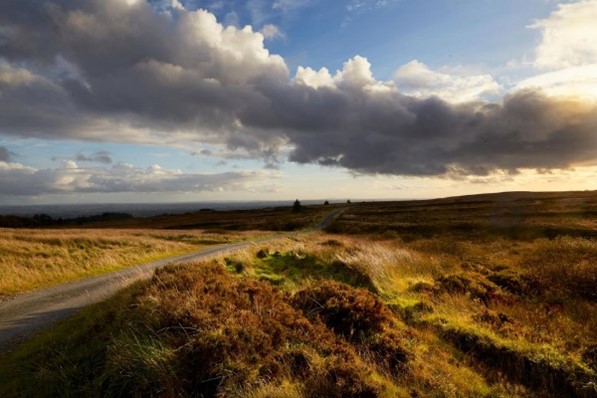
Wool
For a young girl who died c.1848
You fell weak from hunger in the bog,
on your way to the market in Clogher
to sell wool, accompanied by your Father,
out on Slieve Beagh during the Famine.
He went to get help for you,
but when he returned,
the soul was gone from your thin little body,
and with his fingers, he closed both your eyes.
Olann
Do chailín óg a fuair bás (c.1848)
Ar do bhealach chun an aonaigh i gClochar
chun olann a dhíol, a bhí tú, ag tionlacan d’athar
nuair a thit tú i laige le hocras sa phortach
amuigh ar Shliabh Bheatha aimsir an drochshaoil.
D’imigh d’athair le cabhair a fháil duit
ach nuair a d’fhill sé, bhí an t-anam imithe
as do cholainn bheag thanaí
is lena mhéara, dhún sé do dhá shúil.
.
Slieve Beagh*
Here where the strong wind blows
among the heather and whin on the bog,
in this beautiful place on Slieve Beagh Mountain
echoes the high-pitched call of the white-fronted Geese
West of us is Fermanagh and Cavan
To the north, the Sperrin Mountains of Tyrone
To the east, Armagh and Auchnacloy,
To the south, the black woods of Glaslough.
Before daybreak at Bruíon sí Bragan
While you were saying mass at the Rock,
You were shot in the head
As you turned to read the last Gospel
Through Eshcloghfin, early in the night
The soldiers came hunting you
And seeing the candlelight
Left you for dead
In your bloodstained garments
When you fell at dawn on Christmas day
At the foot of the rock in Bragan
During the penal times
The lonely call of the the white-fronted Geese echoes on and on.
*For Father Mc Kenna who was shot on Bragan Mountain during the Penal Times (Christmas Day 1754)
.
Sliabh Bheatha
Anseo san áit a shéideann an ghaoth go tréan,
i measc an fhraoigh is an aitinn ar an phortach
san áit álainn fhiáin seo, ar Shliabh Bheatha
a gcluintear beadaoil na ngéanna bánéadanacha
Siar uainn tá Fear Manach agus an Cabhán
Ó thuaidh, tá sléibhte na Speiríní i dTír Eoghain
San oirthear, tá Ard Mhacha agus Achadh na Cloiche,
soir ó dheas tá coillte dubha Ghlas Locha
roimh bhreacadh an lae, ag Bruíon-sí-Bragán
Bhí tú ag an charraig, an t-aifreann á rá agat
nuair a scaoileadh urchar trí do chloigeann
is tú ag casadh chun an soiscéal deireanach a léamh
Go luath san oíche, trí Ais Cloiche Finne
agus iad ag teacht sa tóir ort
b’é solas na gcoinnle a chonaic
na saighdiúirí, a d’fhág ann marbh thú
i d’éide fuilsmeartha ag bun na carriage
nuair a thit tú ag Leac an tSagairt
le gealadh an lae, Lá Nollag
aimsir na bPéindlíthe, ar Bhragán
rac rac a ghlaonn na géanna,
rac rac a ghlaonn na géanna bánéadanacha
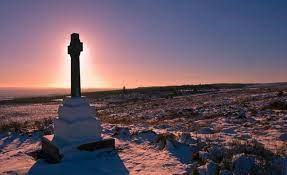
Don Sagart Mac Cionnaith ar scaoileadh urchair leis ar Bhrágán, aimsir na bPéindlíthe (Lá Nollag 1754)
Simon Ó Faoláin
Translated by Seán Lysaght
Fire
When lightning struck the dunes
it left red embers in the scorched grass.
A man approached and crouched
and blew on them until a fire took.
Fire saw him and was hafted to his side
and smothered him with love because it understood
that it was neither liquid, nor solid, nor air,
not particle, wave, or ray,
and he, that he was neither fish, nor fowl, nor whale,
not hobgoblin, demon, or god,
and they both knew that they were there
without issue or forebears.
Fire said, ‘Nurture me and I will nurture you.’
The man said, ‘It’s a deal.’
First published in The Stinging Fly
.
Adhaint
Bhí aibhleoga dearga san fhéar dóite
mar ar bhuail tintreach an machaire.
Tháinig an duine is chrom is
shéid orthu gur tháinig tine.
Chonaic sí é is chloígh lena thaobh
is ladhb é le grá mar gur thuig
sise (nach leacht, solad ná gás,
Nach cáithnín, tonn ná ga í),
eisean (nach iasc, éan ná míol,
nach púca, deamhan ná dia é),
Is go rabhadar araon
gan sliocht gan sinsear.
Ar sise “Beathaigh mise is beathód tusa”.
Ar seisean “Bíodh ina mhargadh”.
First published in Simon Ó Faoláin’s Iasachtaigh (Coiscéim 2022)
.
Translated by Simon Ó Faoláin
A Riddle
What is there in this world
that is heavier than a lead coffin
that is like a millstone
grinding your shoulder,
with your knees ready to give way
as you struggle up the hill
towards the graveyard?
There is this –
a boatman’s cap
being thrown
into his son’s grave.
What is there in this world
that is heavier than a lead coffin
but which challenges
both gravity
and masculinity,
rising up in your breast
years after the loss?
There is this –
sadness,
leaden loss.
.
Tomhas
Cad is ann dó ar an saol seo
atá níos troime ná cónra luaidhe
atá mar bhró ag meilt do ghualainne,
le do ghlúine ar tí cliseadh
fút, is tú ag strácáil i gcoinne fána
i dtreo na reilige?
Atá –
caipín bádóra
agus é á raideadh aige
isteach in uaigh a mhic.
Cad is ann dó ar an saol seo
atá níos troime ná cónra luaidhe,
ach a thugann dúshlán
na domhantarraingthe
agus na fearúlachta,
ag éirí aníos id’ chliabh
na blianta fada tar éis an bhriste?
Atá –
an brón,
an brón róthrom.
Ailbhe Ní Ghearbhuigh
Translated by Billy Ramsell
Electricity is in Everything
alles leben besteht
aus elektrizität – Jan Wagner
i
that bark over there
that soaking trunk
sends such currents
toward its own soft core
ii
even the pinkish lizard
creeping casually
into the bathroom
while you sojourn
in some simmering distance;
there’s flame to be gathered
from its gecko eyes
iii
the soviet beaches of Sunday
huge concrete impediments
a cliff of half-built houses
the seaweed’s live black wires
iv
on the day of seven elements
it oscillates through me
.
Tá aibhléis san uile ní
alles leben besteht
aus elektrizität – Jan Wagner
i
an stoc sin thall
an tamhan fliuch
seolann sé srutha
trína croí bog
ii
fiú an laghairt bhándearg
a théaltaíonn isteach
sa seomra folctha
is tú ar saoire
sna críocha teo;
tá faghairt le feiscint
ina shúil gheiceo
iii
trá shóivéadach an Domhnaigh
slabanna coincréite ina mbacainn
foirgneamh díthógtha ar an aill
sreanga dubha beo ina bhfeamainn
iv
lá na seacht síon
cuislíonn sí tríom.
.
There are gulls in your breathing
I won’t slumber tonight
with such a hoarse chorus
beneath your breast bone.
You’re in my bent arm
sheer as a sea-cliff
with me on the precipice.
I won’t give in to vertigo
nor to sinews’ exhaustion;
wobbling but steadfast.
The ocean is furious.
There are gulls in your breathing.
I taste each wave’s spray
First published in The Stinging Fly
.
Tá faoileáin ar d’anáil
Ní chodlód anocht
is an cór scarbhach
istigh i do chliabhrach.
Tá tú i mo bhaclainn
chomh díreach le faill
is mise ar a mullach.
Don meadhrán ní ghéillfead
ná do thraochadh na matán;
más guagach, is teann.
Tá an fharraige suaite.
Tá faoileáin ar d’anáil.
Blaisim cáitheadh na dtonn.
.
Cathal Ó Searcaigh
Translated by Paddy Bushe
Calling
(For Paddy Bushe)
Not for fame
nor for its trappings
do I spend my days with words
but to invigorate
the language of my tribe
with the energy of music.
Not for gods
nor for their creeds or muses
do I recite psalms of carnality,
but for love;
body and blood conjoined
in daily celebration.
Not for society
nor for the literati, the chatterers,
do I burden myself with poems
but for the community of the dead,
for those who never learned
the words for their suffering.
Not for overlordship
nor power nor rank
do I yearn for the precedence of poetry
but in order to fortify
the democracy of the word
and the rule of Light.
.
Gairm
(Do Paddy Bushe)
Chan i bhfách le cáil,
le hór ná le stór
atá mé ag saothrú na bhfocal
ach ar mhaithe le teangaidh
mo dhaoine a aclú
le fuadar an cheoil.
Chan i bhfách leis na déithe,
lena gCré ná le béithe
a chanaimse sailm na seirce,
ach ar mhaithe leis an ghrá;
feis na fola is na feola
a cheiliúradh gach lá.
Chan i bhfách le pobal,
le lucht léite, lucht pléite,
a chuirimse dua an dáin orm féin
ach ar mhaithe le slua na marbh,
iadsan nach bhfuair bua
lena gcrá a chuir i bhfocla.
Chan i bhfách le tiarnas,
le cumhacht ná le ceannas
a shantaímse urlámhas an dáin
ach le neart a thabhairt
do dhaonlathas an bhriathair
agus do reacht an tSolais.
.
Thinking of Ukraine in Machaire Rabhartaigh
(For Tatiana and Patrick Breslin)
(1)
Seaweed lies thrown
at the edge of the tide
and over Innis Bó Finne
floats a mackerel sky.
Before me, a smooth
lime-white strand.
In the dunes, a rampant
growth of marram grass.
A cormorant, its wings
spread regally wide,
stands admiring its reflection
in the blue-green tide.
Calmness, tranquillity,
over land, over water,
far, far from Ukraine’s
unremitting slaughter.
Endless killing, scorched earth!
The heart is breaking
for broken, bloodstained homes,
for death, for displacement.
(2)
From a desecrated grave in my heart
the skeletons arise;
scorched, stripped of flesh
and tendon, soldiers
Who died in war, in plague
and carnage in Bucha,
in Mariupol, in Zaparizhia
and in the hellfire of Bakhmut.
They trust their death
was not in vain; the hard struggle
to lift up their country
from oppression, from suffering.
But at this fateful moment
I have only inadequate words
to give voice to their sacrifice,
the youths who were destroyed
by ripping bullets, by rending bombs
on battlefields in Ukraine.
Under the earth of my poem
I will lay their remains.
(3)
There were those, they had their time,
those who celebrated
the Soviet revolution, celebrated Lenin,
celebrated Russia’s glorious destiny.
Had they got their way,
the Red Flag would have flown
over Europe’s capitals.
They yearned for the Soviet gospel,
the herd over the individual and the groupthink of the state,
to be set in stone far and wide.
That evil propaganda and the lie
that would make a bondage of our lives.
There were those, they had their time,
those who had faith
in Lenin as the world’s redeemer
and that Stalin’s long reign
was a paradise for the masses.
And although Jan Palach immolated himself
in Prague, imploring the world
with the fearful cry of his death
not to surrender to Soviet rule,
they never wavered in their loyalty.
To that twisted propaganda, to the lie
that would mean slavery for life.
(4)
It seems forever since I took
pleasure in writing a poem.
Hostilities and conflict
have corroded all my hopes.
Desolate, despairing,
I walk through high tide,
scrambling for a poem
in what it leaves behind.
The dark time is on us
that has been foretold.
The empty shore, as daylight
diminishes, is cold, cold.
.
Ag cuimhníu ar an Úcráin i Machaire Rabhartaigh
(Do Tatiana agus Patrick Breslin)
(1)
Tchím bodógaí mara
i mbéal na toinne
is spéir an mhurlais
os cionn Innis Bó Finne.
Os mo choinne, tráigh
mhíngheal shoilseach:
Sna dumhaigh, tá uabhair
fáis sa mhuiríneach.
Tá an treathlach mhór
ina shuí go rí-dheas
ag móradh a Íomhá féin
sa tsáile gormghlas.
Síocháin agus suaimhneas
fa mhuir is fa thír,
chan ionann is an Úcráin
mar a bhfuil ár go síor.
Ár agus slad oíche is lá!
Crá croí domh a gcás,
an doirteadh fola, a mbailte
á ndíothú is a mbás.
(2)
As uaigh réabtha i mo chroí
éiríonn na cnámharlaigh;
Iad scallta, feannta ó fhéith
is ó fheoil, saighdiúrí
A bhásaigh san ár, sa phláigh,
sa deargadh fola i mBucha,
i Mariapol, i Zaparizhzhia
agus i gcraos Ifrinn Baghmut.
Iad ag súil nach gníomh in aisce
a bhí ina mbás; an cath tréan
a throid siad ar son fuascailt a dtíre
ón leatrom agus ón léan.
Faraoir, ar an uair chinniúnach seo,
níl agam ach focla gan bhrí
le teangaidh a thabhairt dá n-iobairt,
na stócaigh seo a cuireadh ó chrích
i réabadh piléar, i roiseadh pleascán
ar ármhá catha sa Úcráin.
Caidé a thig liom a dhéanamh ach á dtaisí
á adhlacadh i bfód mo dháin?
(3)
Tráth den tsaol, bhí siad ann,
Iadsan a bhíodh ag maíomh
as réabhlóid na Sóivéide, as Lenin,
as cinniúnt ghlórmhar na Rúise.
Dá mba á dtoil é, is cinnte
go n-ardóidh an Bratach Dearg
ar cheann-cheathrúna na hEorpa.
B’fhada leo go mbeadh soiscéal na Sóivéide:
an tréad seachas an duine is slua-dhearcadh an Stáit,
a bhuanú go fada agus go leitheadach.
An bholscaireacht bhithiúnta sin is an bhréag
a d’fhágfadh muid i ngeimhlí go h-éag.
Tráth den tsaol, bhí siad ann,
iadsan a chreid go diagánta
gur slánú an tsaoil a bhí i Lenin
is gur Parthas na coitiantachta
a bhí i dtiarnas fada Stalin.
Is cé gur loisc Jan Palach é féin ina bheatha
i bPrague ag achainí ar an tsaol
le scréad ghéibhinneach a bháis
gan géilleadh do réimeas na Sóivéide,
níor loic ar a n-iontaoibh siúd.
Sa bholscaireacht bhithiúnta sin agus sa bhréag
a d’fhagfadh muid i ngeimhlí go h-éag.
(4)
Is fada ó chum mé
aon dán le haiteas.
Tá aighneas is achrann
ag cur smál ar mo dhóchas.
Idir an lag agus an lom
siúlaim amach sa tsruth.
Tá mé ar thoír mo dháin
sa raic agus sa bhruth.
Tá ré dhorcha chugainn
mar a bhíothas á thuar.
Ar an traígh fholamh is an lá
ag dul ó sholas, tá sé fuar, fuar.
Gabriel Rosenstock
Translated by Gabriel Rosenstock
From the unpublished collection Meditation on Known Mysteries / Machnamh ar Rúndiamhra Léire (Selected Tanka Poems in Response to Paintings)
Link to Károly Ferenczy’s Birdsong (1893):
https://artvee.com/dl/birdsong#00
the full-throated birds
what is it they are singing
let their notes trickle
filling spaces in my heart
of Your making, Belovèd
éin lánghlóracha
cad atá acu á rá
lig dá gceol sileadh
is spás a líonadh im’ chroí
bearnaí do neamhláithreachta
Link to Katsushika Hokusai’s A bird perched on a tree branch with blossoms, watching a spider on a web (1830-1850):
https://artvee.com/dl/a-bird-perched-on-a-tree-branch-with-blossoms-watching-a-spider-on-a-web#00
You too have seen them
birds that alight on a branch
and fly off again
will my words stay in Your heart
or have they long since vanished?
táid feicthe agat
éanlaith ag tuirlingt ar ghéag
is as go brách leo
an bhfanfaidh mo bhriathra leat
nó ’bhfuilid imithe fadó?
Link to Carl Holsøe’s Interieur med en cello (1935):
https://artvee.com/dl/interieur-med-en-cello#00
all i know is this
the cello has fallen still
and all is quiet:
the music of what is not
ah, what strange music that is
ní heol dom ach seo
tá an dordveidhil ina tost
tá gach aon ní ciúin
ceol úd nithe nach dtarlaíonn
is ait an ceol é go deimhin
Link to Claude Monet’s Weeping Willow, Giverny (1920 – 1922):
https://www.wikiart.org/en/claude-monet/weeping-willow-giverny-1922-1
a willow weeping
i do not know how to weep
where are all my tears?
willow, teach me a lesson
what is it to be alive?
an tsaileach shilte
ní shilimse deoir ar bith
cá bhfuil na deora?
a shaileach, múin ceacht domsa
cad is brí leis an saol seo?
Link to Egon Schiele’s A Tree in Late Autumn (1911):
https://www.wikiart.org/en/egon-schiele/a-tree-in-late-autumn-1911
it’s in everyone
this lone tree of late autumn
in the laughing child
in the silent sage as well
and in a remembered kiss
tá sé i ngach neach
an crann seo amach san fhómhar
i ngáire an pháiste
agus i dtost an tsaoi leis
is cuimhne mhilis ar phóg
Link to Ary Scheffer’s Portrait de Calvin (1858):
https://artvee.com/dl/portrait-de-calvin
if Calvin saw You
he would give up religion
and dance in the streets
he would learn the violin
and play all night on rooftops
dá bhfeicfeadh sé thú
d’éireodh Calvin as ar fad
rincfeadh sé gach lá
d’fhoghlaimeodh sé an veidhlín
is sheinnfeadh ar na díonta é
© Colm Breathnach, Eibhlis Carcione, Máirtín Coilféir, Philip Cummings, Celia de Fréine, Áine Durkin, Caitríona Lane, Proinsias Mac a’Bhaird, DS Maolalaí, Caitríona Ní Chléirchín, Aibhe Ní Ghearbhuigh, Simon Ó Faoláin, Cathal Ó Searcaigh, Gabriel Rosenstock, Paddy Bushe, Sean Lysaght, Thomas McCarthy, Seosamh Ó Maolalaí, and Billy Ramsell
BIOS
GUEST EDITOR
Brendan Corcoran is an Associate Professor of English at Indiana State University, where he works on twentieth-century and contemporary Irish and British poetry, the intersection of literature and climate change, and the elegy. He has published widely on the poetry of Seamus Heaney, Derek Mahon, Michael Longley, Ciaran Carson, and John Keats. His poems have appeared in War, Literature, and the Arts, Open-Eyed, Full-Throated: An Anthology of American/Irish Poets, Cimarron Review, and Nimrod International Journal among other venues. Currently he is completing a book manuscript on Seamus Heaney’s elegiac practices and editing a special “Nature in Crisis” issue of Plane Tree.
POETS
Colm Breathnach is a poet and novelist. He has published nine collections of poetry and a novel. He has won the principal poetry prize at the annual Oireachtas Literary Competitions four times. The Irish American Cultural Institute presented him with the ‘Butler Prize’ in 1999. He has been awarded residencies in Ireland, China and Slovenia. Poems of his have been translated into eight languages. A poetry collection, Breacadh an Lae, and a selected volume with English translations are forthcoming.
Eibhlís Carcione is a bilingual poet and children’s author from Cork, Ireland. Her three poetry collections in Irish, Tonn Chlíodhna (2015), Eala Oíche (2019), and Bean Róin (2023), are published by Coiscéim. She has won numerous awards for her poetry. She was awarded an Arts Council literature bursary in 2021. Her debut middle grade novel Welcome to Dead Town Raven McKay was published in 2023 by Everything With Words.
Máirtín Coilféir is a lecturer in Irish Studies in Concordia University, Montréal. His poems have been published in literary journals such as Comhar, Poetry Ireland Review, Gorse and Stinging Fly, as well as the bilingual anthology Calling Cards (Gallery Press, 2019), with translations by Paul Muldoon.
Born in 1964 in Belfast, Philip Cummings was released early after thirty years for good behaviour and now lives somewhere in the Antrim countryside. He was the Arts Editor for the Irish-language daily newspaper Lá Nua when such a thing existed, and has published a collection of his humorous articles from that time as Dar Liom. His three individual poetry collections have won various prizes. A fourth collection will appear soon.
Celia de Fréine writes in many genres in Irish and English. Awards for her poetry include Gradam Litríochta Chló Iar-Chonnacht, the Patrick Kavanagh Award and the British Comparative Literature AssociationTranslation Award. Her new and selected poems Aoi ag Bord na Teanga was published by LeabhairCOMHAR IN 2022.
Originally from Connemara, Áine Durkin is an award-winning author of poetry and song. She reports, reveals and reminisces on her Irish language blog, Mise Áine ag Rámhaille. She also participates online as @MiseÁine. She has contributed articles to various Irish language radio stations, magazines, newspapers and collections. She loves family, fun and fairness. And cats. In fact, she loves all animals. So much so, she doesn’t eat any. Ever. She has been living in Donegal for over forty years, with the ‘love of my life.’ He does eat animals. He doesn’t really speak much Gaeilge. She forgives him.
Caitríona Lane was born in Dublin by the Irish sea. She now lives by the Atlantic where the wild wind refreshes her mind. She holds a post graduate qualification in translation from the Atlantic Technological University. A former Irish language teacher, Caitríona draws inspiration from both languages. Her poetry was shortlisted for the Eavan Boland Emerging Poet Award 2023. She is a 2022 Éigse Éireann / Poetry Ireland Introductions / Céadlínte Awardee. Her poetry has appeared in Poetry Ireland Review, Comhar, Aneas, Feasta, HOWL, I mBun Pinn, The Storms, and elsewhere. You can find her on Instagram caitrionalane_file. She is working towards a debut collection.
Proinsias Mac a’ Bhaird is a poet and novelist from Arranmore Island in Co Donegal. He has published four collections of poetry and four novels in addition to several children’s books. He has been awarded many literary prizes including the Irish Language Book of the Year award at the Irish Book Awards in 2019 for his novel Tairngreacht. His fifth novel, based on the life of Saint Columba, will be published in 2023.
Caitríona Ní Chléirchín is an award-winning poet, lecturer, academic and critic in Dublin City University. The author of a Ph.D. on contemporary poetry in Irish, she has published widely as a critic and co-edited the volume of Léachtaí Cholm Chille devoted to the Innti poets. She has published four collections of poetry in Irish. The judges of the 2015 Michael Hartnett Award for Poetry praised her work as ‘powerful, courageous, sassy and important.”
Ailbhe Ní Ghearbhuigh writes exclusively in the Irish language. A lecturer in Modern Irish at Univeristy College Cork, her most recent poetry collection is Tonn Teaspaigh agus Dánta Eile (2022). The Coast Road (Gallery Press, 2016) was awarded the O’Shaughnessy Prize. A co-edited collection of essays, Inside Innti: A New Wave in Irish Poetry, was published in 2023 by Cork University Press.
Simon Ó Faoláin was born in Dublin and raised in Corca Dhuibhne. He has published four collections of poetry in Irish to date, the most recent being Iasachtaigh (Coiscéim 2022), as well as two books of literary translation. Amongst the awards his work has received are The Glen Dimplex Prize, Strong Prize, Walter Macken Prize, Colmcille Prize, and the Foras na Gaeilge Prize. He is the director of An Fhéile Bheag Filíochta (the Little Poetry Festival), an annual bilingual poetry festival taking place in West Kerry, and editor of the Irish-language literary journal Aneas.
DS Maolalaí has been described by one editor as “a cosmopolitan poet” and another as “prolific, bordering on incontinent.” His work has been nominated eleven times for Best of the Net, eight for the Pushcart Prize, once for the Forward Prize, and has been released in three collections; Love is Breaking Plates in the Garden (Encircle Press, 2016), Sad Havoc Among the Birds (Turas Press, 2019) and Noble Rot (Turas Press, 2022).
Cathal Ó Searcaigh was born and grew up on a hill farm in Caiseal na gCorr, Gort an Choirce, an Irish-speaking glen and Gaeltacht community in the northwest of County Donegal. The author of 20 volumes of poetry, three plays, and four works of prose, he is a leading figure in the remarkable renaissance of Irish-language writing in our time. He is a member of Aosdána and continues to live on the home ground of his parents.
Gabriel Rosenstock is a bilingual poet, tankaist, haikuist, novelist, playwright, essayist, children’s author, short story writer, translator and in the words of Hugh MacDiarmid, “a champion of forlorn causes.” His multicultural blog: https://roghaghabriel.blogspot.com/
TRANSLATORS
In addition to the nine poets who are also translators of their works, here are:
Paddy Bushe is a poet, editor, and translator. In 2020, Dedalus Press published Double Vision, a two-volume publication comprising Second Sight, a selection of his Irish language poems accompanied by his own translations, as well as Peripheral Vision, his latest collection in English. The Amergin Step, a long prose work which is a personal exploration of the landscape of the Iveragh peninsula and of the literature entwined with that landscape, is forthcoming. He is a member of Aosdána.
Seán Lysaght was born in Cork in 1957 and brought up in Limerick city. He was educated at Crescent College and University College Dublin. Following several years living abroad, in Switzerland and Germany, he returned to Ireland in 1990 and taught for many years as a lecturer in Heritage Studies at the Galway Mayo Institute of Technology. He lives in Westport, Co Mayo with his wife Jessica. He is the author of several volumes of poems, including Scarecrow (1998), The Mouth of a River (2007), Carnival Masks (2014), and New Leaf (2022) from The Gallery Press.
Seosamh Ó Maolalaí is a retired public servant and trade unionist, a fluent speaker and part-time teacher of the Irish language. He is a storyteller and an aspiring Seanchaí (a teller of traditional Irish epic folktales). He has told stories in schools, libraries and arts centers across the island of Ireland. This is his second published work of translation.
Thomas McCarthy was born in Cappoquin, County Waterford. He has published ten collections of poetry including The Sorrow Garden (1981), The Last Geraldine Officer (2009), Pandemonium (2016) and Prophecy (2019) as well as two novels and two books of non-fiction. Awards include The Patrick Kavanagh Award, The Alice Hunt Bartlett Prize, The Lawrence O’Shaughnessy Award for Poetry, and the Annual Literary Award of the Ireland Funds. A member of Aosdána, he lives in Cork City.
Billy Ramsell’s most recent collection is The Architect’s Dream of Winter (Dedalus Press).
 The Loch Raven Review