
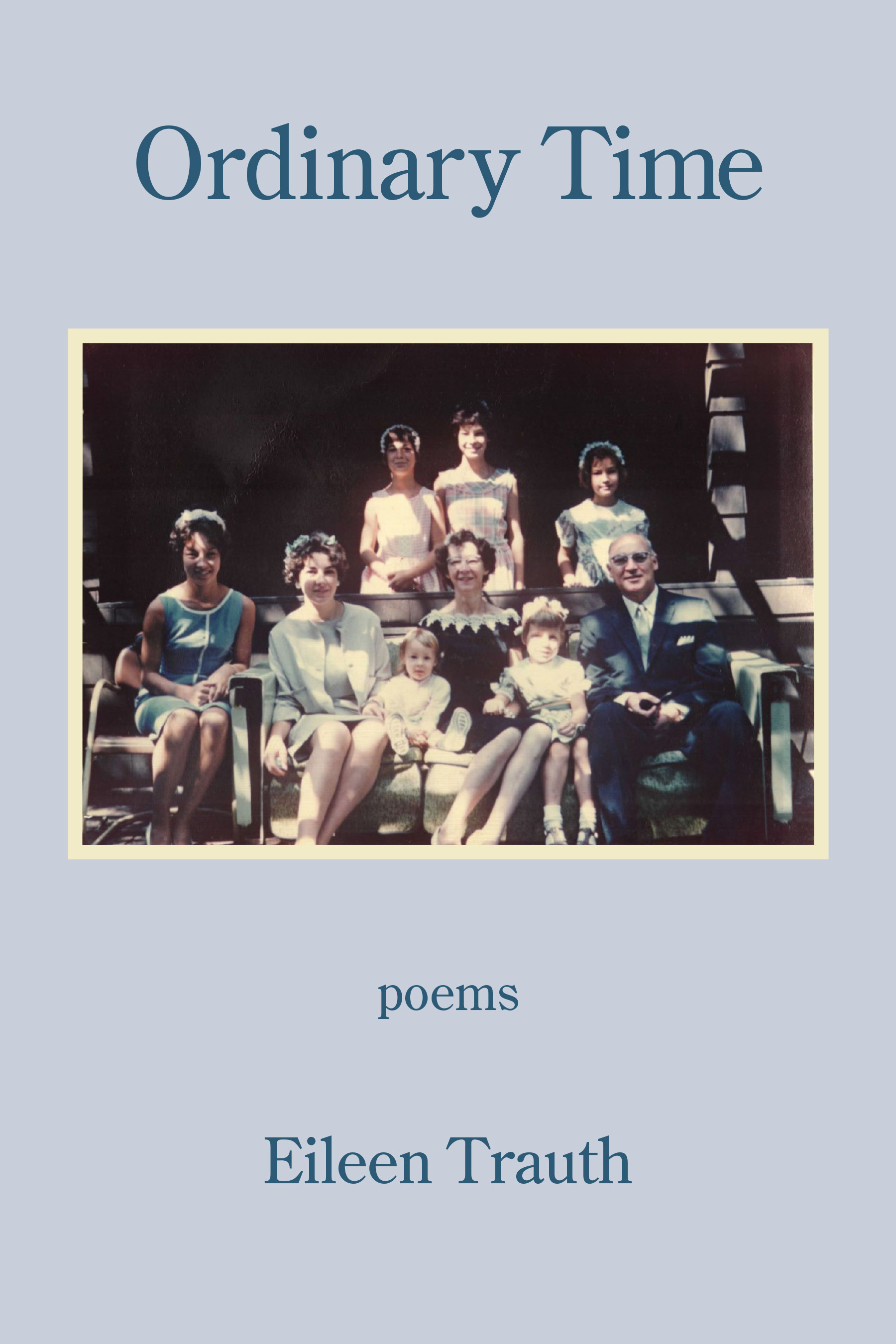
Eileen Trauth, Ordinary Time. American Fork. UT: Kelsay Books, 2023
In her powerful debut collection of poetry, Eileen Trauth has written a poignant chronicle of her mother’s decline and death. The book is dedicated to her mother, Martha Donelan Trauth, who finally passed away on New Year’s Day 2020 at the dawning of a year that would see the world devastated by a COVID pandemic.
Brought up in a religious Irish-German Catholic family, Ms. Trauth freely admits that her poetry is infused with images of “religion, food, and family.” In the Foreword, she explains that the title derives from Ordinary Time, the period in the Roman Catholic liturgical calendar that begins the day after Epiphany and ends the day before Ash Wednesday. It was during this very period that her mother’s health deteriorated and Eileen and her five sisters feared death to be imminent. Their fears proved premature: Martha survived Ordinary Time and lived on.
The book stands as a wonderful tribute to a woman who was a nurturer and caregiver but who, as with so many of our seniors, needed care from the very loved ones on whom she had lavished attention years before. This fact is captured by the poet in one of the most effective poems in the book, “Circles,” the final lines of which read:
We learned from you: with scissors poised
and heads lined up, you did your Easter vigil,
trimmed bangs and rolled flips that never fit
those Sunday bonnets. Our world now reversed:
you gave us life; we give you curls.
The collection is divided into three sections. Section 2 addresses the family’s Irish roots in the poem, “Unearthed.” quoted here in full:
My mother’s father’s mother’s father:
the youngest son, left his father’s famine field
and other brothers, to carry on and excavate
the Sligo stones they carried to construct
the stoic church the year he left his roots behind
to till Kentucky soil, make shoes, marry someone
with his surname, no relation, they assured the priest
who did not understand how far away could be the day’s
walk to the bogland home that expelled her.
My mother’s father’s father:
with his mother left their Galway home,
youngest sister in his arms, and father
in the ground, to join the trickle that became
a torrent, and never speak of what was left.
Spoke Irish; could not read nor write,
the Census said. Made a living and a family;
lost three children before their time.
Made sure the rest could read.
My father’s father’s father:
mystery man, who never said the Irish place
he left behind, never left the space
on the Mississippi delta where he landed,
and made a secret son
who went upriver, passed
through my town and left a son.
Emancipated and immigrant, hidden
in the pages of the past.
Not only is this a fine capture of the story of an immigrant family, the stalwart members, and even one not so creditable man (!), it displays clever use of language as the poet drills into us the phrase “My mother’s father’s mother’s father” and similar in the first line of each stanza.
The duties of the mother are chronicled in great detail as she labors to care for seven daughters (one would die prematurely in 1998), as here in “Making Doughnuts” the first two stanzas of which read:
Mother punched the sticky mass
into her mother’s crockery bowl
and let it rise into thin towels
that Duz provided free to those
who bought a box of soap.
When we got home from school
we saw her coax the gooey heap
onto the amber-lacquered kitchen table—
flour-dusted end to end—
and spread it for us smooth and thin.
Similarly, how the poet and her siblings experience everyday life in the house is nicely described here in “Shell” as the following two stanzas capture the world as seen by the poet’s mother:
Our lopsided driveway
became a sledding slope for the Red Flyer
on days the school busses conceded
to the slippery hills; we needed tire chains
to reach the German bakery near the church
where we braved the snow for morning mass.
Our carport-gazebo came alive,
once every summer, with the stereo sounds
of big bands and the smell of wet earth
from its hosing by my daughters
before they donned matching middy blouses
and settled down with glasses of Pepsi
to welcome my club members.
The heartbreaking third and final section of the book describes the mother’s final decline and death.
The thoughts of the poet, her mother’s caregiver, are chronicled in four fine sonnets, Departures I–IV. “Departure I” turns as she’s surprised at how her mom’s final moments actually turn out. Here is the sonnet in full:
I thought I knew the way you’d leave. I read
the pamphlet, learned from watching others wane:
the shallow breaths, a last exhale, it said
before the end would come and you were gone.
I could caress your fingers one last time
say final parting words enough to hold
the feel of fleeting warmth, your hand in mine
as you slipped away, and it grew cold.
But that was not the way you chose to go.
With cheerful chatter as the new year dawned
you hid behind a happiness tableau
and measured out your last few breaths in song.
You would not let me wallow in farewell;
you left quickly, before my heart rebelled.
In “Departure 2,” toward the end:
You departed before the others left
me all alone to watch your stricken face
relaxing into peaceful sleep, bereft
of fighting life. . . .
. . . and in the final four lines of “Departure 4”:
This decade of every day made me long
to stay with you forever. But I know
you gave me all you had. I am at peace
today. I always knew the way I’d leave.
© Eileen Trauth and Christopher T. George
Eileen Trauth is a poet, playwright, and author. As a college professor, she published several nonfiction books. Her poetry appears in The Boston Poet, Braided Way, Common Threads, Loch Raven Review, The Orchards Poetry Journal, PoetryXHunger, Sheila-Na-Gig, and in anthologies including Conversations, For A Better World, InsideOut, and Within Us. Eileen is a member of the Greater Cincinnati Writers League and the Ohio Poetry Association. She lives with her wife, Kathy, in Cincinnati, Ohio. www.eileentrauth.com.
Christopher T. George was born in 1948 in Liverpool, England, and came to the United States in 1955. He is now a resident of Newark, Delaware. Chris’s poetry has been published worldwide, including in Poet Lore, the American Poetry Journal, Anti-Heroin Chic, Loch Raven Review, Gargoyle, and The Times of London. He is a board member of the Eastern Shore Writers Association (ESWA) and is a former President of the Maryland State Poetry Society. Chris has a poetry site at http://chrisgeorge.netpublish.net/
 The Loch Raven Review