Eight Welsh-Language Poets: Menna Elfyn, David Greenslade, Jo Heyde, Mererid Hopwood, Mike Jenkins, Nia Morais, Rufus Mufasa, and clare e. potter
Translated by: Menna Elfyn, David Greenslade, Jo Heyde, Mererid Hopwood, Mike Jenkins, Nigel Jenkins, Nia Morais, Rufus Mufasa, clare e. potter, Robert Walton, and Meleri Wyn Davies
INTRODUCTION
Wales is a country with an immensely rich bardic tradition that dates back to the 7th century, to poets such as Aneirin and Taliesin. Poetry has always had a fundamental place in Welsh society, with the bards under the patronage of rulers and noblemen. And their role of writing poetry to eulogize leading figures and commemorate events was an important societal and political function. To this day, Welsh poets write works with a societal role, poems that “cyfarch” (greet), that “coffáu” (commemorate), “dathlu” (celebrate), “croesawu” (welcome)—often as commissions, but also as a natural creative response to people and events.
The Welsh language itself is beautifully complex both in its syntax and its system of “treigladau” (mutations of consonants). It has great musicality and a unique sound world, with the “mutations” allowing for “a change of key,” and subtle patterning. And it is these qualities that gave rise to the unique and wonderful poetic “language,” namely the “cynghanedd” (harmony or concordance). The roots of this intricate system and its sound patterns can be traced back to those aforementioned 7th century poets. And as described so meticulously in Alan Llwyd’s “Hanes y Gynghanedd” (History of the Cynghanedd, Barddas), the complete form of this poetic language was to be seen by the 14th century, and has survived and, indeed, flourished to this day.
Poetry weaves its way through the “cymdeithas” (society) from early on, with children in schools taking part in local “eisteddfods” (from the word “to sit”). These are events/festivals where competitions are held in literature, music and art. Reciting and composing poetry is an important part of every eisteddfod. The annual week-long National Eisteddfod takes place at the beginning of August, in a different region every time, and is a veritable “gwledd” (feast) of culture, with the main poetry competition awarding “Y Gadair” (The Chair—literally a hand carved chair) for a 250- line poem in the “cynghanedd.” And “Y Goron” (The Crown) is awarded for a 250-line Pryddest (a long free poem).
There was a special significance to this year’s event, as it celebrated 850 years since the first recorded Eisteddfod in 1176, in Aberteifi, Ceredigion, as well as being nestled near the green of the Preseli hills, where the poet Waldo Williams grew up.
The significance of the National Eisteddfod, cannot be under-estimated in its relevance to the Welsh language, culture and identity. As the Chaired Bard, Aneirin Karadog, states, “The Welsh cultural phenomenon of the “eisteddfod” commands a sacred place at the heart of what it means to wear one’s “cymreictod” (meaning Welshness seen through the identity of the language) on one’s sleeve. However, the notion of “Cymreictod” (Welshness) is also a complex matter in the context of the language and its history. The repression of the Welsh language, and the dominance of English, has had a ripple effect across many generations.
The eight poets featured here all have their own unique experience of “Cymreictod” and of their relationship to the Welsh language. This inevitably impacts their experience of translating poems from or into Welsh, and it informs the creative process.
As an internationally renowned poet, who has recently published her volume, Carco, as a celebration of 50 years of poetry since her first volume, Mwyara, Menna Elfyn’s work has been translated into over twenty languages. The majority of Menna’s work is written in Welsh, but as a former Head of Creative Writing in the English Department of the University of Wales, Trinity Saint David, her mastery of English at a creative level is undeniable, and she has also published bilingual volumes. She has worked with numerous translators, Gillian Clarke, Nigel Jenkins, Robert Minhinnick, Joseph P Clancy, Tony Conran, as well as her close friend, Elin ap Hywel. These collaborations represented a “sanctuary” and “a way forward.” Menna’s education as a child was in English, and today, she feels that the two languages “speak to each other” naturally. Menna points to many significant influences on the world stage, Lorca, Neruda, Whitman, to name but a few, but the three important Welsh figures are Dylan Thomas, Edward Thomas, and R.S.Thomas, Menna’s friend in his last decades. “Dynamic Guns” is a powerful phrophetic poem which reaches to the core of current world issues. “Poem loitering in the rain” is a beautiful contrast with its awakening of senses and the timeless nature of love counterposed with the moment of the happening upon a letter.
David Greenslade is a poet who has “returned to his language,” with the Welsh roots deeply embedded in his identity. The nature of his creating in Welsh is inevitably different to that of his work in English, more of a collaborative journey with others along the way. David perceives “versions” of his poems as opposed to “translations”—two things very closely related to each other, and yet different. Rather than being tied to a literal representation of the original, he feels the freedom to newly create with words, idioms, “harmony” and expression. This is reflected in his principle of working alongside living writers as an integral part of the work process, in order to allow the mutual co-creativity to flourish. He refers to translating as “exo-skeleton writing” rather than “endo-skeleton writing.” He has translated works from Japanese, Czech and Romanian. “Objects Return in Triumph” was written in Welsh first, in 1995, for an event in Valencia, Spain and was translated into Catalan for a bilingual chapbook. The English version was written around the same time for the later, collection Each Broken Object (Two Rivers Press, 2000). Objects are chosen more for their music than their function, so the list of objects is different between each version. “Commuter Butterflies” was also written in Welsh first, for the collection Y Gwiblu Brith (Llanelli Eisteddfod 2000), with the music of the language transforming rather than translating the nicknames. “The Doctor of Myddfai” was written as a vehicle for the artist William Brown and launch of the book March at the Bro Ogwr Eisteddfod (1998). The poet believes it to be a faithful translation. There is now also a Romanian version which is faithful to the original.
Jo Heyde has no family connection to Wales but started learning Welsh at the end of 2018 after falling in love with the sound of the language on a trip to Pembrokeshire. It was the musicality and complexity of “y Gymraeg” that struck a chord, and, in 2021, having learned the Cynghanedd and started reading Welsh poetry, she began writing both in the Cynghanedd, and in free verse. Discovering two new languages, as well as turning to poetry for the first time, led to the realization that her creative “mindset” had finally found its natural home. She has not shifted to writing in her mother tongue, as her words and images shape themselves naturally in Welsh–her “poetry language.” The poems featured here are the first time she has translated her work into English, and the experience of accessing her original language through her more instinctive acquired language, was a new and interesting experience. The poem “Four Metres” derives from the unnerving feeling that possesses her of imagining jumping off the edge of the harbour drop in Tenby. “Folding Sheets” is a memory of helping her mother, but it is also a reference to the submissive female role that was expected in the household. “Maternal Instinct” is also a memory–one of half wanting a doll, again, an allusion to the expected wishes of a young girl, and then the subsequent disillusionment.
For Mererid Hopwood, Welsh has always been the language of home. She was brought up in a Welsh-speaking household in Cardiff, the capital city, in a time when there was only one Welsh-medium primary school and no Welsh-medium secondary schools. This is in contrast to today, where the city provides Welsh-medium education in some fifteen primary schools and three comprehensive schools. Having studied Modern Languages, she has enjoyed reading the works of French, German and Spanish poets directly in their original forms. She writes almost exclusively in Welsh and often in Cynghanedd. However, one of the poems included in this anthology, “When the Shadow Dies,” was originally composed in English and it too is influenced by the principles of Cynghanedd.
“When The Shadow Dies” reflects Mererid’s thoughts at the 50-year commemoration of the Aberfan tragedy, with the words being set to a duo in the Cantata Memoria, Er Mwyn y Plant, by Karl Jenkins. “E=mc2” reflects the attempt to turn the negative into the positive, with the concept of energy transforming rather than disappearing. It is a poem which grew from a project in the hospice Tŷ Geraint, Aberystwyth, and from listening to patients’, carers’ and doctors’ voices. The date in “System Change 2.3.22” (a commissioned poem for S4C) signifies the start of the current fighting in Ukraine. It is a poem that condemns every war. All the horrors of war are perceived here by their effects one or two at a time, bringing everything gradually closer to the heart.
Mike Jenkins has reclaimed the language of his fore-fathers, and feels as a learner, that he has not necessarily mastered the grammar. This presents some challenges when occasionally writing in Welsh. Mike writes the majority of his poems in English. However, even in English, he finds inspiration in Welsh words and idioms, especially those relating to nature. Rather than “translating” his poems here, he “converts” them, with the freedom to adapt where required, in order to preserve the “spirit of the poems” without being confined. As he writes in “Vers Libre,” he feels unconstrained by the needs of the Cynghanedd. He feels that the Welsh language is flourishing on the streets, much as the grass is growing on the old coal tips. “Jamie’s Journey” was inspired by the poet’s friend, Jamie Bevan, and his jouney through Europe to raise money for the Cylch Meithrin (Welsh language playgroup) in Merthyr. The “Bees’ Nest” portrays a nest in his house by the bedroom. Geraint Jarman, the “king” of Welsh music, in Mike’s words, is the inspiration for the poem, ‘The Present.”
Nia Morais grew up in non-Welsh speaking family but attended a Welsh language school. As with much of her writing, her poems “Gwawr” and “One time I dreamt” were written in English, and she translated them to Welsh for her volume, Yn y Freuddwyd. Dreaming repeatedly over many years about the end of the world was the spark to writing “One time I dreamt,” and it sits in a place of particular relevence in the midst of the current global crises. “Gwawr” is rooted in Nia’s early morning stirring during the Covid lockdown and her use of surreal imagery evokes her feeling of surrendering to optimism. She prefers to adhere to an informal style which reflects her “voice” and she engages with the translating as a process of “wandering” through the poems line by line.
Rufus Mufasa sees writing and translating as a process where they enable the poem to transform in the space between Welsh and English, each language carrying variations in rhythm, memory and place. They have a particular interest in the relationship between language, authority and power. Who is it that gets to speak, understand, and which language gets translated. At times, the translating feels like a “bridge,” but it can also feel like an “opposition” sparking discussion. While writing in Welsh, it is the musical and rhythmic elements that often emerge first. And in the act of translation, Rufus goes to pains to avoid sacrificing the “body of the poem” on the altar of a neat literal translation. The process itself generates the question of what is impossible to translate. These poems were written in Welsh first, with the English version of “Chanting in the Mother Tongue” having been created for this review. The two other poems evolved in the two languages almost at the same time, with sound, word-play, context and feeling being crucial elements in the poems’ language journeys. In “Highlights & Freedom” she retains “rhydd-id” in the English version due to its rhythmic qualities that supercede the need for a neat translation.
clare e. potter is relatively new to writing in Welsh. Her previous experience of translating with Ifor Ap Glyn served as an “apprenticeship” to thinking creatively in Welsh, deciphering meaning from the “inside-out.” Over time, poems would start to “arrive” in Welsh, and this sparked contradictory responses in clare e. potter–excitement, and also a painful reminder of the wound of not having been brought up in the “language of her land,” and the politics that accompany that grief. The opportunity to be Bardd y Mis (Poet of the Month, Radio Cymru) was a turning point that imbued the creative process with a renewed sense of connecting with feelings, observations, rhythm and words. Her pamphlet, Nôl Iaith, is an important “fetching language” and her reclaiming of what should be first-language Welshness. “Heart Song” was written in English first and was inspired by finding potato urchins on the beach and imagining them drying out to form an instrument with tones of the poet’s own language. The to-and-fro collaborative translation process led to the Welsh bringing a focus on sound, both in the heart/instrument element and the rhythms. “Mineral Wealth” refers to the poet’s hometown, a mining village where their coal was extracted exported to the rest of the world. The poet states, “I was happy in the woods, lying on this huge boulder that was a presence to me in the way the Welsh language was not. But I thought about mining, and land and movement, how I didn’t need language to be in some sort of relationship with this ice age stone that would have made its mark on the land, the tongue of the land. That I wasn’t outside of communication, that I didn’t falter in grammar. That I was at one with it, in the most elemental way.” “Giving Way” was written in Welsh as part of a 3-year residency with the Landmark Trust during the renovation of a medieval hall house in Cwmyoy, where Owain Glyndwr fought. A culturally important place of “wounds and wonder.”
Jo Heyde
.
It was such a pleasure to work on this Welsh-language feature and to share everyone’s enthusiasm. Special thanks to Menna Elfyn for introducing me to clare e. potter, who recruited such great poets to the cause, and to Jo Heyde for writing the insightful Introduction.
Danuta E. Kosk-Kosicka
Poetry Translations Editor
.
Menna Elfyn
Translated by Nigel Jenkins
Poem Loitering in the Rain
‘I know I won’t be seeing you tonight, being Sunday and all. I’m counting the minutes until Monday. I can’t wait to try and fill your heart with love as you fill mine. (Love letter found in a puddle in Philadelphia.)
Love in a drizzle,
picksome love,
Phili finds me in flight
from its sting, then I step
in a puddle almost upon
this shard of an iceberg,
its soggy eyelids closed
till I open and drain them,
finding there a poem in wait,
a heart pocking up the beat,
love orphaned out and away
by some door maybe not utterly
closed.
He styled in cold black words
desires incarnadine,
carved out small letters
then tossed them to the wind.
Why make simply to unmake?
No one can know another’s pain,
but a poet attending the heart’s pool
may fathom the depth of it,
and turn for her go-between,
if need be warning
that the will is not done
in the stale waters of fugitive fate,
messenger of love any time or place,
mill and castle and hideaway;
how anonymous the marker of time,
ever, in the ancient heart, made new.
How timeless the message of love
in the restless April showers,
as true as a man who’s lost somewhere
his heart picking, like rain distilling.
.
Canfod Cerdd yn Loetran yn y Glaw
(darganfod llythyr caru mewn pwll o ddŵr yn Philadelphia’)
Glaw mân o gariad
serch sigledig sy yn Phili,
a minnau’n ffaelu
dianc o’i brath wrth gamu
i bwll o ddŵr, a thalch
fel darn o iâ llonydd
ei lygaid ar gau nes im
sychu’r llith yn llwyr,
a chanfod cerdd yn aros ei chyfle:
calon yn curo’n drwm,
eto amddifad yw serch ymhell
a’i gil- ddrws heb ei gau yn llwyr.
Saernїodd oerni ei eiriau
am gariad noethlwm;
cerfio llythrennau bach
cyn eu harllwys i’r gwynt.
Pam creu er mwyn dileu?
Pwy all ddeall gwewyr arall?
Ond gall bardd fod wrth ymyl
pwll y galon yn nawsio’i ddibyn
gan droi ymysg yr anwadal
os oedd angen rhybudd,
am ewyllys anhreuliedig
yn llif y merddwr—
tynged un ar ffo
cennad cariad oedd yno’n dyheu
awr mewn melin, gastell neu guddfan twt;
mor anhysbys o hyd yw naddwr amser
yn y galon, hi hen ond newydd sbon.
Ac mor ddiamser yw neges serch
ymysg cawodydd aflonydd Ebrill,
mor driw â’r sawl a gollodd yn y dirgel
gariad a thra bo’r glaw yn arllwys
y galon yn dal i bigo, pigo.
.
Menna Elfyn
Translated by Menna Elfyn
Dynamic Guns
(found poem by a gun supporter, on CNN October 2018)
‘We need guns,’ he said
‘to defend the state
in case big corporations
implement left-wing policies,
or, in case the government
gets out of control—
just think,’ he said,
‘a tyrant could run the country
and that’s when we’d need
a militia to remove him.’
‘If you are afraid
of handling guns
I suggest you go to the countryside,
to practice shooting.’
That night I dreamt of the steel sky
heard the echo of my four-year-old
grandson asking why the sky is dark
and where does it go at night?
The trees of the forest swallowing lead,
every deer, and wild turkey,
racoon and sparrowhawk
a target for gun beginners,
fleeing for their lives before the sudden
thud in the mud of winter.
‘But three hundred million guns’?
the interviewer asks, aslant?
Oh, yes, he replies, there will always be
a need for those intelligent guns.
.
Cerdd y Gwn
(ar CNN Hydref 2018 gan hyrwyddwr cwmni drylliau)
‘Mae angen drylliau arnom’, meddai
i amddiffyn y wladwriaeth rhag ofn
i gorfforaethau mawrion
weithredu polisiau asgell chwith;
‘neu’, meddai wedyn, ‘rhag ofn
i’r llywodraeth golli pob rheolaeth.
Meddyliwch shwd beth’, meddai,
‘gallai unben redeg y wlad
a dyna pryd y bydde eisie ‘militia,
a byddin i’w ddymchwel’.
Yna, dywedodd, ‘os ych chi’n ofnus
o drafod drylliau awgrymaf eich bod
yn mynd mas i’r wlad i ymarfer saethu.’
Y noson honno, breuddwydiais
am yr awyr yn llawn plwm,
clywed fy ŵyr yn ei bedair blwydd
yn gofyn ‘i ble aeth yr awyr’ ?
Y goedwig oll wedi llyncu dur,
pob carw a thwrci gwyllt
pob racŵn a gwalch glas
yn darged i ddechreuwyr,
yn sgathru am eu bywydau
cyn y sgwd yn y mwd o aeaf.
‘Ond tair mil o filiynau o ddrylliau
gofynnodd yr holwraig, ar slent’?
‘O ie, meddai, fe fydd wastad
ac o hyd yr angen am ddrylliau deallus.’
.
.
David Greenslade
Translated by David Greenslade
Objects Return in Triumph from their Exile
Objects return in triumph from their exile
their enormous bulk compressed between
the forks of my paw and blade of my thumb.
They nestle in a bowl of lifelines
and I feel their ultimate weight.
Each one assaults my body
taking root, branching out
shattering my story like an injection
through amniotic waters,
until every one of them
finds refuge in my memory.
.
Fe Ddychwel Pethe’n Diasbedain O’u Halltud
Fe ddychwel pethe’n diasbedain o’u halltud
eu maint anhygoel cywasgedig rhwng
ffyrc y bawen a llafn y bawd.
Nythant yn nysgl y cledrau
a theimlaf terfynau eu pwys.
Ceisant dyllau ynof,
llefydd i wreiddio.
llefydd i fod,
ac yn hollti hanes, fel pigiad
trwy ddyfroedd prilifig y groth.
nes bod pawb ohynynt wedi maglu
porthladd yn fy nghof.
.
Commuter Butterflies
Here are a few commuter butterflies,
legions of the road of every type—
road-trip ranger,
addled brain,
main street blockhead,
griever crash,
weaver-lane,
pilgrim shortcut,burned-out worker,
adventure flasher,
conceited prayerback,
aggressive big tongue,
stuffed belly,
dainty lady.
These are just a few
of the highway’s lepidoptera,
plenty of saints, and quite a few devils.
.
Glöynnod y Draffordd
Dyma rai
o löynnod y daith,
lleng yr heol o sawl rhywogaeth;
fflamysgwydd y gilffordd,
galarus y ddamwain,
gwib-ddart y saethlon,
syth-ddart y siwrnai,
blinddart pendilio,
chwit-chwat yr helynt,
ymffrostfalch chwimlachar,
cyfrwys y gamffordd,
trwyndrwm cornfyddar y gwyll,
trwyndrwm cornllefain y gwyllt,
bolorlawn y gwyliau,
y perffaith pob braint,
dyma rai’n unig o löynnod yr heol—
ambell sant ac ambell gythraul.
.
The Physicians of Myddfai*
One as three-fold triple / and not a shade of difference / between them / except for the way /
She turned her ankle / on the beach/
Three oxen walking / from the lake behind her / guardians raising / their horns from the water / pouring enchantment /
She delivered three doctors / each one with knowledge of the herbs of Myddfai / and the virtues of Dinefwr’s soil /
Until this magic wife / neglected the orange / pony of her husband – and he / with a silk glove /
chided her lightly on the arm / three times / as though iron / mashed her ashes / ready for the funeral urn / the essence of ritual in this mortal man’s / inevitable failure
Three maidens came / but she alone bore Doctors / before returning to the waters.
*This poem tells the story of the Lake-Lady of Llyn y Fan Fach and of the Doctors of Myddfai in mid-Wales.
The poems is translated in a horizontal style as it doesn’t really work in English with line breaks.
.
Meddygon Myddfai
Un yn driphlyg – tair
heb gysgod o whahaniaeth
rhyngddynt – ond am y ffordd
y gwnaeth hithau droi ei sawdl
ar y traeth.
A thri ych yn cerdded
o’r llyn y tu ôl iddi,
gwarchodwyr a gododd
gyrn o’r dyfroedd
ac arllwys hud.
Esgor ar dri meddyg
a wnaeth – a phob un
yn dwyn cyfarwyddyd
llysiau Myddfai –
rhinwedd Dinefwr.
Nes i’r wraig
esgeuluso merlyn
aur y gŵr, ac yntau
â’i faneg sidan
yn cyffwrdd â hi deirgwaith
ar ei braich,
fel tasai haearn
wedi ei malu’n lludw
ar gyfer galwad yr wrn.
Anian defod ym methiant
ei ddyletswydd ef.
Tair morwyn a ddaeth,
ond hi yn unig a aeth,
yn Fam ar Feddyginiaeth,
yn ôl at ddŵr y chwedlau.
.
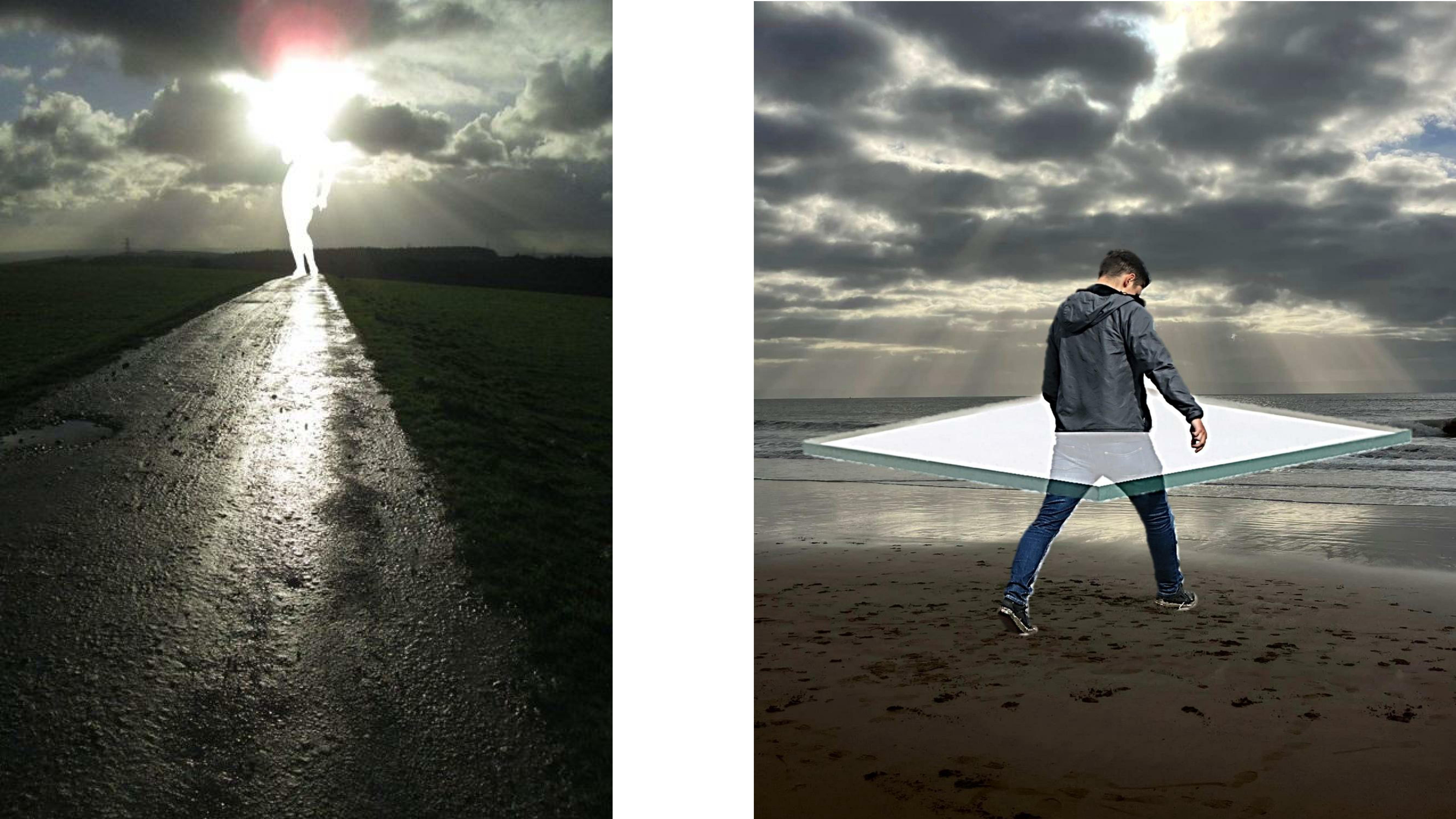
Left: Uwchben Cefn Cribbwr. | Above Cefn Cribbwr.
Right: Cerdded Trwy Wydr. | Walking Through Glass.
.
.
Jo Heyde
Translated by Jo Heyde
Four Metres
I’ll not walk
the edge of the quay,
today…
harbour’s low ebb—
breath-sucked,
paper tongues
licking dregs,
and lobster limbs
a motley rim
to wall shadow;
I’ll not walk
where the void
summons gloom;
sugar-brown-trickery
softness of sand
calling me
to take a chance…
.
Pedwar Medr
Ni cherddaf
ar erchwyn y cei,
heddiw,
a’r trai wedi
sugno’r anadl
o’r harbwr,
dim ond brithwaith sydd…
tafodau papur
yn llyfu’r gwaddodion,
a chymalau cimychod
yn hap-siapio ymyl amryliw
am gysgod y wal;
ni cherddaf
lle bo’r gwagle’n
gwysio tywyllwch;
tywod twyllodrus
o siwgr-brown-feddal,
a’r gwaelod yn galw arnaf
i fynd amdani…
.
Maternal Instinct
I yearned for one
without knowing why,
one with a crocheted bonnet
and jacket to match;
she came,
with her plastic rejection
of cradling arms,
and her oh-so-pink lips,
and mascara-blinked stare
such proof of my scant capacity
to care
for her,
I saw then
that real babies
never come in boxes.
.
Greddf Y Fam
Roeddwn yn dymuno
cael un,
heb wybod pam,
un gyda bonet
wedi’i chrosio,
a siaced i fatsio,
a phan ddaeth,
a’i phlastig
yn gwrthod siapio
i grud fy mreichiau,
a’i gwefus yn rhy binc,
a’i syllu syllu
mascara-smicio’n
brawf nad oedd modd
imi ei chysuro,
deallais nad yw babis
go iawn
byth yn dod
mewn bocs.
.
Folding Sheets
A ritual
on the landing,
space for two to stretch out arms
and pinch starched corners
white-cotton-tight—
two paces forward
two back again,
a hushed pavane,
palms smoothing creases
and square kept angles.
.
Plygu Cynfasau
defod
ar y landin,
digon o le
i ddwy ymestyn breichiau
a dal y corneli startsh
yn wyn-gotwm-dynn—
dau gam ymlaen,
dau’n ôl,
taw pavane,
a chledrau dwylo’n
llyfnhau rhychau
i gadw popeth
mor sgwâr
a phosibl.
.
.
Mererid Hopwood
Translated by Mererid Hopwood
When the Shadow Dies
How should we weep when the shadow dies,
fading, slipping till the sun lies
asleep?
Should we now leave,
for the stars shed no light?
Or shall we mourn by the shallow moon
that has no dawn,
no day, say,
shall we stay?
And still,
shall we grieve by the shallow grave
of a flown-away life like a fallen leaf?
And if so, how?
And when winter blows,
might we rest by the empty tree?
Shall we try?
Should I?
Nobody knows.
But if to be alive is to belong
then we must
keep
still
this song.
.
Yn Nydd Marw Cysgod
A pha fodd yr wylwn yn nydd marw cysgod,
dydd ei bylu tan i’r haul fynd
i gysgu?
A ddylem ni adael,
oherwydd nid yw’r sêr yn bwrw golau?
Neu beth am i ni alaru dan leuad fas,
na ŵyr am wawr
na dydd na dim ond nos;
dwed, beth am aros?
Neu beth am ddal ati
mor llonydd â llwch,
wrth fedd fas
un bywyd a fu, ac a drodd,
fel deilen las, yn friwsion brau?
Ac os felly, ym mha fodd?
A phan chwytho’r gaeaf,
beth am i ni orffwys wrth goeden wag?
Beth am i ni drïo?
Ddylwn i?
Does neb a ŵyr.
Ond os byw yw perthyn
yna mae rhaid
dal
gafael
yn y gân hon.
.
E=mc2
And if there’s a closing, there’s an opening,
and if there’s far, there’s near,
and if there’s a cell, there’s a large hall,
and if there’s night, there’s dawn and its call,
and if there’s despair, there’s hope,
and if there’s afraid, there’s brave,
and if there’s a scar, there are stiches that save,
and if there’s a journey’s end,
there’s also a beginning,
just as there’s a wanting to see
if there’s a want of seeing.
.
E=mc2
Ac os oes cau, mae agor,
ac os oes pell, mae agos,
ac os oes cell, mae neuadd fawr,
ac os oes nos, mae toriad gwawr,
ac os oes anobaith, mae gobaith,
ac os oes ofn, mae dewrder,
ac os oes craith, mae dwylo tyner,
ac os oes diwedd taith,
mae hefyd ei dechrau,
fel y mae eisiau gweld
os oes gweld eisiau.
.
System Change 2.3.22
Mightier than asking
who, how, why,
is to hold in your heart
one father, one mother;
mightier than questioning
why cell, why fortress,
is to hold in your heart
one brother, one sister;
than asking who shattered
the clear, clean sky
mightier is to hold in your heart
one small child;
mightier than pretending
that the worry’s far
is to hold in your heart
the better knowing:
the knowing than war
than bomb than gun
mightier peace, mightier love
a flower, sun,
than battlefield,
mightier a table and chair
a coming together
talking here;
mightier than the lie
is the truth that will stay,
mightier than the night
is the dawning day;
mightier than despairing
that it’s beyond your range
is the knowing in your heart:
the system must change.
.
Newid Y Drefn 2.3.22
Trech na’r cwestiynau
pwy, sut, pam,
yw dal yn dy galon
un tad, un fam;
trech na’r holi
am werth cell a chaer,
yw dal yn dy galon
un brawd, un chwaer;
na gofyn pwy chwalodd
yr awyr iach,
trech dal yn dy galon
un plentyn bach;
a threch na thwyllo
bod y gofid ymhell,
yw dal yn dy galon
y gwybod gwell:
gwybod, na rhyfel
na bom, na gwn,
trech heddwch, trech cariad,
a’r heddiw hwn
na maes y gad,
trech cadair a bwrdd,
trech dod at ein gilydd,
siarad, cwrdd;
trech na chelwydd
yw’r gwir di-ffael,
trech na’r tywyllwch
yw blodyn yr haul;
a threch nag anobaith
troi dy gefn,
yw gwybod dy galon:
rhaid newid y drefn.
.
.
Mike Jenkins
Translated by Mike Jenkins
Jamie’s Journey
Is he on a walk or ramble,
Is he on an adventure or pilgrimage
From the Gurnos to Istanbul?
Our square mile on his back
And proud town on his shoulders
Through England and almost to the coast.
His beard is growing
Like weeds in a field.
Is there a yellow poppy on his way
Or legends in the lake ?
Is the continent ready yet?
Is that bear waiting
In the dense forest
To try something tasty
From Cymru which talks
Our ‘foreigner’s’ language in other countries?
Is he a messenger, like a small bird,
Singing the blues of the streets
Through the valleys, across the mountains?
Note — the poem describes my friend and fellow Merthyr person Jamie Bevan, who walked from our hometown to Istanbul (some 3000 miles) to raise money for a Welsh language nursery.
.
Taith Jamie
Ydy e ar wâc neu am dro,
Ydy e ar antur neu bererindod
O’r stad Gurnos i Istanbwl?
Ein milltir sgwâr ar ei gefn
Ac ein bro ar ei ysgwyddau
Trwy Loegr a bron at y môr.
Mae ei farf yn tyfu
Fel chwyn mewn cae.
Oes pabi melyn ar ei ffordd
Neu chwedlau yn y llyn?
Ydy’r cyfandir yn barod?
Ydy’r arth yn aros
Yng nghefndir y goedwig
I fwyta rhywbeth blasus
O Gymru sy’n siarad iaith
Y ‘foreigner’ yng ngweledydd eraill?
Ydy e’n negesydd fel aderyn bach
Sy’n canu blŵs y strydoedd
Trwy’r cymoedd, dros y mynyddoedd?
.
Bees’ Nest
These our friends,
these our neighbours,
bees in our dormer.
So silent through winter
dreaming of colours
in the coldest weather.
But with the summer
these insects swarm
like starlings over the pier.
Taste of honey in the air,
each flower opens and waits
for the visitors.
Through the days
the sound in our bedroom
like waves in the distance.
A boat full of bodies
sailing with their wings,
travelling through our dreams.
.
Cwch Gwenyn
Ein cymdogion ni,
ein cyfeillion ni
yw’r gwenyn yn fy nhŷ.
Dawel iawn drwy’r gaeaf,
yn breuddwydio o liwiau
yn y tywydd oerach.
Ond yn yr hâf
y mae’r pryfed yn heidio
fel drudwy dros y pier.
Blas o fêl yn yr awyr
a phob blodyn yn agor ac yn aros
am yr ymwelwyr.
Dros y dyddiau
y mae sŵn ein hystafell
fel tonnau yn y pellter.
Mae’r cwch llawn cyrff
sy’n hwylio gyda’u hadenydd
ac yn teithio trwy ein cwsg.
.
The Present
‘Here we are in early morning, dawn chorus singing’ – Geraint Jarman
One moment in the sun
When the woods are singing—
When we turn away
When the birds’ choir
Performs without audience
When the varying songs
Fill our bodies and the air—
When we leave the town’s noise
To walk slowly down the trail—
Place where the old canal’s water
Remains silent and still
And the faces of Quay Row
Smile clearly in the morning—
When we feel the Present
Like a Zen Master following
The seasonal flight of a swallow.
.
Y Presennol
‘Dyma ni yn y bore bach, côr wawr yn canu’ – Geraint Jarman (‘Diwrnod y Brenin’)
Un foment yn yr haul
Pan fydd y coed yn canu—
Pan ryn ni’n troi i ffwrdd,
Pan fydd côr adar
Yn perfformio heb gynulleidfa
Ac mae’r caneuon amrywiol
Yn llenwi cyrff ac awyr—
Pan ryn ni’n gadael sŵn y dre
A cherdded yn araf ar hyd llwybr—
Lle mae dŵr yr hen gamlas
Yn dal i sefyll yn ddistaw
Ac wynebau Quay Row
Yn gwenu’n glir yn y bore—
Pan ryn ni’n teimlo’r Presennol
Fel meistr Zen yn dilyn
Hedfan tymorol y wennol.
.
.
Nia Morais
Translated by Nia Morais
Early Morning
As I sleep on my belly
dew in the dip of my spine
a swarm of flies spy an open door
they come down the hall
turn the corner
spot my soft open mouth
pour down my throat like syrup
they bounce off the walls of my stomach
stretching me filling me up
I rise like a hospital balloon
I drift round the corner
down the hall
over the balcony railing
when the world wakes they look up
see me twitching twisting
near the top of a waning streetlight
they stop their cars pause
on their doorsteps
shaking their heads stroking their chins
Asking what now where
can she go from here
I do not hear I am performing
my gentle sky ballet
I can feel the morning air a wet living haze
I am the bit of sky
that turns peach as a bridesmaid’s dress
my belly buzzing and buoyant
anticipating sunlight.
.
Gwawr
Wrth gysgu ar fy mol
y gwlith yn bedyddio fy nghefn
mae haid o bryfed yn gweld drws agored
maen nhw’n dod i lawr y coridor
yn troi’r gornel
ac yn gweld fy ngheg feddal wag
ac yn llithro lawr fy llwnc fel surop
maen nhw’n bownsio ar waliau fy stumog
yn fy llenwi a’m chwyddo fi
rwy’n codi fel balŵn mewn ysbyty
ac yn drifftio rownd y gornel
i lawr y coridor
dros reilin y balconi
pan ddeffra’r byd, welan nhw fi
yn troelli yn dychlamu
ger golau gwelw lamp y stryd
maen nhw’n arafu’u ceir ac yn stopio
ar y stepen ddrws
yn siglo’u pennau mwytho’u genau
yn gofyn be nawr ble’r
aiff hi o fan’na
ond dydw i ddim yn eu clywed.
Rwy’n perfformio
dawns ballet addfwynol y gwawr
a theimlaf aer y bore fel niwl glwyb byw o’m cwmpas
fi yw’r darn o awyr
sy’n troi’n binc fel ffrog morwyn briodas
fy mola’n hymian, hynawf
fi sy’n rhagweld
yr haul.
.
One Time I Dreamt
That I was running home from church as heads fell from the sky.
The clouds were angry and dark like villainous meringues
and sweet cool rain kissed my face as I ran.
My mother rang, panic in her voice, to ask
What should I do? I have the camping stove,
the non-perishables, the winter clothing-
oh, my baby, I have locked the door against you.
Shall I outlive my own daughter? What should I do?
And the phone was hard and hot in my hands
and the voice inside my head said good.
Do what you want in your last hours.
It is time to unworship yourself.
Why must everything be so hard?
I passed a woman resplendent in furs, crying, her little dog happy
unexpectedly out, sniffing puddles, as the world fell.
The voice said unworship yourself.
What are you afraid of?
Don’t waste energy keeping the cupboard shut.
Open the door and watch it struggle in the light.
The voice said if your life was a cross-stitch what would it look like?
Not to God, but to you.
Where do the stitches falter?
My shoes slipped off as I ran,
dodging bikes and planter boxes,
letting other people look up if they wanted.
Stop fighting yourself.
At last, I stopped at a riverbank
and watched the heads fall like blossoms.
I am unsure if I ever made it home.
.
Un Tro Breuddwydiais
am frysio adref o’r eglwys wrth i bennau gwympo o’r awyr,
y cymylau’n dywyll fel meringues crac
a glaw oer yn cusanu fy ngwyneb wrth redeg.
Ges i alwad gan Mam, ei llais yn llawn panig wrth ofyn,
Beth ddylwn i wneud? Mae gen i’r stof wersylla,
bwyd mewn tuniau, dillad cynnes –
’merch i, roedd rhaid imi gloi’r drws â tithau ar yr ochr arall.
A fydda i’n goroesi epoc fy mhlentyn? Beth ddylwn i wneud?
Roedd y ffôn yn boeth yn fy nwylo
ac fe ddywedodd llais yn fy mhen, gwna be fynni di yn dy
oriau olaf.
Mae’r amser wedi dod. Dad-addola dy hunan.
A oes angen i fywyd fod mor anodd?
Es i heibio hen fenyw mewn ffwr, ei dagrau fel gemau, a’i chi
bach
yn hapus yn llyfu pyllau wrth i’r byd gwympo.
Meddai’r llais, dad-addola dy hunan.
Beth wyt ti’n ei ofni?
Paid â chau’r cwpwrdd.
Agora’r drws. Gwylia’r ofn yn gwingo yn y golau.
Sibrydodd y llais, sut mae brodwaith dy fywyd yn edrych?
Nid i Dduw, ond i ti.
Ble mae’r pwythau’n methu?
Llithrodd fy esgidiau o’m traed, rhedais,
neidiais dros feiciau a gwelyau blodau,
pawb arall yn y stryd wedi rhewi mewn syfrdan.
Paid ag ymladd â ti dy hunan.
Yn y diwedd stopiais ger yr afon
a gwylio’r pennau’n cwympo fel blagur.
Sa i’n siŵr a wnes i gyrraedd adref.
.
.
Rufus Mufasa
Translated by Rufus Mufasa
Highlights & Freedom
Wild pony with 90s vibes
Looking like a billboard for Sun-In
Your roots in Bondi & Nimbin.
Saturated by sun-kisses
That give you that J. Lo glow
Hoofing the ground with your Bronx.
Your Viking Irish streaks
Cross-fertilized with Kurt Cobain’s
Smells Like Teen Spirit.
Where did you sleep last night?
Under the stars with God as my witness,
heart singing to the beat of
rhydd-id-rhydd-id-rhydd-id[1]
.
Rhydd-id
Merlyn gwyllt gyda naws y nawdegau
fel hysbysfwrdd ar gyfer Sun-In
a teulu o Bondi a Nimbin.
Dirlawn gan dywalltiad o gusanau haul
yn rhoi i chi eich glow J.Lo
i carnau’r ddaear gyda’ch Bronx.
Eich rhediadau Gwyddelig Llychlynnaidd
croes wrteithio gyda Kurt Cobain
Smells like Teen Spirit.
Ble wnest ti gysgu neithiwr?
[2]Dan y sêr gyda Duw yn dyst,
calon yn canu mewn curiad
rhydd-id-rhydd-id-rhydd-id
.
Dragonfly
full of all-knowing
[3]tinkering in the twinkle of the sun
lullabies innate and native
carries the cries of the mam’s wounded grief
a bridge between realms, if you can master the pause
there’s enough spiritual bypassing happening
and the’ll sell you an expensive kit
but all you need is surrender and presence
sit up close to this moment
see and hear through your deep-down antenna
be with self and discover peace
[3]tinkering in the twinkle of the sun
.
Gwas y Neidr
llawn dealltwriaeth
yn tincian ym mhelydr yr haul
yn [4]canu caneuon cynhenid
yn cario cri mamau galarus
pont rhwng tiroedd os ti’n gallu meistroli arafu
mae yna ddigonedd o osgoi ysbrydol yn digwydd
mae yna anwiredd bod angen cit drud
does ond angen ildio i’r presennol
dod yn agos at y foment
gweld a chlywed gydag antena a greddf
eistedd gyda dy hun a dod o hyd heddwch
.
Chanting in the Mother Tongue
Trauma response — stay silent while they dismantle you — every song your heart ever sang — pawn every war medal — trauma response — build yourself back up without cheating —
Without cheating — call on karma — nights of vintage whisky — time travel — vacuum of the void — you’ll dance with your demons to the soundtrack of Mary J. Blige’s No More Drama —
No More Drama — double denim — war paint — massive earrings — constant creativity — artful avoidance — micro macro — holistic heartbreak — the same mistakes won’t make outcomes any different —
Different — I play chess with a council of wise witches — they chant in the mother tongue — an ancient chant that sounds like the waves — waves singing from home —
Home — I can’t return without my coat — the coat you stole — your uncertainty is trying to lull my light — transform me into an owl before allowing me the freedom to choose —
Freedom to choose — boundaries — limits — consent — safety — build belief —
Trauma response — burn their rulebooks in a sacred ceremony — sing-in the forwardness — reparations and back-pay — reclaim your place — soon and without apology — imagine —
our daughters deserve peace.
.
Llafarganu yn y Famiaith
Ymateb trawma — aros yn ddistaw pan fyddant yn eich datgymalu — pob cân a ganodd eich calon — aeth â phob medal rhyfel i’r dyn gwystlo — ymateb trawma — adeiladu’ch hun yn ôl i fyny heb dwyllo —
Heb dwyllo — ymddiried yn y karma — bydd nosweithiau o wisgi vintage — teithio amser — gwactod gofod — byddwch chi’n dawnsio gyda’ch cythreuliaid i’r trac sain Mary J Blige No More Drama —
No More Drama — denim dwbl — paent rhyfel — clustdlysau masif — creadigrwydd cyson
— osgoi artistig — micro macro — torcalon cyfannol — nid yw’r un camgymeriadau yn gwneud y canlyniadau’n wahanol —
Wahanol — rwy’n chwarae gwyddbwyll gyda chyngor o wrachod doeth — maent yn llafarganu yn y famiaith — siant hynafol sy’n swnio fel y tonnau — tonnau sy’n canu o adref —
Adref — ni allaf ddychwelyd heb fy nghot — fy nghot gwnaethoch ei dwyn — mae eich ansicrwydd yn ceisio difetha fy nisgleirio — trowch fi yn dylluan cyn caniatáu rhyddid i mi ddewis —
Rhyddid i mi ddewis — ffiniau — terfynau — cydsyniad — diogelwch — codi credwch —
Ymateb trawma — llosgi eu llyfrau rheolau mewn seremoni gysegredig — cenwch yn y blaendrwch[5] — iawndal ôl-daliad — adenill eu lle yn fuan dim druan — dychmygwch —
mae ein merched yn haeddu heddwch.
[1] Rhyddid is the Welsh language word for freedom. Repeated/looped it creates the sound of a galloping horse.
[2] The letters in bold can be beatboxed/turned into a soundscape, emulating a horse.
[3] The individual letters in bold create a beat/soundscape/incantation
[4] The individual letters in bold create a beat/soundscape/incantation
[5] Blaendrwch is a coined word, drawing on blaen (forward/front) to suggest forwardness or progressive thought and action.
.
.
clare e. potter
Translated by Robert Walton
Mineral Wealth
After ‘Go Inside a Stone,’ Charles Simic
Giant boulder, are you still there
in the woodland behind our old house,
the place I retreated to instead of making a den of sticks.
Do you remember me, boulder, the ethereal little girl
who came leaping across the stream to clamber all over you?
And when I stretched out along the top,
my spine across yours, did memories of the ice
that brought you here
return to unite us again?
Do you recall the grooves you carved in the tongue of the land,
metaphors you promised to leave behind,
the rhythms of the melting ice?
No need
for grammatical constructions between us:
we shared the same galactic language,
the tremor of our consonants and vowels,
both of us, debris of the stars.
.
Cyfoeth Mwynol
Ar ôl ‘Go Inside a Stone,’ Charles Simic
Ar ôl ‘Go Inside a Stone,’ Charles Simic
Glogfaen, wyt ti dal yna
yn y goedwig tu ôl i’n hen dŷ
lle gorffwysais yn lle adeiladu cuddfan o ffyn?
A chlogfaen, wyt ti’n fy nghofio i? Y ferch fach arallfydol
oedd yn neidio dros y nant i ddringo drosot ti
wastad, i orwedd ar draws dy dalcen,
gefn wrth gefn, yr atgofion o iâ
a ddaeth â thi yma er mwyn i ni gyfuno eto?
A pha rychau a grёaist ar dafod y tir,
pa drosiadau a adewaist ar dy ôl, a pha
rythmau yn y tawdd?
Rhyngom ni,
doedd dim angen cystrawennau gramadegol;
fe rannon ni iaith alaethol,
dyrgryniad oedd ein cytseiniaid a’n llafariaid:
malurion sér oedd y ddau ohonom.
.
Giving Way
Here, no words fill the air,
just the birds’ heartsongs,
the stream keening, and the dog over there,
barking orders at the sheep.
The music of nature is magic to the ear:
the voice’s attempt to make rhythmic sound—
hopeless; language can’t capture
the magnificence of this vast green landscape.
Giving way is the only option,
letting all the senses go.
In the slowfulness,
at last, a soul breathing.
.
Ymollwng
Nid geiriau sy’n llenwi’r lle hwn,
dim ond cân calon yr adar,
galarnad y nant, y ci gyferbyn
yn cyhoeddi gorchmynion wrth y defaid:
cerddorfa natur, hudolus i’r glust;
di-ffrwyth yw iaith, anobeithiol
yw’r llais sy’n ceisio llafarganu’r sain,
amhosib esbonio godidowgrwydd y gwyrddni;
ymollwng: yr unig opsiwn
i ganiatáu rhyddhad i’r synhwyrau.
Yn yr arafu, o’r diwedd,
enaid yn anadlu.
.
.
clare e. potter
Translated by clare e. potter
with editorial suggestions from Meleri Wyn Davies
Heart Song
untether from vessel and valve, lift from bone-cage,
leave your heart on a beach to calcify, pulse laid down like grooves
of a vinyl record, air to the chambers, a music of the sea’s tide,
harmony and melody, the depths
not here Aum but
Cymric Cynghanedd, Celtic flute: your own organ
played not by dictate or rote but by shared vibration,
moon call. Oh look now, in to sound—this heart’s a planet, too,
once held in the astrology of your ribs, star charts
you couldn’t quite read. But soon,
when that wind from wave, when that breeze
from far away finds its mouth
on the ventricles of what once kept you alive, listen
to the song, to the song of the world soul
that you sometimes feel in your chest, and like now,
a heart urchin’s test on your palm; heart-shaped, sea psalm.
.
Can y Galon
datglymu’r rhydwelïau a chapilarïau, codi o ogof esgyrn
rhoi’r galon ar draeth i sychu, y curiad yn ei dal yn y rhychau
fel rhigolau record finyl, awyr i’r siambrau, cerddoriaeth llanw’r tonnau
awen ac alaw o ddyfnder
nid sŵn Aum
ond offeryn cysegredig y Gynghanedd: organ Cymreig
wedi’i chwarae nid trwy orchymyn
neu ailadrodd ond trwy ddirgryniad cyfarwydd,
galwad y lleuad. Edrych nawr, i’r sêr y sain—mae’r galon hon
yn blaned hefyd a ddaliwyd unwaith yn dy asennau a’u hastroleg,
siartiau seren rhy ddiarth i ti eto’u darllen. Ond cyn hir
pan ddaw’r gwynt hwnnw o’r don, a phan ddaw’r awel
o bellafion i ganfod ceg
ar fentriglau’r hyn a fu’n dy gadw yn fyw, gwranda
ar y gân, ar gân enaid y byd
yr un sy’n curo yn dy galon. Fel nawr, yng nghledr dy law
cragen, siâp calon, cân salm y môr.
© Menna Elfyn, David Greenslade, Jo Heyde, Mererid Hopwood, Mike Jenkins, Nigel Jenkins, Nia Morais, Rufus Mufasa, clare e. potter, Robert Walton, and Meleri Wyn Davies
BIOS
Poets
Menna Elfyn is an award-winning poet and playwright who writes in Welsh, whose work has been translated into over twenty languages. She has published seventeen books, the latest is a selected Carco, Barddas, 2026 which celebrates 50 years of publishing in Welsh and Welsh/ English dual texts. She has also written children’s novels, libretti for UK and US composers as well as plays for stage, television and radio.
David Greenslade publishes in Welsh and English and shares his time between Wales and Romania where he translates and organizes art exhibitions and performances between the two countries. Now retired he has had many jobs including lighthouse keeper, restaurant Maître d’ and Creative Writing tutor at Cardiff University (Wales). In 2026 Incunabula Media published his digital collages with the title A Renegade Frame. He has been anthologized by Faber and Faber, Parthian, Angel Exhaust; published by Shearsman, Avallon, Two Rivers, Aquifer and others. Recent collections include Full Pareidolia (Contraband, Netherlands) and City of Opal Altars (Musatinii, Romania).
Jo Heyde, originally from London, trained as a classical pianist, attending the Royal Academy of Music at a young age, before graduating in music from King’s College, London. She has published, in Welsh, a pamphlet, Cân y Croesi (2024), a volume, Chwarter Eiliad (2025) and was editor of Trysorau’r Nadolig (2025). Her poems have been published in Barddas, MODRON 4, Ffosfforws 2-7 and the anthology O Ffrwyth y Gangen Hon. She coordinates Poet of the Month (Barddas), her ‘awdl’ was deemed worthy of the National Eisteddfod Chair in 2025, and her volume was shortlisted for Welsh Book of the Year, 2026.
Mererid Hopwood has won two of Wales’ main national poetry prizes (Chair, 2001; Crown, 2003), the national Prose Medal (2008), the First Minister of Wales award (2019) and the Hay Festival Medal for Poetry (2023). Her collection of poems, Mae, won the 2026 Welsh Book of the Year prize. She is Professor of Welsh and Celtic Studies at Aberystwyth University, a founding member of Academi Heddwch Cymru (Wales’ peace institute) and a vice-president of the Movement for the Abolition of War.
Mike Jenkins lives in Merthyr Tydfil in the Welsh Valleys. Former editor of Poetry Wales and co-founder and co-editor of Red Poets magazine for 33 years. Winner of many prizes including an Eric Gregory from the Society of Authors and Wales Book of the Year for Wanting to Belong (Seren), stories about young people from the Valleys. His recent books include as editor, We not me /Ni nid fi (Culture Matters) radical poems from Cymru/Wales and He sings the broken cities (Culture Matters) poems in English, Welsh and Merthyr dialect.
Nia Morais is a writer, playwright and poet from Cardiff, Wales. She writes bilingually for both children and adults. Nia was the 2023-2025 Bardd Plant Cymru (Welsh-language Children’s Laureate) and the editor of Welsh women’s poetry anthology, O Ffrwyth y Gangen Hon, with Cyhoeddiadau Barddas, published March 2025. Her debut Welsh poetry collection, Yn y Freuddwyd (Cyhoeddiadau Barddas), was published in spring 2026.
Rufus Mufasa is a Welsh poet, rapper and multidisciplinary participatory artist from Rhydaman, based in Pontypridd. Her work moves between Welsh and English, page and stage, music and community, often exploring language, class, motherhood, trauma and joy. Rooted in Wales but reaching internationally, Rufus is interested in what language carries: memory, resistance, inheritance, play and possibility. Her practice is collaborative and curious, bringing creative work into unexpected places and inviting different ways of knowing, making and belonging. rufusmufasa.com
clare e. potter is a bilingual poet and radio presenter who studied and taught in The Deep South, USA. As a poetry therapy practitioner-in-training she facilitates creative projects with community groups. She won the John Tripp Award for Spoken Poetry, translated for the National Poet of Wales, was a Hay Festival Writer at Work and Royal Society of Literature/Jerwood Poetry Award winner for Cymru. Her Cymraeg book Nôl Iaith follows second collection Healing the Pack. She was an ambassador for the Welsh language at a European languages retreat with focus on ecology and culture. clare is the Artist-in-Service for the county.
Translators
Most of the poems written in Walsh have been translated into English by the poets themselves. As specified, some were translated by the below listed translators.
Nigel Jenkins (1949-2014), Welsh author, poet, editor, and political activist was also Menna Elfyn’s first English translator. They travelled far and wide for readings and they also co-directed the Creative Writing program at the University of Wales, Trinity Saint David for many years. Lecturer at Swansea University. Winner of Book of the Year for a travel book Gwalia in Khasia, in 1996. He was also the editor for many years of the Encyclopedia of Wales, leaving along with his many collections, a lasting legacy on the Welsh literary scene.
Dr. Robert Walton is a poet, playwright and a member of The Spoke, the Bristol poetry workshop and performance group. His first collection of poems, Workings (Gomer), won the Welsh Arts Council New Poet Award. His second full collection, Sax Burglar Blues followed his pamphlet, Waiting for the Wave (Pighog). He is an active performer, academic, and multidisciplinary collaborator who taught Creative Writing at Cardiff University. Bob is a member of the Association for Welsh Writing in English (AWWE) and is learning Welsh.
Meleri Wyn Davies is a poet and writer living and working in Dyffryn Ogwen. She has published her work in a number of journals and publications and her first collection of poetry Rhuo ei distawrwydd hi Roaring her silence was published by Cyhoeddiadau’r Stamp (2024). The collection won the Wales Book of the Year 2025 award for Welsh-language poetry. She is passionate about communities, sustainability and creativity. She is now a freelance community development consultant and a creative practitioner. This work includes project management and planning support and leading creative writing workshops.

