
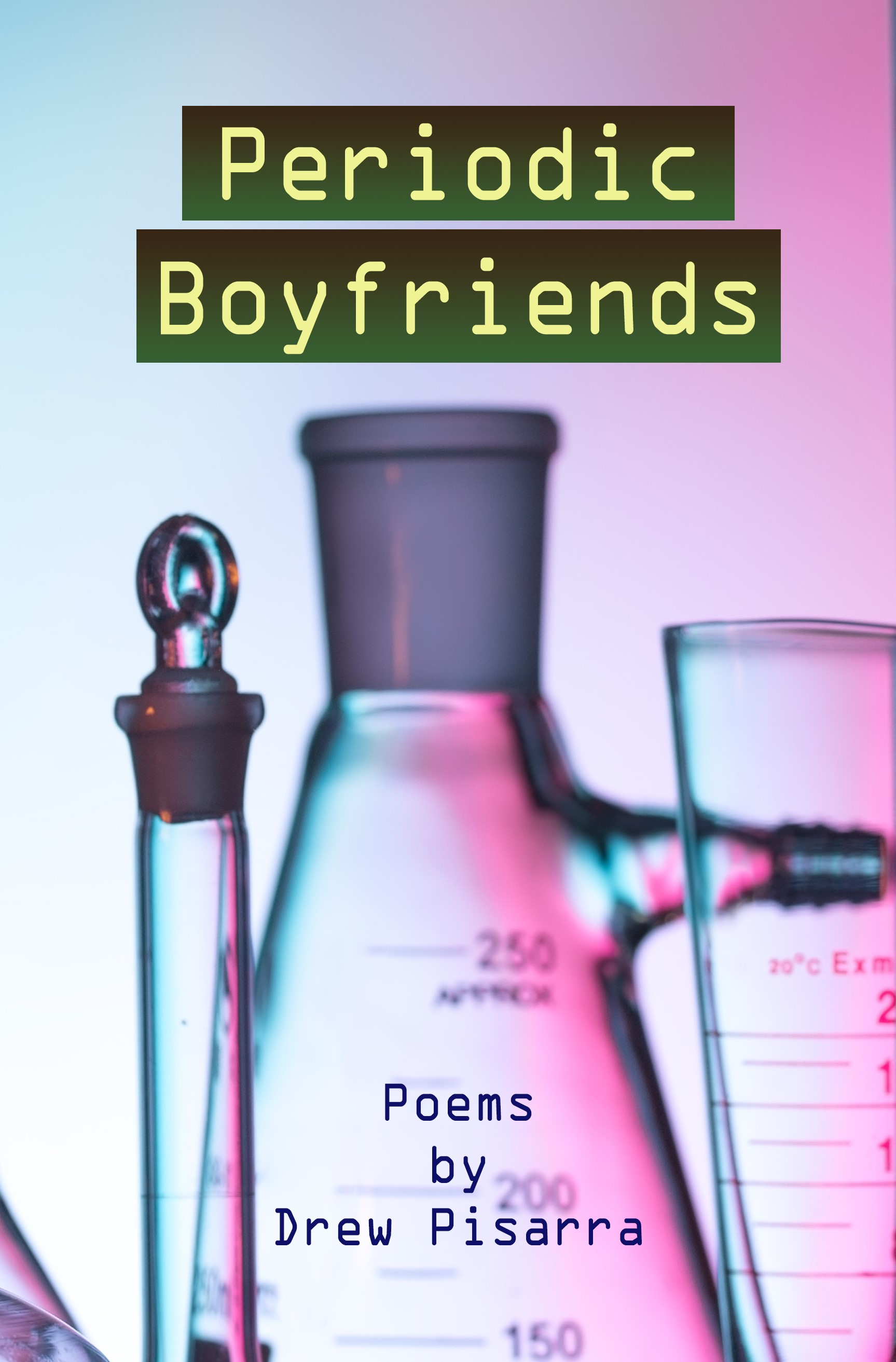
Drew Pisarra, Periodic Boyfriends, Capturing Fire Press, Washington, DC 2023, 152 pages, ISBN 978-1-7328759-6-8 US $20.00
Readers of classic sonnets may relate the form to romantic, flowery language that equates a person to things of beauty. In Periodic Boyfriends, Pisarra pushes the typical boundaries of the form’s subject matter in ways reminiscent of the subversive Shakespeare classic “My Mistress’ Eyes Are Nothing Like the Sun.” Pisarra describes his various encounters, most sexual in nature, with roughly 118 men using exciting, humorous, and simultaneously revolting language to relate each experience with an element on the periodic table. Take “Helium” on page four, for example:
Sorry to say we maxed out at two dates
‘cause you made me laugh real hard with those “bad
kiss” impersonations, three silly-sad
sendups of men who weren’t that great
with pucker-and-press: a stoner too high
to retract his tongue then a CEO
with cryogenic lips too stiff to show
true passion. Last but not least: a drunk guy,
so zonked he belched inside your mouth, my mouth
in your copycat crime: That sudden burp
left the taste of burnt balloon rubber
and triggered a shriek in falsetto loud
enough to shatter unbreakable glass
That swallowed gag gave pause. And so I passed.
Realities of fleeting romance, imperfect bodies, and complicated personalities often disrupt the desire for love and connection in Periodic Boyfriends. The collection features sick men (metaphorically and literally), dirty dwellings, and breakdowns of chemistry that left me conflicted over whether I should feel thankful or heartbroken.
Pisarra is bold and unapologetic in his creative descriptions of nether regions, drug-altered experiences, and unorthodox sexual acts (and accidents). Gustier, though, is his decision to display his faults to the reader. Several sonnets touch on Pisarra’s flaws and struggles with alcohol addiction. “Scandium” shows the author’s lack of trepidation toward engaging with a married man, and in “Technetium,” he makes his disappointment clear by describing another’s manhood as “flat as day-old Perrier.” Rather than defending or apologizing, Pisarra often retains the scene’s authenticity by presenting his in-the-moment state of mind and refusing to obscure what might embarrass or attract judgment. There are notable exceptions to this approach; “Bromine” trades the raw and unfiltered style with present-day–self-reflection on a soured relationship:
I’ve been the villain of my own story
(not the salty hero I’d like to be).
I’ve caused pain, not as in allegory,
but real pain to real pals regretfully.
One incident still haunts me. Man, there have
been many! Though most of my wrongdoings
evaporate over time. My motives
were base; longstanding lust, my undoing.
My mark? The soulmate of my closest friend.
You can likely see where this is going –
Betrayal’s the surest path to one end
and the saddest part for me is knowing
that I broke not one bond but two that night.
I doubt, I’d do that again, but I might
While “Neodymium,” “Beryllium,” and a few other elements portray Pisarra’s wild and wonderful experiences with their partners, many contain vignettes of poignant and harrowing moments that contribute to the greater whole of life. I spent extended amounts of time on “Lithium,” “Nitrogen,” “Zinc,” and “Roentgenium,” and soaked in their ability to capture the essence of a powerful story on a single page.
The albums of hardcore punk acts like Operation Ivy and Minutemen are defined by many short-length songs. Their fast-paced flow from one track to another maintains momentum even if some are too rough or crass for the listener. Your experience with Periodic Boyfriends may draw parallels to this punk-rock approach. A handful of the poems didn’t connect with me as much as others did, and I can imagine specific passages with sexual or disturbing content being too much for some of the audience. Thankfully, there are over a hundred sonnets in the work, and the read-time of each one is less than two minutes. While only a few poems deviate from the work’s visual structure and style, the situations presented in each sonnet are distinct from the others and memorable thanks to Pisarra’s creative and visceral descriptions of interactions with his many friends, lovers, and flings (e.g., “Potassium” and the No. 2 pencil).
Much like punk culture, the most provocative, daring, and honest art often comes from the LGBT+ community. Periodic Boyfriends is no exception to this rule. There is a simplicity to its structure and direct delivery but also great complexity with which it unapologetically portrays and humanizes those who exist on the margins of society.
© Drew Pisarra and Michael Fialkowski
Drew Pisarra is the author of the poetry collection Infinity Standing Up (2019) and two short story collections, You’re Pretty Gay (2021) and Publick Spanking (1996). A literary guarantee of both Cafe Royal Cultural Foundations and Curious Elixirs: Curious Creators, he also penned the radio play The Strange Case of Nick M. (2021) which was commissioned by Imago Theatre then broadcast on K-BOO FM.
Michael Fialkowski is a Communications and Creative Writing student at the University of Maryland Baltimore County. As a part of his coursework, he researches and writes about the sociopolitical implications of online discourse and narrative. His first published work can be found in Volume 18 of Loch Raven Review.
 The Loch Raven Review