
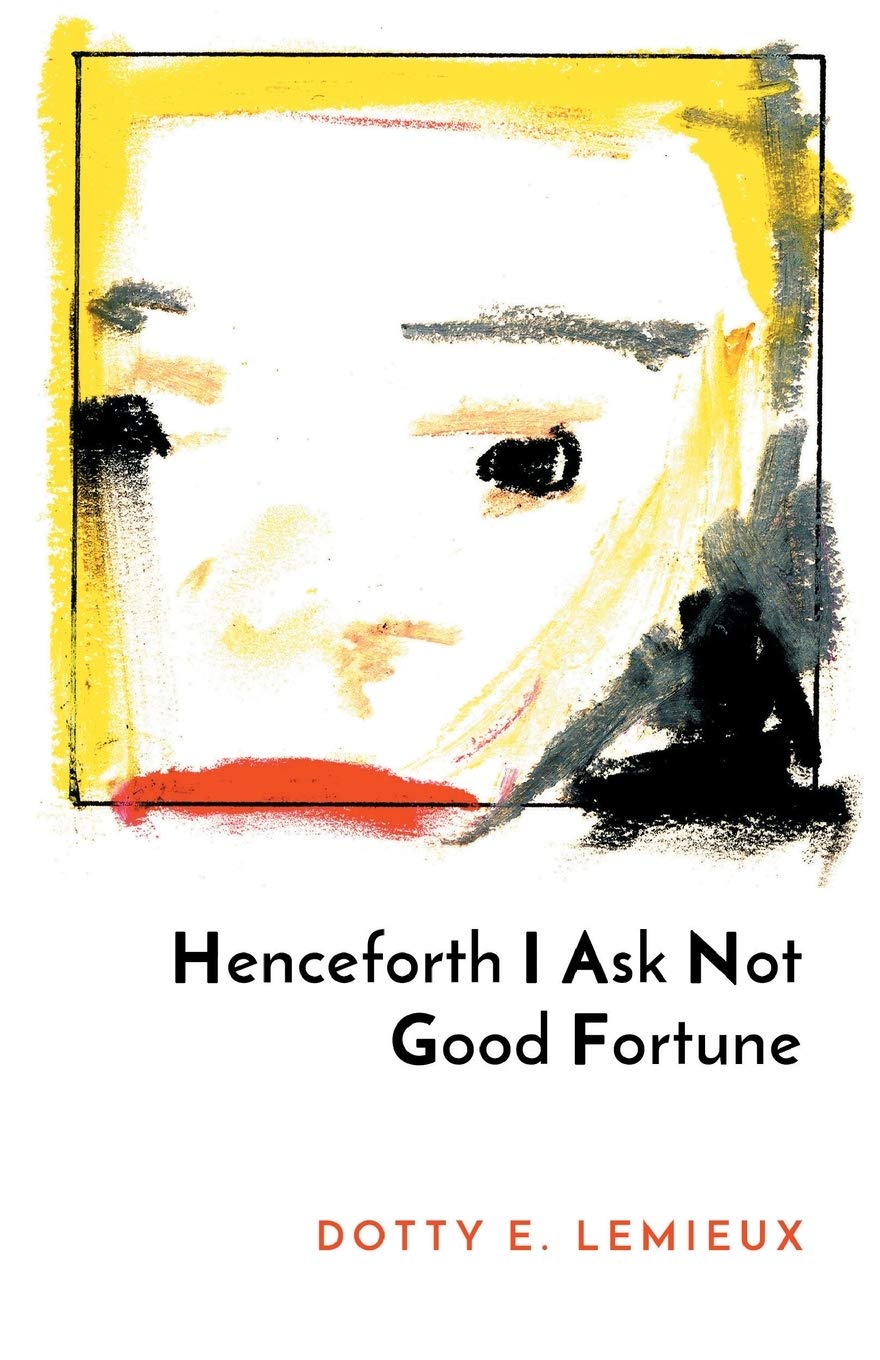
Dotty LeMieux, Henceforth I Ask Not Good Fortune, Finishing Line Press, 2020, Georgetown KY, ISBN 978-1-64662-3792, 23 pages, $14.99
From the book’s title all the way through to the final poem, Dotty LeMieux’s Henceforth I Ask Not Good Fortune pays tribute to some of the greatest poets and poetic movements of the 19th and 20th centuries. LeMieux opens her collection with a quote from Walt Whitman’s “Song of the Open Road,” which inspired the title: “Henceforth I ask not good-fortune, I myself am good-fortune.” Much like Whitman, LeMieux frequently utilizes strong imagery and detail with gritty realism to convey an often political message.
Whitman is not the only poet that LeMieux pays tribute to. She pays homage to T.S. Eliot in “For a Poet I Once Loved,” and in one particularly delightful poem titled “Just to let you know,” LeMieux offers an apology to William Carlos Williams:
I polished off
the prunes in
the cupboard
which you were probably
planning to eat
for regularity
Sorry, I needed them
more; I was hungry and
the chip bag was empty
If it’s any comfort
they were dry and only
gave me gas
LeMieux herself is a self-identified political activist, and for much of this collection, she acts as an observer. The world naturally offers plenty of material for her to use when conveying her ideas. In the first poem of the collection, “Woman her World on Skids,” LeMieux observes an “urban traveler… bearing the world” in folded boxes and plastic bags. LeMieux likens the woman’s burden to that of Atlas, and observes her from the comfort of her vehicle at a traffic light until it turns to green.
I watch her adjust the weight, knuckling
gnarled hands into locked grip
Bearing the more private, the precious, cargo
on her bent back not a bit
of slack in sinewy limbs, face taut as a fist, eyes
tight against unforgiving sun, not an ounce of wanting
to be here but with steadiness
because after all, she is moving
if not quiet upright, at least, not quite
prone, and with purpose
As the light changes.
Poems such as “America Sends More Thoughts and Prayers” and “Unaccompanied Minors,” offer social commentary, granting LeMieux the vantage point of somebody who stays on top of the news; others, such as “Solstice,” place LeMieux in a similar position as the one she occupies in “Woman her World on Skids,” in which she personally observes the actions of others without taking part in them.
The final poem in the collection, “Skip to My Lou, My Darling,” expertly combines playful language and imagery with a darker, more menacing theme, effectively ending the collection on a haunting note. The title is an obvious reference to the classical folk song commonly used as a square dance tune, and LeMieux references the term “skip” throughout:
1.
Skipping, you are bound to trip on the hitch
in the sidewalk where the tree roots push it up
and land splat on your face, glasses
flying
2.
The way your heart skips a beat
when you spy your true love across the barroom
but can’t get there in time to stop another from leading him
into dance
3.
When we were young, Lisa and I skipped out
on the the check at Chez Pannise’s upstairs café
We didn’t mean to but the bill never came
and the door was open
4.
The girl with coltish legs crossing the parking lot
her arms like sticks, and tall as a young oak
How many meals did she skip to have that
disappearing look?
5.
How long until she vanishes altogether, her mother hoping
her schoolmates just skip the funeral
no one could prevent, no amount of square dance tunes
karaoke or prom invitations could cajole her out of?
Like Whitman, Eliot, and Williams, LeMieux’s strength lies in her ability to make her readers see the world the way she sees it. Though she is an observer in many of her poems, she rarely takes a passive tone and is almost always sympathetic towards those she is viewing, embuing her work with an undeniable heart. Henceforth I Ask Not Good Fortune is well worth reading.
© Dotty LeMieux and Ginny Phalen
Dotty LeMieux is the author of three earlier chapbooks, Five Angels, Five Trees Press; Let Us Not Blame Foolish Women, Tombouctou Books; The Land, Smithereens Press, and was the editor of the literary journal Turkey Buzzard Review. Her work has been shortlisted by 2 Sylvias Press and appeared in numerous print and online journals and anthologies. She lives in Northern California, where she practices environmental law and helps elect progressive candidates to office. You may read more at her blog: dottylemieuxpoemsandmore.com
Ginny Phalen graduated from the University of Maryland Baltimore County with a Bachelor’s degree in English literature. She has had poems and short stories published in magazines such as Connections and Bartleby and has written for various newspapers, including The Retriever and The Enterprise. She currently lives in Arlington, VA, where she writes in her free time.
 The Loch Raven Review