
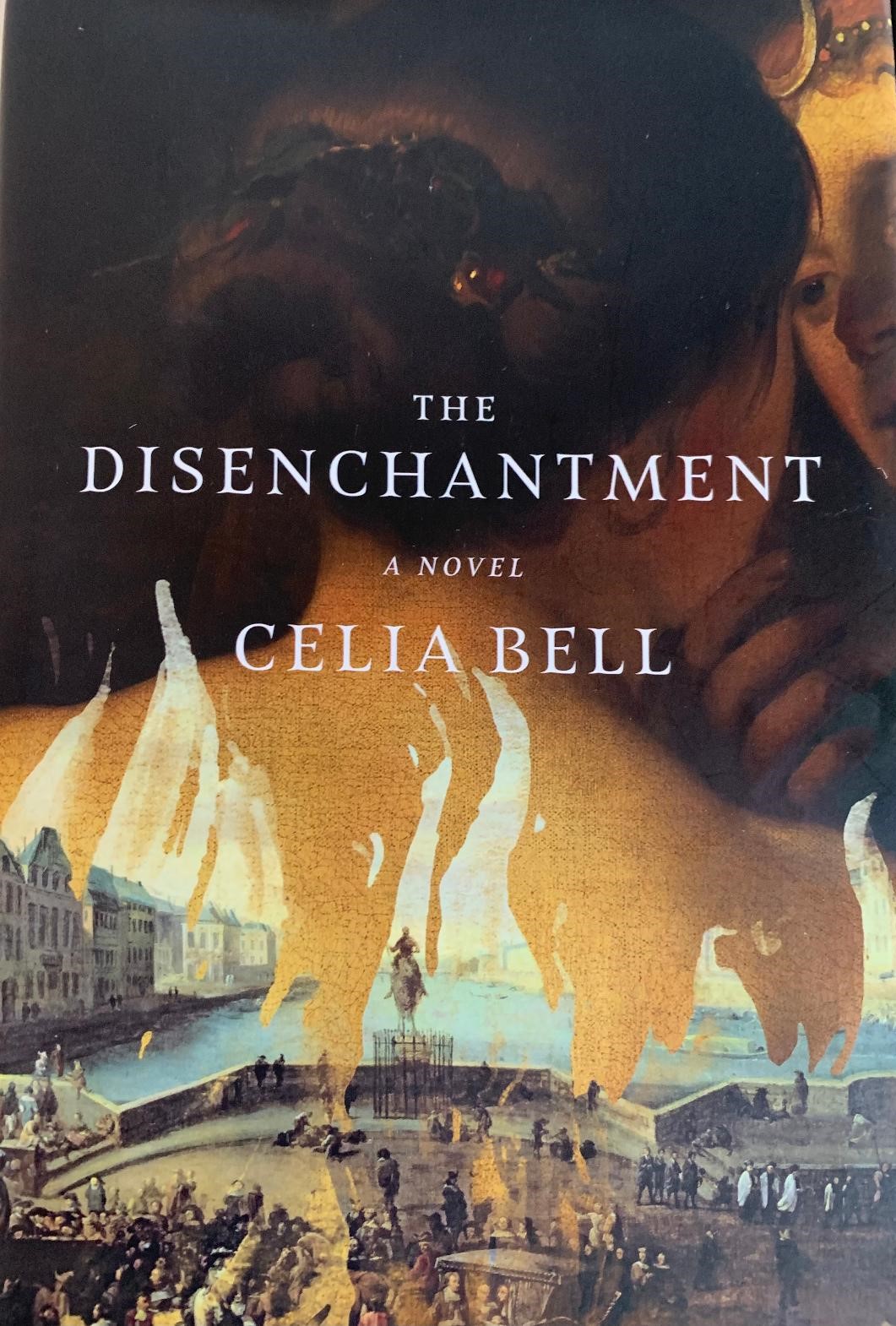
Celia Bell The Disenchantment, Pantheon Books, New York, 2023, 352 pages, ISBN 9780593317174 $28.00
There is nothing disenchanting about Celia Bell’s debut novel, The Disenchantment. The novel brings seventeenth-century Paris to life with clear details that are eloquently written. The brilliant plot revolves around a murder. Though the reader knows who has committed the murder, the tension keeps one turning the pages as the character (or characters) involved, hide and dissuade others.
However, disenchantments do abound in Bell’s novel. There is the disenchantment of Marie Catherine la Jumelle, Baronne de Chardonnoy, the main character’s marriage:
… she turned away from the baron and refused to catch his eye, although he put his hand on her shoulder and guided her down the stairs…She had been afraid that this might be a night when he would follow her into her bedroom, reproaching her with how she refused her marital duty.
The disenchantment of the of Court of King Louis XIV:
…In all the halls there was a faint but pervasive smell of piss and old meat, the smell of the streets of Paris in winter, so that Marie Catherine found herself holding her breath before each inhalation….Then the king took her hand and made her rise, and she looked directly into his face. This close, she realized that he was growing old. The magnificent curled hair was not his own, the skin under his eyes had slacked into soft folds like fresh dough, his cheeks were thick and jowly….“I remember you came here once as a young girl, before the palace was built,” Louis said. “You wore a pink dress and you rode out hunting with us. I remember you fondly.”
“I am glad to hear that, Your Majesty,” said Marie Catherine, although she had no memory of the day he described. He had confused her with another woman.
The head of the Paris police force, Gabriel Nicolas de la Reynie, is also disenchanted, “There had been poison, black magic, renegade priests, and all playing right at the feet of the king, ignored.” His anguish is meticulously described:
On La Reynie’s desk were papers that needed attending to. It was the whole mundane business of Paris, whose care he had been charged with: the cleaning of her streets, the upkeep of her buildings, the price of bread, her street lights, her granaries, her tradesmen, her rich, her poor, her criminals. He began the mental work of composing himself, tapping his pen against the pigeonhole drawers of his desk…
La Reynie is actually modelled after a real person. The Disenchantment is fiction, though many of the characters Celia Bell has created are inspired by real people who were involved in the Affair of the Poisons of Paris in the later part of the seventeenth century.
Celia Bell writes beautifully of that era. The reader actually feels the bumpy carriage rides she describes, the uneven cobblestones through the soles of a lady’s satin shoes. The ladies maids, valets, a household’s vast kitchen staff, the courtiers of King Louis XIV, even a portrait artist are all carefully depicted. And throughout The Disenchantment, there are incredible fairy tales that absolutely enchant. Read the author’s acknowledgements, at the end of the book, to discover their importance to the novel.
Woven into the narrative is the fluidity of gender and the attraction between the sexes and those of the same sex. It is at the center of the story and vital to the plot.
…Victoire sat very still. She had not been this frightened when the king’s companion scolded her for her gentleman’s suit. If Madame de Maintenon knew her secret. Many women had bosom friends. But how many would die for them?
An exhilarating treat is in store for readers who pick up and open The Disenchantment.
© Celia Bell and Caryn Coyle
A native of Baltimore, Celia Bell is an award-winning writer whose work has been published in Bomb, The Sewanee Review, The Southern Review, The White Review, and VQR.
Caryn Coyle is an editor at The Loch Raven Review.
 The Loch Raven Review