
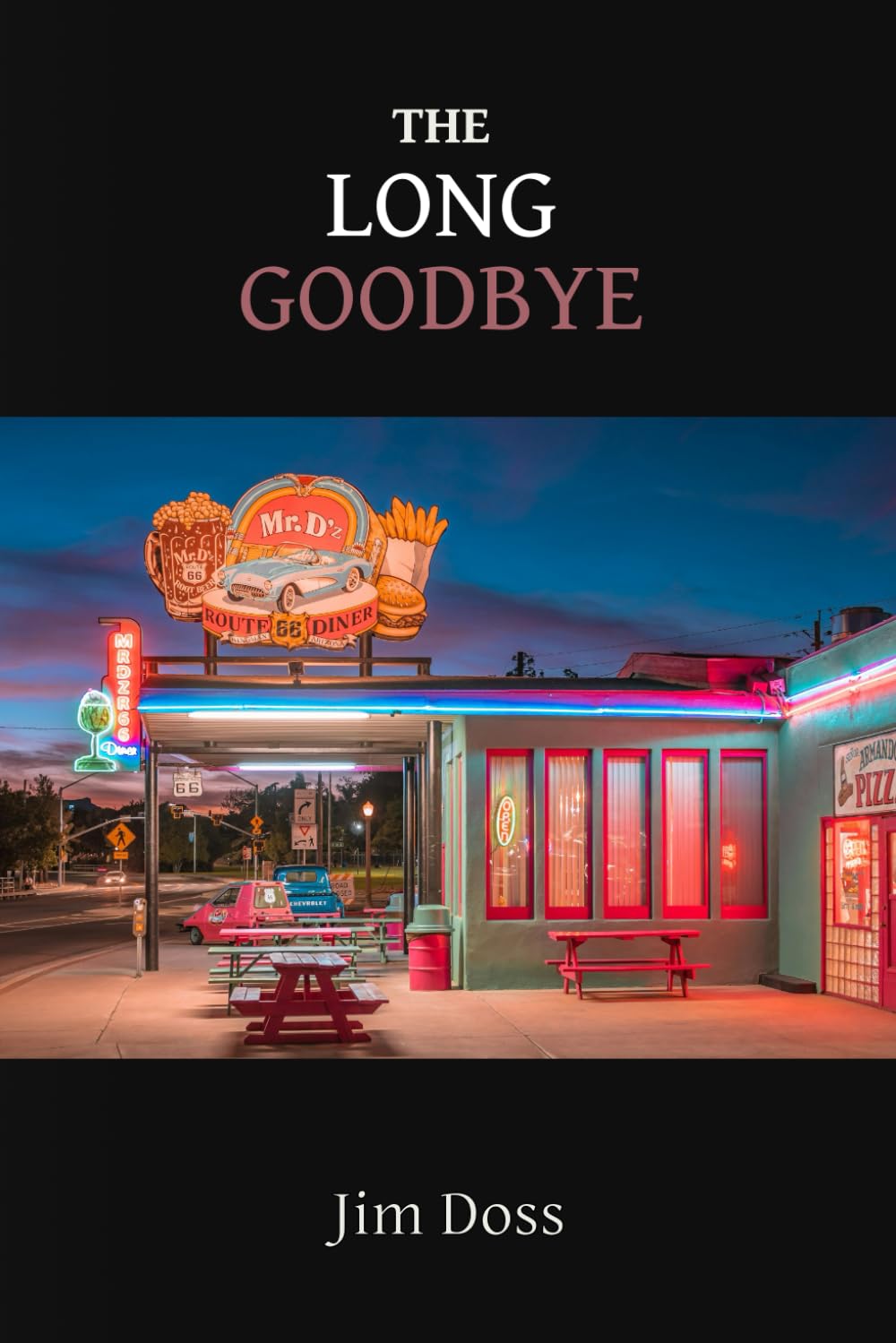
Jim Doss, The Long Goodbye, Loch Raven Press, Sykesville, MD, 2024, ISBN 979-8-9905505-1-3, 339 pages $16.95
There are many poets who live and write in the little State of Maryland, but one of the most prolific and magnificent as a poet is hardly known, though he deserves to be read and celebrated. In addition to writing his own take on history, humanity, the universe, the American experience, and the chance experiences and insights of his own personal experiences, he is also a translator of German poetry and prose. He has written 5 books of translations of Ernst Toller’s work. Jim Doss has written a book of Translated into English poems of Georg Trakl, and a Poetry Anthology of Nine Holocaust Poets. In addition, he has published two average-sized books of his own poetry and the behemoth book “The Long Goobye”, which is a 339-page book of poems not published in book form before and very unfamiliar to readers in general. In a sense, it is a Collected Poems of Jim Doss.
My problem in reviewing this wide-ranging and, at times, intense book of poems that are always well-crafted, sophisticated but characterized by their skill in communicating is doing the book justice. There are many facets to Doss. I hope to reveal some of them, but there are more for the average reader to discover themselves. Reading about such a poet is a poor substitute for immersing yourself in the poems. Doss is both a master of styles and a creator of metaphors, and an investigator of history.
There are Seven Sections in the book. The first is called Mythologies. Some of the titles of the poems here give you the range of Jim Doss’s subjects in this category: Waiting for the Second Coming; The Road to Lorca ( Federico Garcia Lorca, famous Spanish poet); My Love Affair With the Final Problem ( Sherlock Holmes & Professor Moriarity); Cronos in the Underworld; Aphrodite; The Labors of Hercules (the ancient Greek hero brought up to modern times, a 5-page poem inventively imagined); Sisyphus in Descent; Narcissus Americanus: All Eyez On Me; An Everman Odyssey; Cain and Abel—-and many more—and this poem about Thomas Jefferson and a pet dog.
Jefferson’s Dog
From the dainty, well-manicured hills of France
he selected me from all the other dogs,
deemed my breed worthy to colonize the wilds
of the New World, smiled with pleasure seeing my belly
round with pup. Six dollars he paid for me
and my unseen brood before we boarded the ship
Clermont at Le Havre. He named me Bergère
as I whimpered through the North Atlantic passage,
giving birth to two more in a gale that rocked
many a hardened soul into seasickness. By the time
we got to Monticello he set me down beside
the figs, cork oaks, larch trees and the vinifera grapes
he shipped back. I followed as he paced the slopes
around the mountain looking for the perfect planting
spot for each species, directing his people to dig
here or there, how deep and wide, the right amount of water.
I continued to follow him on his morning walks
as he monitored the progress of each, watched some
wither while others took root. He was the loneliest man
alive when the freeloaders descended periodically to eat him
out of house and home. He would retreat with me
into his study for hours at a time, day or night,
to pull dusty books off the shelves as I lay
by his feet, or scribe his letters with the polygraph
making an exact copy. It was here he was happiest,
alone, abandoned in thought, contemplating the sciences
or philosophies, dreaming of those eventual flocks
of Shetland he would bring back for my offspring to tend,
the ram with four horns, and those other, more difficult flocks
who would hang on every phrase liberated by his pen.
The poem is more a narrative poem than a lyrical one, but the first line introduces the situation with a lyrical touch. “From the dainty, well-manicured hills of France” adds a delicate touch. After that note the wording goes for narration and historical fact. Jefferson modified a machine called the Portable Polygraph to his own needs so that it made it easier for him to dip both pens in the ink at the same time so that he would have a second copy of every letter he wrote that he could keep for his records. , which is referred to in the poem above. For more info on that use this link: Portable Polygraph, owned by Thomas Jefferson. Also, Doss refers to a biological oddity that Jefferson owned: the ram with four horns. The poet was very taken with all things Jefferson as Doss grew up in Lynchburg, Virginia.
Just outside Lynchburg is Jefferson’s second home that he inherited from his wife’s family called Poplar Forest. (link: Thomas Jefferson’s Poplar Forest – Experience Thomas Jefferson. Discover his personal retreat. Step into his private world.)
The poem is written from the dog’s view. It is very descriptive and presents a unique portrait of a very complex man and his life. It is just one of many mythological creations explored by our poet.
The second section of the book is called Ritalin Dreams. Ritalin is a medicine to counteract Attention Deficit Hyperactivity Disorder. (ADHD). There are 34 pages of poetry in this section. It seems to be a kind of surrealism. If there is logic in its construction, it may be in relation to the hyperactivity of the mind caused by ADHD. Each poem is unique and exists in its own logic, but it is not the logic of our common everyday existence. Entering the world of any of these poems is a unique adventure. The poem that most intrigues me is a poem written for the masterful but tortured poet Paul Celan, the author of the Holocaust-obsessed poem Death Fugue. Jim Doss’s poem is titled (In)Seine, certainly a pun that title.
He drowned himself nearly fifty years ago
over love. A different kind of love.
Of self, and language. The god of words,
vengeful, spiteful, filled us with illusions.
Our quarrel began that day and continues
like a one-sided marathon, him talking backwards
through time, me conversing forwards, tripping, stammering
over every stone, lost in the black forest
of his thoughts. His wound’s mark in the air,
I always found myself standing in its shadow,
knee-deep in ferns, smelling the damp, fertile rot
of the forest floor as I poured the urnfull of dust
collected since he departed into his memory.
We were like brothers in love with the same girl,
blonde, curly hair, absinthe-tinted eyes with umlaut-dimples
on her cheeks. She was that goal we could never obtain.
We both failed miserably in our own disagreeable ways
as we broke the living room furniture
with our verbal gymnastics. Moonshadows
possessed him, together with star-swifts
darting through the night sky. I find myself always
writing in a strange voice, clutching icicles
torn from his brow as if they were pens filled with hope.
The poem will be difficult to understand, though acquaintance with Paul Celan will help considerably. Some of the words and images are brilliant. I particularly like “absinthe-tinted eyes with umlaut-dimples on her cheeks.” I think the emotional meaning of the poem comes through loud and clear. Perhaps some of the factual details have to be consciously sought but it isn’t impossible. Celan’s work can be esoteric at times. Jim Doss enters different realms and constructs them accordingly.
The poems in this section are more difficult for the average reader. In other sections of the book, the poems are more open to common understanding, but everyone should read and pursue the truths contained in the diverse poems of Ritalin Dreams.
The next section is titled Alphabet. The poetry here is pure ingenuity. I think most readers will admire the playful constructions of Jim Doss. The Alphabet is not the alphabet we use for our modern Western languages but a kind of inventive hieroglyphics that the poet has created and defined. Here are a few examples:
The Alphabet of Life
@
face of the dog
eager to play fetch
dig through the trash
tear up the mail
;
tadpole in a pond
fighting hard to grow
develop legs and walk
and multiply
to fill the night with song
&
piece of string
laid down to find
my way back home
through life’s maze
to keep our two lives
from separating.
+
the compounding
of you me
the children
the grandkids, etc. etc.
Section Four is titled Chemo. It tells the story of Jim Doss’s treatment for cancer. Though there are medical terms, this section was written for the average educated reader. It will communicate. People who have been treated for cancer will identify with it. Those who have not will have the treatments and surrounding emotions revealed. The whole book, The Long Goodbye is worth reading, but especially this section. Note the metaphoric language and imagery in poem after poem.
Here are two poems from this section. The first is the opening poem here. The second illustrates the poet’s wizardry with figurative language.
Diagnosis
After the biopsy, during that next office visit
when the doctor pulls his chair close to yours
and looks you in the eye, both seriously and sympathetically,
and utters those words you never thought you’d hear
during your lifetime, you grow numb,
your brain detaches itself from your body,
the world assumes a surreal air.
Cancer, the word that was only meant for others,
now lives inside your body like a foreign being, a monster,
growing, multiplying, slowly taking over your organs
like an invading army you can’t fight,
can’t resist, that each day inches
closer and closer to complete victory
without the possibility of a peace treaty.
Your life is failing, shutting down,
only a limited time left. Grasp onto the hope,
believe in miracles, the treatment plan is laid out
before you, along with its percentages of success.
A path is clearly drawn, the poisons labeled and identified
required to kill what has chosen to rebel inside you,
those cells whose triumph will banish you to death’s kingdom.
The Chemo Lizards
I don’t even feel the jab
of the IV needle in my arm
anymore as the nurse prods
for a vein in a swamp of little creeks.
The bruises ripen like plums
as she continues to prod,
then sticks again in a different spot
searching for blood flow,
any trickle before taping
the tubing to the hairs on my forearm.
She hangs a bag of chemo,
sets the flow rate as I watch
invisible chemical lizards
swirl around in the bag
waiting to be freed to feast
as they descend through the tube.
I sense their excitement as they get closer
to the target, feel them slithering
through my veins, searching
my body’s labyrinth for those cells
they so love to devour. They are on
a magic carpet ride to destroy
the evil temple of cancer,
brick by brick, mortar by mortar
as they themselves die,
exhausted by their hunger.
I feel them enter my body
week after week wondering
when will it stop,
when will the temple
and all its rubble be removed
without a trace. The clock ticks on.
The lizards breed and breed
back in the chemo lab.
My hair drifts down around me
like angel wings, like leaves falling
on a cold, breezy day
until I become a shining dome
surrounded by followers
all praying for the second coming.
The above poems are just two of the masterful creations by Jim Doss recreating the many facets of suffering through the illness of cancer and its treatment. The Chemo section is a book itself and worth way more than the $16.95 purchase price of the whole diverse book of poetry.
Section five is Letters and Visions. Some of the diverse titles here are Advice to a High School Senior (after Hans Magnus Enzensberger); The Cubist Paints His ideal Woman; Your Dream of Deliverance; Your Dream of Fame; The Wind-Bride Speaks; The Marriage Bed; Landscape with D.H. Lawrence; Neal Cassady Gets Rhythm on Rt. 66; Kerouac Takes a Swig; After Making Love Othello Paints the Virgin Mary. There are many more poems but to keep listing everything that should be individually read would tire the reader of this review. Suffice it to say our poet’s work sparkles and is thought-provoking and deserves attention.
Section Six is called Colors. It is somewhat similar to the Alphabet poems but written in a fuller, more expansive style. The poems are full of distinctive, eye-grabbing imagery. (Red) It assaults the eye/with the bloom of a rose, the bloody knife-tip, the sports car speeding through the changing light. (Yellow) The prairie cornfields are lit on fire before us. // Crows dive/ into these oceans of yellow……
Section Seven is titled Black and White. The poems here are about, for the most part, Jim Doss’s individual experience. There are poems about his family life, such as The Day My Mother Died; there are imaginative insightful poems like the Mystery Tramp, which is the poet adopting a persona. There are descriptive poems like the Church Graveyard at Saint Michaels which lead to a leap of discursive thinking that is a key element of much poetry. Section Seven runs from page 228 to 339. There is a poem titled Hippopotomonstrosesquippeddaliophobia.
The Long Goodbye is a diverse, fascinating book where the unexpected hits the reader on almost every page. I’ve just given you, future reader, a small hint of the treasures it contains.
© Jim Doss and Dan Cuddy
Jim Doss grew up in the Blue Ridge Mountains, attended the University of Virginia, and is a founding editor of the Loch Raven Review. He is a retired software engineer who spends much of his spare time dabbling in Linux, FreeBSD, and other flavors of Unix. He has previously published two books of poetry, Learning to Talk Again and What Remains, and translations of Georg Trakl’s complete poems entitled The Last Gold of Expired Stars, five volumes of work by Ernst Toller including an autobiography, letters from prison, and plays, a collection of poems entitled Nine Holocaust Poets, and Klabund’s Brache and Six Other Novels.
Dan Cuddy is currently an editor of the Loch Raven Review. In the past, he was a contributing editor of the Maryland Poetry Review and Lite: Baltimore’s Literary Newspaper. His book of poetry, Handprint on the Window, was published in 2003. Recently, he has had poems published in Super Poetry Highway, Literary Heist, Horror Sleaze Trash, Poetry in Chewers by Masticadores, Roanoke Review, the Amethyst Review, Synchronized Chaos, Fixator Press, The Manor Mill Anthology, Gargoyle, Witcraft, and the WE Anthology.
 The Loch Raven Review